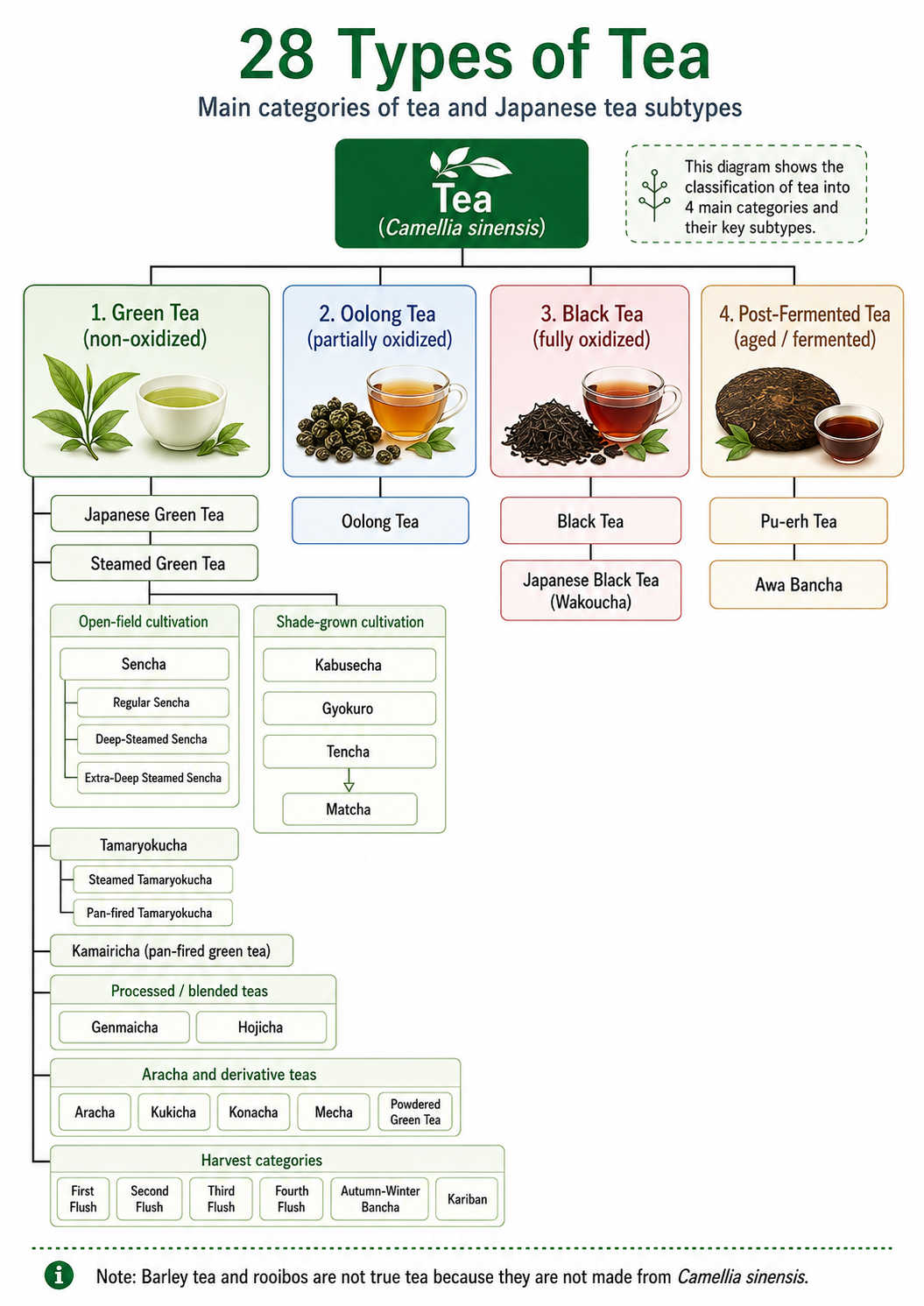
Tea can be divided broadly into green tea, oolong tea, black tea and post-fermented tea. These are not necessarily made from different plants. They are generally made from leaves of the tea plant, Camellia sinensis, and become different teas through cultivation, oxidation, heating, rolling, roasting and microbial fermentation.
At a glance: green tea is heated before substantial oxidation, oolong is partially oxidized, black tea is more fully oxidized, and post-fermented tea undergoes microbial fermentation after the leaf has first been heated.
What Is Tea?
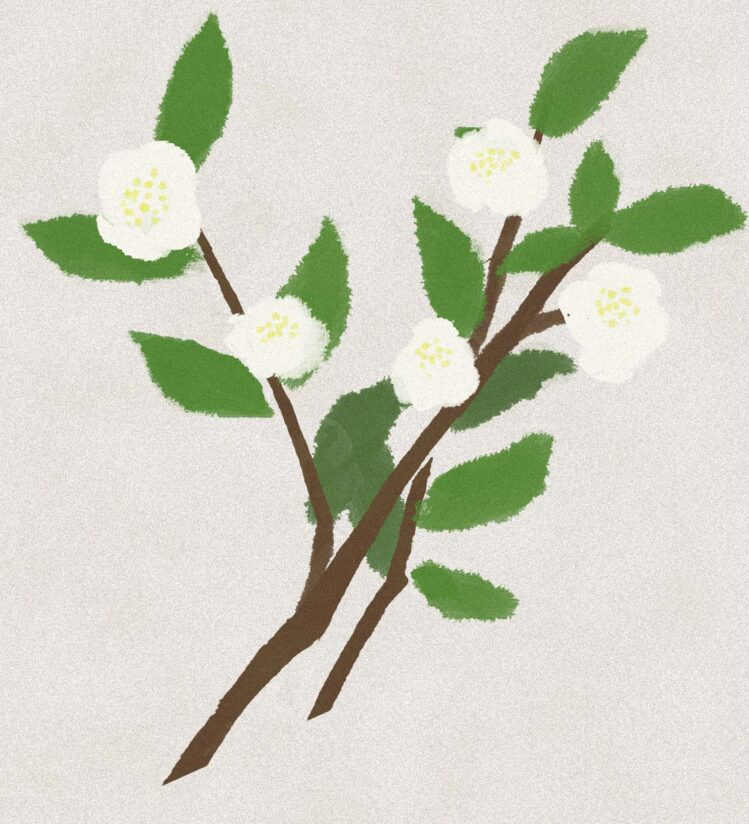
In the strict botanical sense, tea is a beverage made from leaves of Camellia sinensis, a plant in the camellia family. The tea plant produces small white flowers that resemble camellia blossoms.
Drinks such as barley tea, rooibos tea and guava-leaf tea are commonly called “tea” in everyday English, but they are technically herbal infusions because they are not made from Camellia sinensis. Green tea, oolong tea and black tea, by contrast, all come from the tea plant.
The cultivated tea plant is often discussed in terms of two broad botanical groups: the smaller-leaf China type and the larger-leaf Assam type. Many Japanese tea cultivars belong primarily to the China-type lineage, while Assam-type plants have larger leaves and are widely associated with black-tea production in warmer regions.
A note on “fermentation”: In traditional tea terminology, oolong and black tea are often described as semi-fermented and fully fermented. More precisely, the main change is enzymatic oxidation. Post-fermented tea is different because microorganisms also take part in the transformation.
For a related Japanese-language explanation, see How green tea, oolong tea, black tea and pu-erh are made from the same tea plant.
Types of Japanese Green Tea
Most tea produced in Japan is green tea. Japanese green tea is made mainly by one of two heating methods: steaming or pan-firing. Steaming dominates modern Japanese production, while pan-fired tea survives as a distinctive regional tradition, especially in parts of Kyushu.
Steaming: the Characteristic Japanese Method
Fresh tea leaves begin to oxidize soon after they are picked. For Japanese steamed green tea, the leaves are quickly exposed to steam. Heat inactivates the leaf enzymes and helps preserve the green character. The leaves are then rolled and dried.

The exact machinery and sequence vary by tea style. Sencha is shaped into straighter, needle-like leaves during the final rolling stage, while steamed tamaryokucha omits the same straightening stage and therefore keeps a curled shape.
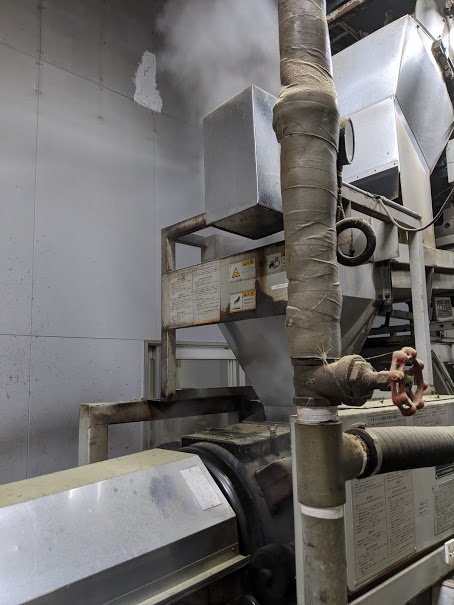
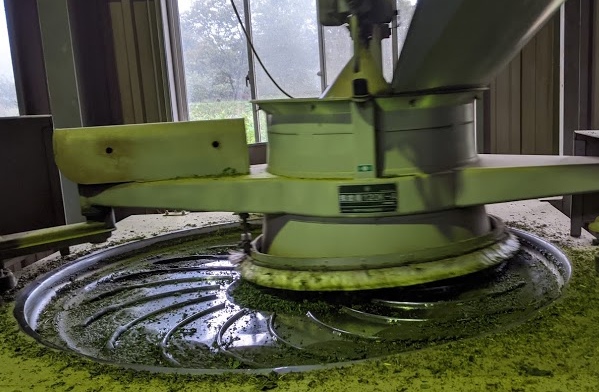
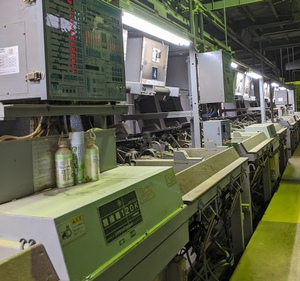
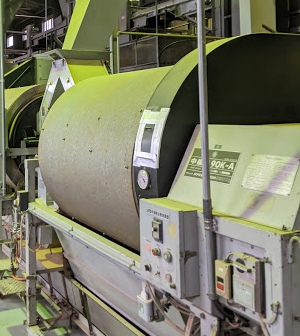
By the time aracha is completed, the weight is typically around one fifth of the original fresh leaves because most of the moisture has been removed.
Open-Field and Shade-Grown Tea
Tea fields are sometimes covered with black material before harvest. This is called shade cultivation. Tea produced under shade is broadly called ooicha, or shaded tea. Kabusecha is a shaded sencha, while gyokuro and tencha—the raw material for matcha—are also shade-grown.

Gyokuro and tencha are normally shaded for longer than ordinary kabusecha. Traditional premium production may use a shelf structure covered with straw or other material, followed by selective hand-picking. Modern production also includes direct covering and machine harvesting. In Yame, hand-picked gyokuro grown by the traditional shelf method is distinguished as Dento Hon Gyokuro, or Traditional Authentic Gyokuro.
Shade suppresses the conversion of theanine into catechins, generally supporting a softer, more umami-rich taste. It also increases chlorophyll and can produce a deep green color and the characteristic seaweed-like aroma known as ooika, or covering aroma. Open-field tea tends to have a brighter, fresher aroma and more pronounced astringency.
Related guide: Why Is Green Tea Astringent? explains how catechins, harvest season, cultivar, shading, steaming and brewing work together to change this drying sensation.
Deep dive: For a side-by-side explanation of how sunlight, shading, leaf chemistry, covered aroma and processing separate sencha, kabusecha, gyokuro, tencha and matcha, read Matcha vs Green Tea: Sencha, Kabusecha, Gyokuro and Tencha Explained.
Gyokuro guide: Learn more about shade cultivation, flavor, brewing and the distinction between Yame Gyokuro and Traditional Authentic Yame Gyokuro in What Is Gyokuro? A Detailed Guide to Japanese Shade-Grown Tea. Japanese version: 玉露とは?
What Is Tencha?
Tencha is the leaf material used to make matcha. Like gyokuro, it is grown under shade, but after steaming it is dried without the rolling process used for sencha. The dry leaf is flat and flaky. Matcha is made by removing coarse veins and stems from processed tencha and milling the refined leaf.
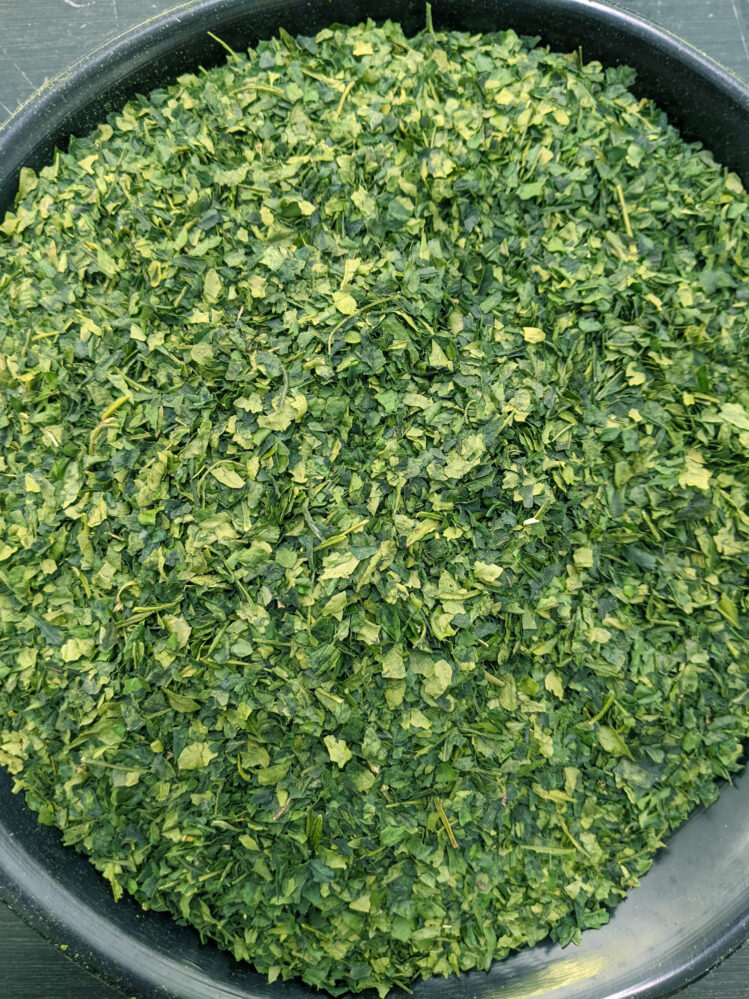
Uji in Kyoto and Nishio in Aichi are famous tencha and matcha areas. Yame in Fukuoka has also expanded tencha production by applying knowledge developed through gyokuro cultivation. Kagoshima ranked first in Japan’s 2023 tencha production statistics, reflecting rapid growth in response to matcha demand.
Sencha and Tamaryokucha: What Is the Difference?
The clearest difference is the shape of the dry leaf. Sencha is generally straight and needle-like, while tamaryokucha is curved. In sencha production, the final rolling stage straightens the leaf. Tamaryokucha omits this stage, leaving a rounded or comma-like shape.


Sencha is the dominant Japanese green tea. Tamaryokucha is associated especially with Saga and Kumamoto, as well as smaller production areas in Kagoshima and Shizuoka. In tea-trade language, straight sencha may be called nobi, while curled tamaryokucha may be called guri.
Regular Sencha, Deep-Steamed Sencha and Extra-Deep-Steamed Tea
The difference is mainly steaming time. Standard sencha is often steamed for roughly 30 to 40 seconds, although actual times vary by leaf condition and factory. Deep-steamed tea is steamed longer, and extra-deep-steamed tea longer still.

Longer steaming softens the leaves, making them break more easily during processing. The brewed tea often has a deeper green color and a rounder taste, while lighter-steamed sencha can retain more distinctive leaf shape, aroma and a sharper refreshing character.
Related Japanese article: The Difference Between Regular Sencha and Deep-Steamed Tea.
Practical brewing guide: Regular sencha and deep-steamed sencha extract at different speeds. See How to Brew Japanese Green Tea for recommended leaf amounts, water temperatures and steeping times for sencha, fukamushi sencha, gyokuro and hojicha.
Kamairicha: Japanese Pan-Fired Green Tea
Kamairicha is made by heating freshly picked leaves in a hot pan instead of steaming them. It is known for a clean taste and a fragrant roasted or pan-fired aroma called kamaka. The liquor often appears more yellow than that of steamed green tea.
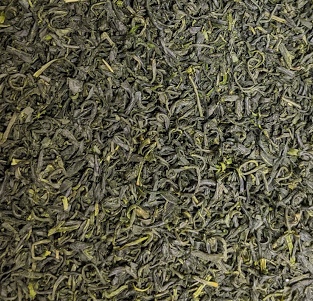
Today, kamairicha is produced mainly in limited parts of Kyushu, including Ureshino and mountain areas of Kumamoto and Miyazaki. Ureshino developed a round-pan tradition influenced by China, while some Kumamoto and Miyazaki traditions are known as Aoyagi-style tea.
Chinese green tea is also generally pan-fired rather than steamed. Although many Japanese consumers associate Chinese tea mainly with oolong, green tea is a major tea category in China.
Related Japanese article: Kamairicha: The Appeal of Pan-Fired Aroma.
Processed and Blended Japanese Teas
Genmaicha
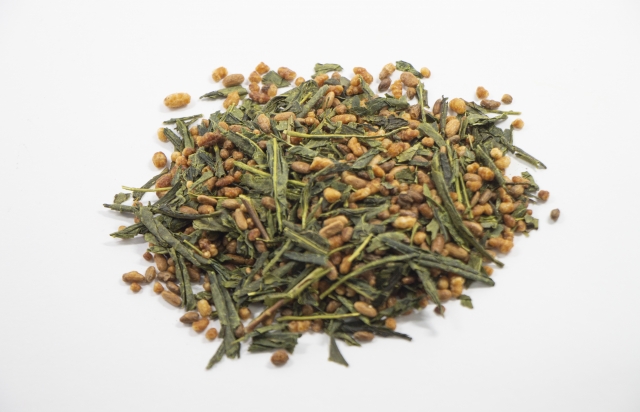
Genmaicha is made by blending green tea—often bancha, sencha or tamaryokucha—with roasted rice. The roasted grain gives the tea a warm, nutty aroma and an approachable taste. Matcha-added genmaicha is also popular.
Hojicha
Hojicha is made by roasting green tea, commonly bancha or stem tea, at high temperature. The roasting changes the leaves from green to brown and creates a strong toasted aroma. Roasted stems can expand dramatically, producing the light and bulky appearance of stem hojicha.

Later-harvest leaf is often used for everyday hojicha, while first-flush material can produce a more refined roasted tea. Roasting generates pyrazines and other aroma compounds responsible for hojicha’s comforting toasted fragrance.
Sanrokuen also produces Japanese hojicha powder from first-harvest tencha material, with in-house roasting and fine milling for lattes, desserts, cafés and food manufacturing.
Production statistics by tea type are available from the National Federation of Tea Production Organizations (Japanese).
From Aracha to Finished Tea
Tea made at the farm or primary-processing factory is called aracha, meaning crude or unfinished tea. It still contains stems, fine particles and leaf pieces of different sizes. Tea merchants refine aracha through sorting, grading, blending and hi-ire, or refiring.
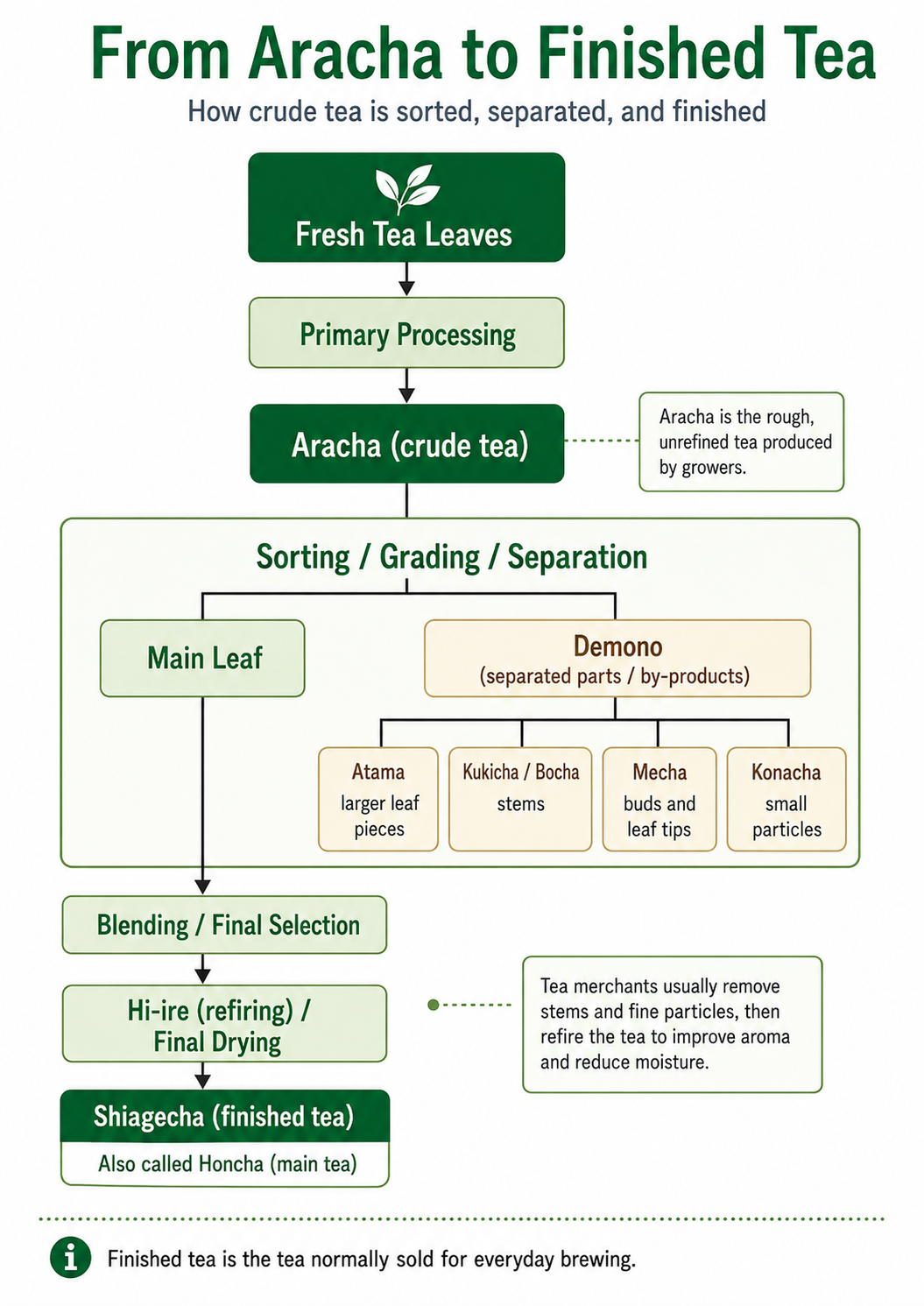
The finished main leaf is called shiagecha or honcha. Separated parts are called demono. In tea-trade terminology, larger leaf pieces may be called atama, stems bo or ki, and fine parts may be grouped under regional trade terms.
What Exactly Is Aracha?
Aracha is the tea shipped by growers or primary tea factories before final refinement. A tea merchant removes unwanted stems and excessive fine particles, blends lots when needed, and refires the tea to adjust moisture and aroma before it becomes the finished tea normally sold to consumers.

Kukicha
Kukicha contains a high proportion of stems separated during finishing. Depending on the region and material, related names include shiraore, karigane and bocha. Stem tea has a fresh, green aroma and a clean taste that can differ noticeably from the finished main leaf.

Konacha
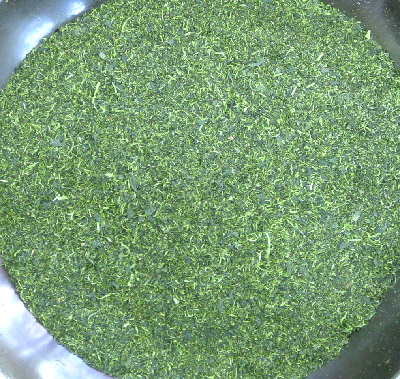
Konacha consists of small leaf particles separated by sieving aracha. It infuses quickly and strongly and is well known as the “agari” tea traditionally served at sushi restaurants. Fine leaf can clog some teapots, so a suitable fine-mesh strainer is helpful.
Japanese reference: How to Solve a Clogged Japanese Teapot.
Mecha
Mecha is made from buds and tightly rolled leaf tips separated during finishing. It can produce a rich taste comparable with the main tea, while often being more affordable because it is classified as a separated part.
Konacha, Powdered Green Tea and Matcha
These three products are often confused:
- Konacha is a collection of naturally small tea-leaf particles separated during finishing.
- Powdered green tea is sencha or another green tea intentionally ground into powder.
- Matcha is made from refined tencha.

Powdered tea disperses in water but does not truly dissolve like instant tea. Insoluble leaf particles remain and may settle over time. Konacha is normally brewed and strained, while powdered tea and matcha are consumed together with the suspended leaf material.
Origins and Tea Cultivars
Tea style is only one part of the story. Flavor also changes greatly with origin and cultivar. Famous Japanese tea areas include Shizuoka, Uji, Sayama, Yame, Ureshino and Kagoshima. Yabukita remains the most widely planted Japanese cultivar, while Yutakamidori is important in southern Japan and Saemidori is highly valued for its color and mellow taste.
First Flush, Second Flush, Later Harvests and Kariban
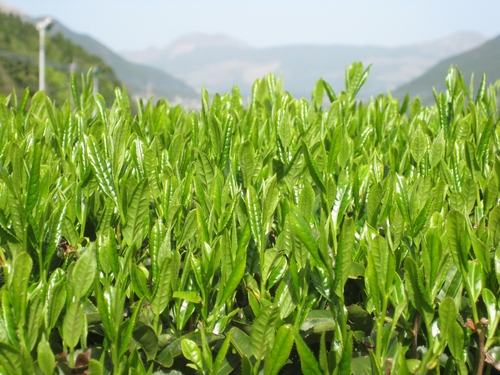
The first harvest of the year, usually picked from late April through May depending on the region, is called ichibancha, or first flush. The second harvest follows around late May through June, and later regions or farms may also produce third and fourth flushes. Autumn-winter bancha is harvested later in the year.

First-flush tea is usually the most highly valued because spring shoots tend to contain more amino acids and produce a softer, more umami-rich taste. Later harvests generally contain more catechins and have a firmer, more astringent character. The word bancha is used differently by region: it can mean later-harvest tea, mature coarse leaf, or—in Kyoto usage—certain everyday roasted teas.
Kariban is made from late shoots and leaf trimmed after the first harvest and before the second. The material is often flat or chip-like rather than tightly rolled and may be used in genmaicha and affordable everyday blends.
Oolong Tea and Other Partially Oxidized Teas
Oolong is known in Chinese classification as qingcha, often translated as blue-green tea. Oxidation levels vary widely, from light and floral pouchong styles to medium-oxidized Tieguanyin and Dong Ding, and more deeply oxidized teas such as Oriental Beauty.

White tea is a separate Chinese tea category rather than a subtype of oolong. It is produced mainly through withering and drying, with minimal handling. Famous Fujian white teas include Silver Needle and White Peony.
For oolong, freshly picked leaves are withered and repeatedly moved or gently agitated. This bruises the leaf edges and controls oxidation. The leaves are then heated to stop oxidation, rolled and dried. The wide range of oxidation, cultivar and roasting creates aromas that may be floral, fruity, creamy, mineral or roasted.
Japanese producers have also developed fragrant withered green teas that retain green-tea processing while expressing floral aromas reminiscent of oolong.
Related Japanese article: Chiran Fragrant Green Tea with Herbal and Floral Aromas.
Black Tea: Fully Oxidized Tea
Black tea is the world’s most widely consumed conventional tea category. It originated in China and spread internationally as European demand grew and production expanded in India, Sri Lanka, Africa and other regions.
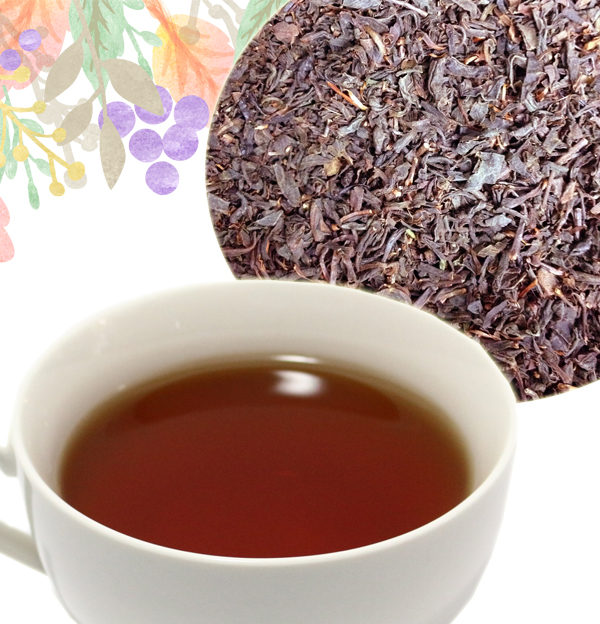
During oxidation, catechins transform into compounds including theaflavins and thearubigins. These changes help create black tea’s reddish-brown color, briskness and rich aroma. Major producing regions include Assam and Darjeeling in India, Sri Lanka and Kenya.
Black tea is enjoyed plain, with sugar or milk, and as a base for flavored and spiced teas. Japanese black tea, called wakoucha, is made from tea grown in Japan and often has a softer, naturally sweet character.

Black tea is sorted into grades such as OP and BOP based mainly on leaf size and form. These grades affect infusion speed and appearance but are not, by themselves, a universal measure of quality.
Post-Fermented Tea: Tea Transformed by Microorganisms
Green, oolong and black tea are classified mainly by enzymatic oxidation. Post-fermented tea is different: after the leaf is heated, microorganisms such as fungi or bacteria take part in fermentation. The idea is similar to the controlled microbial transformations used in koji, miso, pickles and alcoholic beverages.
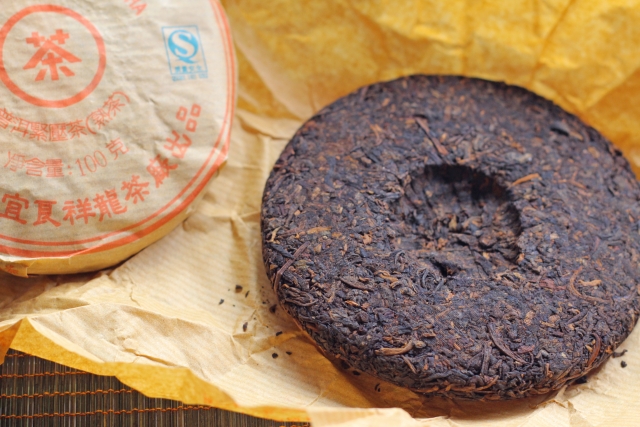
Pu-erh, produced mainly in Yunnan, is the best-known Chinese post-fermented tea. Ripe pu-erh (shou pu-erh) is produced through an accelerated moist-piling process, while raw pu-erh (sheng pu-erh) changes gradually with age. The earthy, woody and mellow flavor of ripe pu-erh is often enjoyed with rich foods.
Japan also has rare regional post-fermented teas, including Goishicha, Awa Bancha and Batabatacha. Goishicha undergoes a two-stage fermentation and is cut into pieces resembling the stones used in the game of Go. Awa Bancha is fermented in a pickling-like process and is known for a refreshing acidity.
Flavor expectations: fungal fermentation can produce earthy or aged aromas, while lactic-acid fermentation can create a distinctive sourness. These teas are highly individual and very different from ordinary sencha.
Summary: Tea Changes Through Cultivation and Processing
Tea begins with the leaves of Camellia sinensis, but it can become an extraordinary range of drinks. Shade cultivation changes color and umami. Steaming and pan-firing create different green-tea aromas. Rolling changes leaf form and extraction. Roasting creates hojicha. Oxidation creates oolong and black tea, while microbial fermentation creates post-fermented tea.
| What you enjoy | Tea styles to explore |
|---|---|
| Fresh, balanced Japanese green tea | Sencha |
| Deep green color and mellow taste | Deep-steamed sencha |
| Curled leaves and a smooth Kyushu character | Tamaryokucha |
| Pan-fired fragrance | Kamairicha |
| Rich shade-grown umami | Gyokuro, kabusecha, matcha |
| Warm roasted aroma | Hojicha |
| Floral or fruity oxidation aroma | Oolong tea |
| Reddish liquor and full aroma | Black tea, wakoucha |
| Earthy, aged or sour fermented character | Pu-erh, Awa Bancha, Goishicha |
Tea also reflects local food, water and culture. Japanese green tea is especially compatible with Japanese cuisine, oolong with many Chinese dishes, and black tea with milk, spices and Western-style sweets. Water hardness can change extraction and aroma, so tea may taste different when prepared abroad. Rather than treating one style as universally superior, it is more rewarding to choose tea according to food, mood, season and personal taste.
Written by Norifumi Kai
Representative Director of SANROKUEN Co., Ltd. This guide is based on Sanrokuen’s experience purchasing, manufacturing and selling Japanese tea and herbal tea. Sanrokuen is a tea company in Kumamoto, Japan, founded in 1975.
Explore Japanese Tea from Kyushu
Sanrokuen offers Japanese matcha and green tea from Kumamoto and other tea-producing areas in Kyushu. English inquiries from individual customers, cafés, restaurants, retailers and food-service buyers are welcome.