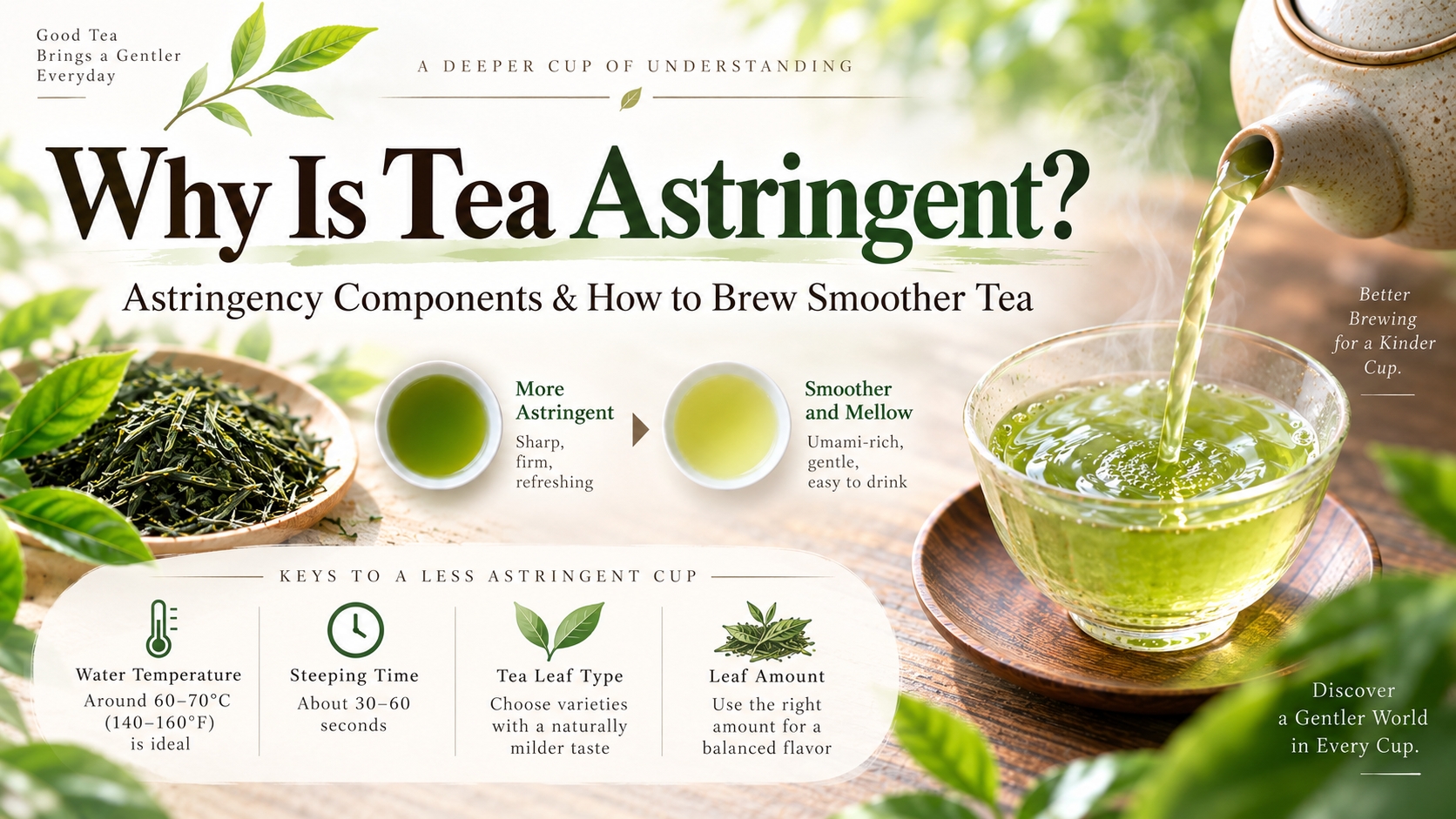
Have you ever brewed Japanese green tea and found it much more astringent than expected? Or wondered why one sencha tastes sweet and mellow while another tastes sharp and drying?
Tea merchants do not judge that difference from one factor alone. A strongly astringent tea may be a later harvest, a naturally powerful cultivar, an open-field tea, a lightly steamed tea—or simply a tea brewed too hot for too long.
This page brings those pieces together. It is designed as a hub for understanding why Japanese green tea tastes astringent and how to adjust both the tea you buy and the way you brew it.
The main reason green tea tastes astringent: catechins
Green tea contains a group of polyphenols known as catechins. Major catechins include:
- EGCG — epigallocatechin gallate
- ECG — epicatechin gallate
- EGC — epigallocatechin
- EC — epicatechin
Among these, gallated catechins such as EGCG and ECG are especially important to the firm, drying sensation associated with tea astringency.
Recent research comparing EGCG with EGC also supports the view that the galloyl group strengthens interactions with salivary proteins and increases perceived astringency.
Astringency and bitterness are not the same thing
Bitterness
Bitterness is a taste detected by bitter taste receptors. In green tea, caffeine and some catechins contribute to bitterness.
Astringency
Astringency is the drying, puckering, tightening or slightly rough sensation you feel across the mouth after drinking tea.
Astringency is therefore more than a simple “taste.” One major mechanism involves interactions between tea polyphenols and salivary proteins, which reduce lubrication in the mouth and create that characteristic drying sensation.
A little astringency can make green tea feel fresh, clean and refreshing. Too much can make the cup feel harsh.
Are “tannin” and “catechin” the same thing?
In the Japanese tea trade, the word tannin has long been used broadly for astringent tea polyphenols. Catechins make up the major tannin-related fraction in green tea, so the terms are often used loosely in practical tea discussions.
However, “tannin 10%” does not mean “EGCG 10%.” Sanrokuen's in-house tea analyzer reports a tannin value, but that value is not a direct laboratory measurement of EGCG alone.
This distinction matters when reading our original component data below.
What makes green tea more or less astringent?
| Factor | General tendency |
|---|---|
| First harvest | Usually milder, with more umami |
| Second / third harvest | Often stronger and more astringent |
| Shade-grown tea | Usually softer in astringency, stronger in umami |
| Open-field tea | Often brighter and more astringent |
| Saemidori / Asatsuyu | Generally milder cultivars |
| Sayamakaori | Often firmer, stronger and more astringent |
| Light / normal steaming | Clearer aroma and more defined astringency |
| Deep steaming | Astringency often feels rounder |
| Pan-fired kamairicha | Often clean and relatively gentle |
| High brewing temperature | More bitterness and astringency |
| Lower brewing temperature | Softer cup, more noticeable umami |
| Long steep | Stronger extraction |
| Short steep | Less extraction and less harshness |
If you dislike astringency, the most effective approach is to change both the tea and the brew.
Why first-harvest tea is usually less astringent than second- or third-harvest tea
First harvest
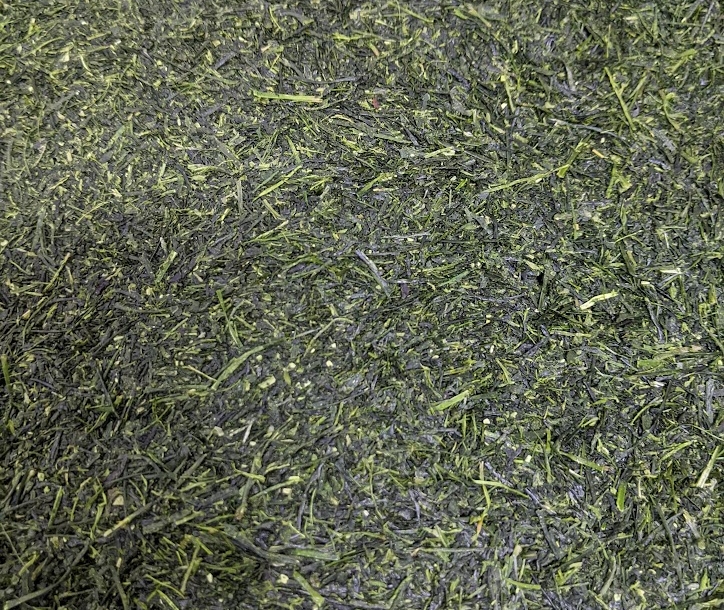
The first spring shoots grow after the tea plant has stored nutrients through winter. First-harvest tea generally tends to contain more free amino acids, including theanine, and is often perceived as sweeter and more umami-rich.
Second and third harvest
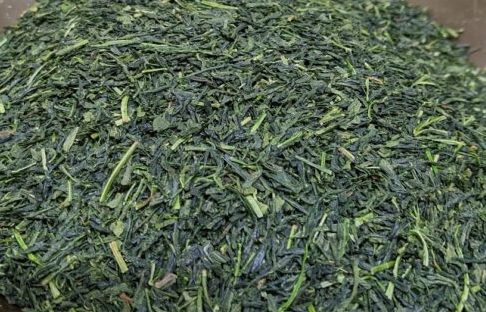
Later harvests grow under warmer conditions and stronger sunlight. As the season advances, free amino acids and theanine often decrease while catechin-related astringency tends to increase.
A useful shorthand is:
First harvest: more umami-oriented.
Later harvests: more strength and astringency.
For a detailed English comparison using Sanrokuen's own component data, see First-Harvest vs Second-Harvest Japanese Matcha. Although that page focuses on matcha raw material, the harvest-season pattern is useful for understanding Japanese tea more broadly.
Sanrokuen's measurements: first, second and third harvests
Sanrokuen measured five first-harvest tea lots and three second-harvest Saeakari lots in 2026.
| Component | First harvest average | Second harvest average |
|---|---|---|
| Free amino acids | 5.18% | 3.33% |
| L-theanine | 2.98% | 1.90% |
| Instrument-reported tannin | 7.02% | 9.90% |
The second-harvest group therefore showed about 41% higher instrument-reported tannin than the first-harvest group, while amino acids and theanine were lower.
In a separate Sanrokuen comparison, one first-harvest matcha material measured 6.2% tannin while a third-harvest powdered green tea measured 16.1%—about 2.6 times as high.
These are not universal values for all Japanese teas. The lots were not all the same cultivar, field and production method. But the direction is consistent with the broader pattern seen in tea science: later-season tea often becomes more catechin-rich and more astringent.
See also our English First-Harvest vs Third-Harvest Green Tea analysis.
Cultivar can change astringency dramatically
Japanese green tea is not one single plant type. Yabukita, Saemidori, Sayamakaori, Seimei, Tsuyuhikari, Yutakamidori and many other cultivars can differ in aroma, amino acids, catechins, color and mouthfeel.
For a broad English overview, see our Japanese Matcha Cultivars guide. Even though that section is matcha-focused, cultivar characteristics such as astringency and umami begin in the tea plant itself.
Sayamakaori: a powerful, structured cultivar
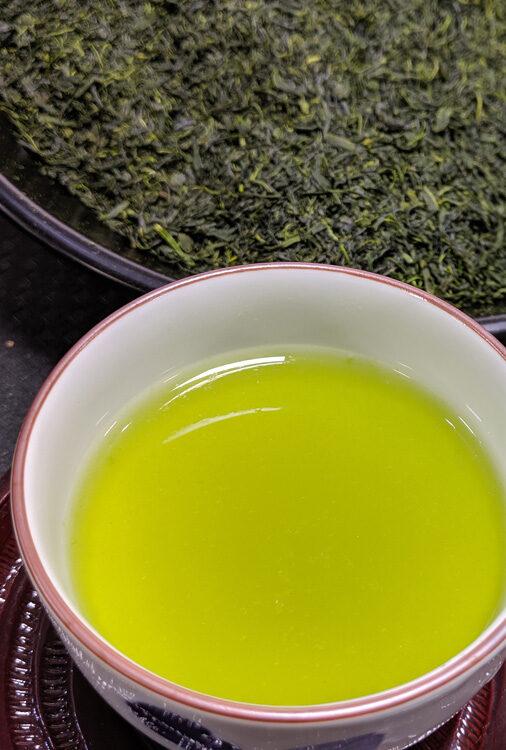
Sayamakaori can produce a firm, clearly structured Japanese tea character with noticeable astringency. In Sanrokuen's experience, open-field Sayamakaori can be especially powerful.
That is not automatically a defect. Astringency can create freshness, body and a clean finish—and can also help tea remain present when blended with milk or food.
Read our English Sayamakaori cultivar guide.
Saemidori: vivid color and a softer profile
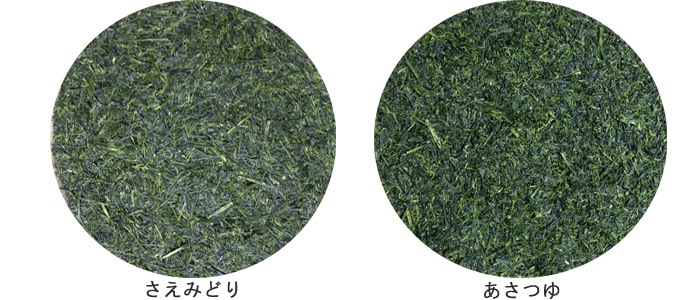
Saemidori is well known for vivid color, elegant umami and comparatively low roughness when well grown and processed. Public Japanese research has also reported high amino acids and relatively low tannin in suitable Saemidori material.
Read our English Saemidori cultivar guide.
Asatsuyu: naturally mellow
Asatsuyu has long been nicknamed “natural gyokuro” because it can show strong umami and relatively low astringency even without heavy shading.
We do not currently have a dedicated English Asatsuyu guide, so readers who can read Japanese can see the original article: あさつゆとは?天然玉露と称される品種の特徴と魅力.
Seimei: a modern cultivar for shaded tea
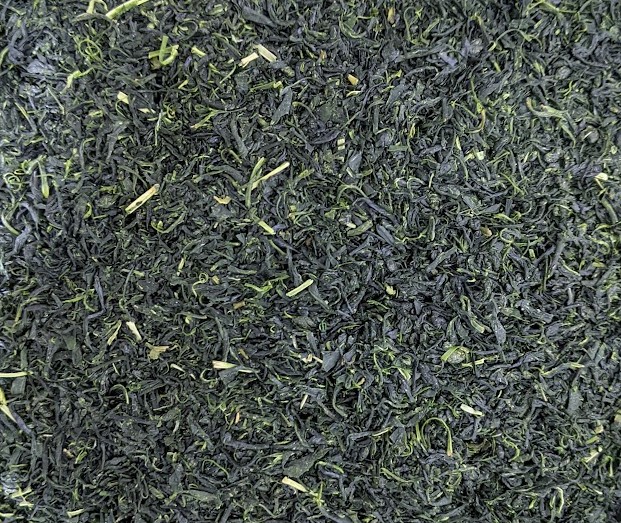
Seimei was bred for high-quality shaded tea, matcha and powdered tea. NARO research has reported high amino acids and comparatively favorable bitterness/astringency characteristics under covered cultivation.
Read our English Seimei cultivar guide.
Open-field vs shade-grown tea: sunlight changes the balance
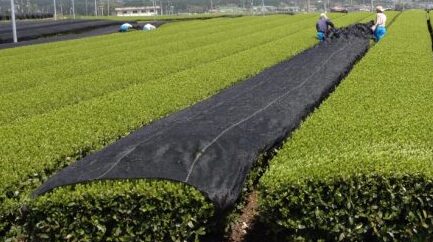
Shading is one of the most important tools for changing tea flavor before the leaves are even picked.
Under shade, tea generally tends to retain more amino-acid character while catechin formation is restrained. Chlorophyll increases, color deepens and the finished tea often becomes more umami-forward and less sharply astringent.
Brighter, fresher, often more astringent.
More umami, deeper green, generally softer astringency.
This is one reason gyokuro, kabusecha, tencha and matcha have such different flavor balance from ordinary open-field sencha.
For an English explanation of shading and tea categories, see Matcha vs Green Tea: How Shading and Processing Change Japanese Tea and What Is Gyokuro?.
Processing also changes how astringency is perceived
Light-steamed and normal-steamed sencha
Shorter steaming preserves more of the original leaf structure. The resulting tea often has clearer aroma, a brighter outline of flavor and more clearly defined astringency.
Why deep-steamed tea can feel rounder
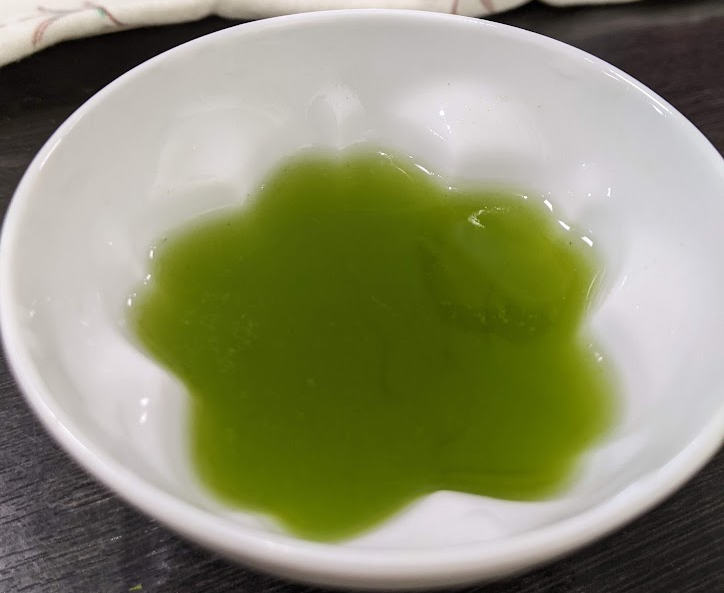
Fukamushi, or deep-steamed tea, is steamed for longer. The leaf structure breaks down more strongly, producing smaller particles and faster extraction.
That may sound as though deep-steamed tea should always taste more astringent. In practice, however, it often tastes rounder and fuller. Research has suggested that soluble pectin and its interactions with gallated catechins can help reduce the perception of astringency.
Deep steaming can therefore create an interesting sensory result: deep color and strong extraction without necessarily feeling sharply astringent.
For brewing advice, see our English How to Brew Japanese Green Tea. For a cultivar strongly associated with fukamushi production, see Yutakamidori.
Kamairicha: pan-fired Japanese green tea
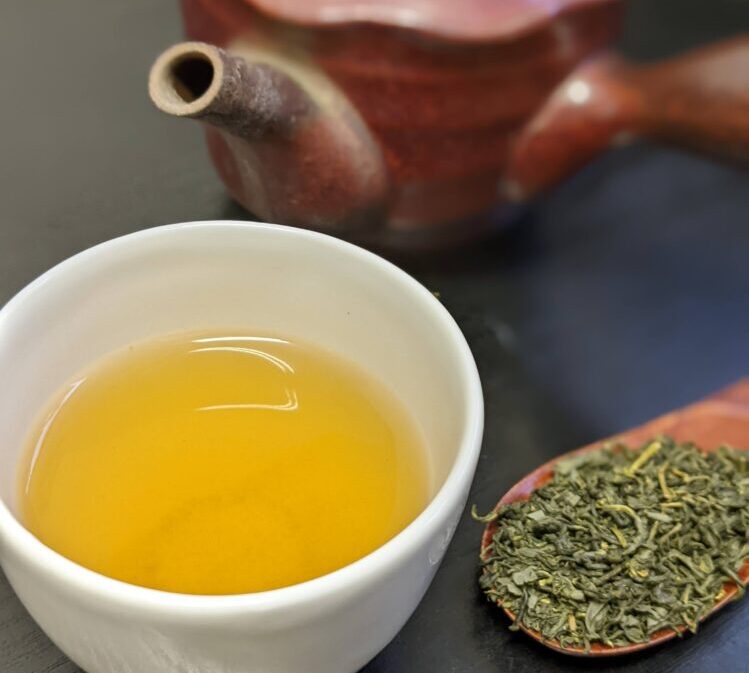
Most Japanese green tea is steamed, but kamairicha is heated in a hot pan. It is especially associated with areas of Kyushu, including Kumamoto and Miyazaki.
Studies using taste-sensing instruments have reported lower perceived astringency in kamairicha than in some steamed sencha samples. Kamairicha is also known for a clean finish and a fragrant pan-fired aroma called kamaka.
See 28 Types of Japanese Tea for the English kamairicha overview. A more detailed Japanese article is also available: 釜炒り茶はどんなお茶?.
The easiest way to reduce astringency: lower the water temperature
You do not always need to buy a different tea. Brewing alone can change the cup dramatically.
Higher temperatures extract caffeine and gallated catechins more aggressively. Lower temperatures suppress those strongly bitter and astringent compounds, allowing amino-acid-driven umami and sweetness to stand out more clearly.
For a detailed English explanation, see Why Water Temperature Changes the Taste of Japanese Green Tea.
For sencha, start around 70°C / 158°F
If you want to reduce astringency, a useful starting point for ordinary sencha is:
Water: 180–200 mL
Temperature: about 70°C / 158°F
Time: about 60 seconds
If the tea is still too astringent, lower the water to about 65°C / 149°F. If you want more aroma and briskness, raise it toward 75–80°C / 167–176°F.
Steeping too long can also make tea harsh
Temperature and time work together. High temperature + long steep + too much leaf is the easiest way to produce an overly strong cup.
For normal sencha, about one minute is a useful starting point. Deep-steamed sencha often needs only 30–60 seconds because the broken leaf structure extracts quickly.
Too much leaf can also increase astringency
If the tea tastes too concentrated, reduce the leaf amount by 10–20% before changing everything else at once.
Pour the kyusu completely empty
Leaving water in the teapot after the first infusion allows extraction to continue. That can make the second infusion unexpectedly harsh.
Pour the first infusion out completely, then use a hotter but much shorter second infusion—often only 10–30 seconds for sencha.
See our full English Japanese Green Tea Brewing Guide.
If you really dislike astringency, try cold brew
Cold water extracts strongly bitter and astringent compounds more slowly than hot water. That makes cold-brew green tea an excellent option for people who prefer a mellow, sweet and umami-rich cup.
First-harvest tea, shaded tea and naturally mellow cultivars such as Saemidori or Asatsuyu can work especially well.
Our English brewing-temperature guide also includes a cold-brew starting recipe.
What if the tea is already too astringent?
Add a little hot water
Dilution is the fastest way to soften an over-extracted cup.
Let it cool slightly
Temperature changes how bitterness, aroma and astringency are perceived.
Make the next infusion shorter
Wet leaves extract quickly, so the second infusion should usually be brief.
Next time, lower the temperature first
Changing one variable at a time makes the difference easier to understand.
How to choose a less astringent Japanese green tea
- Choose first harvest. It generally has more amino acids and a softer balance.
- Choose shaded tea. Kabusecha and gyokuro are obvious examples.
- Choose a mellow cultivar. Saemidori and Asatsuyu are good examples.
- Consider deep-steamed tea. It can feel rich yet rounded.
- Brew cooler. You can adjust the same tea at home.
What if you actually like a strong, refreshing astringency?
Astringency is not something that must always be removed.
If you enjoy a crisp, cleansing Japanese tea character, look for:
- open-field cultivation;
- second- or third-harvest tea;
- powerful cultivars such as Sayamakaori;
- light- or normal-steamed sencha;
- water around 80°C / 176°F;
- a slightly longer steep.
A firm astringency can be especially pleasant after fatty foods, sweets or rich meals.
Low astringency does not automatically mean higher quality
Premium Japanese green tea often does have a softer, sweeter profile because it may combine tender first-harvest shoots, shading, amino-acid-rich cultivars and careful processing.
But that does not mean:
low astringency = good tea, high astringency = bad tea.
A high-quality open-field Sayamakaori can be intentionally powerful. Later-harvest teas may be ideal for food pairings, powder, latte applications or customers who want a stronger green-tea presence.
The best tea depends on the intended use.
A tea merchant's view: astringency is the result of the whole history of the leaf
After handling many Japanese teas, we do not ask only “Is this cultivar astringent?” or “Is this a second harvest?”
Even the same cultivar can taste completely different depending on:
- first vs later harvest;
- open-field vs shaded cultivation;
- light vs deep steaming;
- mountain vs lowland growing conditions;
- early vs late picking;
- brewing temperature and time.
The finished cup is the result of:
Cultivar + growing environment + harvest timing + cultivation + processing + brewing.
That complexity is one of the reasons Japanese tea is so interesting.
Frequently asked questions
What is the main cause of astringency in green tea?
Catechins are the main contributors. Gallated catechins such as EGCG and ECG are especially important, but the final sensation also depends on cultivar, harvest, cultivation, processing and brewing.
Does a more astringent tea contain more catechins?
Often, but not always in a simple one-to-one relationship. Pectin, amino acids and other compounds also change how astringency is perceived.
Why is first-harvest tea usually sweeter?
First-harvest tea generally contains more free amino acids and theanine and often shows lower catechin-related astringency than later-season tea.
Why are second- and third-harvest teas often more astringent?
They grow under warmer and sunnier conditions. As the season advances, amino acids tend to decrease while catechins increase.
Why is Saemidori usually less astringent?
Saemidori is known for high-quality tea with abundant amino-acid character and comparatively low roughness or tannin under suitable growing conditions.
Is deep-steamed tea less astringent?
It often feels rounder and less sharply astringent, but the fragmented leaves extract quickly, so long steeping can still produce a very strong cup.
What temperature should I use to reduce astringency?
For ordinary sencha, 65–75°C / 149–167°F is a useful range. Start around 70°C / 158°F and adjust from there.
Summary: green tea astringency comes from catechins—but the cup is shaped by much more
The main compounds behind green tea astringency are catechins.
But the actual cup depends on several layers:
- Harvest: later harvests tend to become more astringent.
- Cultivar: Sayamakaori can be powerful, while Saemidori and Asatsuyu tend to be softer.
- Cultivation: shading usually increases umami and reduces sharp astringency.
- Processing: light steaming, deep steaming and pan-firing create different sensory profiles.
- Brewing: hotter and longer usually means more bitterness and astringency.
If your tea is too astringent, the simplest first step is:
Lower the water temperature by about 10°C / 18°F.
If that is not enough, shorten the steep. And if you are choosing a new tea, look for first-harvest, shaded or naturally low-astringency cultivars.
Astringency is not a flaw by itself. Once you understand how to increase or reduce it, Japanese green tea becomes something you can actively shape to your own taste.
Related English guides
Sources and further reading
- Deng S, et al. Bitter and astringent substances in green tea: composition, human perception mechanisms, evaluation methods and factors influencing their formation. Food Research International. 2022.
- Wang S, et al. Astringency and its sub-qualities: a review of astringency mechanisms and methods for measuring saliva lubrication. Chemical Senses. 2024.
- Research comparing the astringency of EGCG and EGC and their interaction with salivary proteins. 2025.
- NARO: Suppression of gallated-catechin astringency through pectin complex formation.
- Japanese Society for Food Science and Technology: sensory analysis of kamairicha and sencha.
- Japan Society of Cookery Science: evaluation of tea taste under different brewing conditions.
- NARO: Seimei, a green tea cultivar suitable for covered cultivation, matcha and powdered tea.
- Sanrokuen 2026 in-house tea component analysis: first-, second- and third-harvest comparison.