The result at a glance
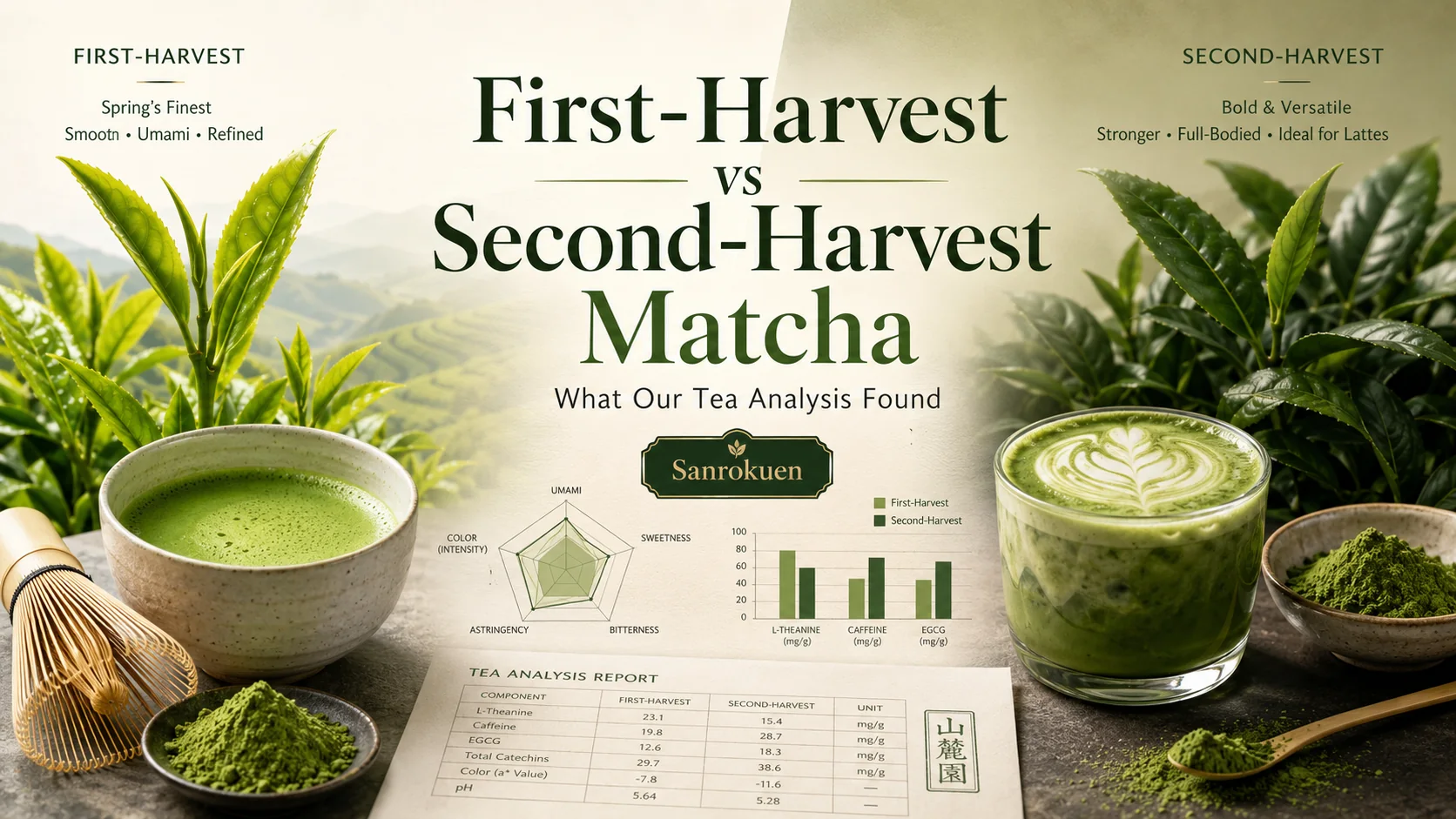
Across the samples measured, the first-harvest group averaged more free amino acids and theanine, while the second-harvest Saeakari group averaged substantially more instrument-reported tannin and fiber. Caffeine was relatively close.
The practical conclusion is not that one harvest is “good” and the other is “bad.” If you want more technical background after reading this article, our Kumamoto Matcha Analysis page provides additional context. First harvest is generally easier to enjoy with water; second harvest can provide the stronger tea presence needed for milk, sugar and desserts.
How we measured the tea
Sanrokuen measured five first-harvest tea raw-material lots and three second-harvest lots with our in-house tea component analyzer. If you are new to our origin and product range, you can also start from our Kumamoto Matcha overview. The three second-harvest samples were all the cultivar Saeakari from the same producer, which makes that group relatively controlled.
The first-harvest samples were measured on May 8 and May 14, 2026. The second-harvest Saeakari samples were measured on June 24, 2026. All values below are the readings printed by the same instrument under the same internal comparison method.
Average composition: first harvest vs second harvest
| Measurement | First harvest | Second harvest | Difference in second harvest |
|---|---|---|---|
| Total nitrogen | 6.44% | 5.27% | −18% |
| Free amino acids | 5.18% | 3.33% | −36% |
| Theanine | 2.98% | 1.90% | −36% |
| Fiber | 20.66% | 23.97% | +16% |
| Instrument-reported tannin | 7.02% | 9.90% | +41% |
| Caffeine | 2.38% | 2.60% | +9% |
| Vitamin C | 0.388% | 0.267% | −31% |
| AF score* | 75.2 | 34.7 | −54% |
*AF score is the analyzer’s internal index and is shown only as supplementary information. It should not be treated as a universal matcha grading standard.
First-harvest average
Second-harvest average
Why matcha makes the numbers especially relevant
Sencha and most leaf teas are infused and then removed. Only part of the leaf’s water-soluble material reaches the cup. Matcha is different: the leaf is milled into fine particles, dispersed in water and consumed.
That does not mean a chemical number can perfectly predict flavor. Aroma, cultivar, shading, leaf maturity, color, milling, storage and preparation all influence the experience. Still, because the whole powdered leaf is consumed, differences in amino acids, theanine, tannin and fiber can be felt more directly than they often are in a lightly infused leaf tea.
In practical terms, a matcha raw material with tannin around 10% may taste noticeably more bitter or astringent when whisked with water than one around 6–7%. The same strength, however, may become useful when the matcha must remain recognizable after adding milk or sugar.
For a broader explanation of what matcha contains—including L-theanine, catechins, caffeine, fiber, vitamins and minerals—see our Matcha Nutrition guide.
Why first-harvest matcha generally suits drinking with water
Our five first-harvest lots averaged 5.18% free amino acids and 2.98% theanine. The second-harvest Saeakari lots averaged 3.33% and 1.90% respectively. At the same time, the first-harvest tannin average was 7.02%, compared with 9.90% in the second-harvest group.
This balance helps explain why carefully made first-harvest matcha is often smoother, fuller in umami and less aggressively astringent when prepared as usucha. The best first-harvest sample in this set reached 6.0% free amino acids, 3.5% theanine and only 6.2% tannin.
It is also important to note the variation within the first harvest itself. One first-harvest sample measured 4.3% free amino acids, 2.4% theanine and 8.4% tannin. Harvest season matters, but it does not erase differences in cultivar, field, shading, picking date and manufacture.
Why second-harvest matcha can work better in lattes and desserts
The three second-harvest Saeakari lots were remarkably consistent in tannin: 9.8%, 9.9% and 10.0%. Their theanine readings ranged from 1.7% to 2.2%.
When matcha is mixed with milk, dairy fat, plant milk, syrup or ice, a delicate matcha can disappear. A later-harvest matcha with more bitterness and a stronger tea character can remain present in the finished drink. This is not automatically a defect; it can be a functional advantage.
The same principle applies to cakes, cookies, chocolate, ice cream and other foods. A strong raw material may give better flavor persistence and better cost performance than a very delicate drinking matcha.
First-harvest matcha
Usucha, straight matcha, premium drinks and applications where smoothness, umami and a refined finish matter most.
Second- or later-harvest matcha
Lattes, sweetened drinks, desserts and commercial recipes where a stronger tea flavor must remain after other ingredients are added.
How Sanrokuen uses harvest season in its matcha grades
At Sanrokuen, our ceremonial-positioned matcha uses high-quality first-harvest raw material because the product is intended to be whisked and drunk with water. You can see the broader product context on our matcha page. We want sufficient umami, a restrained level of bitterness and a balanced finish.
Our standard latte-grade matcha is generally based on second or later harvests. For cafés, manufacturers and private-label inquiries, please see our matcha wholesale page. Higher-quality latte blends may include a portion of first-harvest material to improve color, aroma, umami and overall balance while retaining enough strength for milk.
We often use analytical numbers to design the direction of a blend—but the final decision is always made by actually drinking it.
Composition does not guarantee deliciousness. A tea with attractive figures can still have an unsuitable aroma, weak color or poor balance. Conversely, a tea with more tannin may be excellent for a particular latte recipe. For this reason, our process is: measure, blend, mill, prepare and taste.
All sample results
| Sample | Total N | Free amino acids | Theanine | Fiber | Tannin | Caffeine | Vitamin C | AF |
|---|---|---|---|---|---|---|---|---|
| FH-1 | 6.6% | 5.4% | 3.1% | 20.6% | 6.5% | 2.6% | 0.33% | 77 |
| FH-2 | 6.8% | 5.6% | 3.3% | 19.7% | 6.5% | 2.5% | 0.42% | 87 |
| FH-3 | 6.9% | 6.0% | 3.5% | 18.7% | 6.2% | 2.3% | 0.43% | 104 |
| FH-4 | 6.2% | 4.6% | 2.6% | 21.0% | 7.5% | 2.4% | 0.31% | 60 |
| FH-5 | 5.7% | 4.3% | 2.4% | 23.3% | 8.4% | 2.1% | 0.45% | 48 |
| Sample | Total N | Free amino acids | Theanine | Fiber | Tannin | Caffeine | Vitamin C | AF |
|---|---|---|---|---|---|---|---|---|
| SH-1 | 5.6% | 3.9% | 2.2% | 22.7% | 10.0% | 2.7% | 0.32% | 44 |
| SH-2 | 5.0% | 3.0% | 1.7% | 25.8% | 9.9% | 2.4% | 0.28% | 28 |
| SH-3 | 5.2% | 3.1% | 1.8% | 23.4% | 9.8% | 2.7% | 0.20% | 32 |
View the original first-harvest analyzer receipts


View the original second-harvest Saeakari analyzer receipts


Important limitations
This is a comparison of the lots handled and measured by Sanrokuen. It is not a claim that every first-harvest matcha in Japan will have these values, or that every second-harvest matcha will resemble these three Saeakari samples.
The second-harvest group came from one producer and one cultivar, while the first-harvest group contained five separate lots. A larger study controlling cultivar, producer, field and processing would be needed to isolate harvest season alone.
Even so, the clear pattern in this set—higher amino acids and theanine in the first-harvest average, and higher tannin in the second-harvest average—matches what we experienced in the cup and is useful for practical product design.
Frequently asked questions
Is second-harvest matcha always lower quality?
No. It may be less suitable for delicate straight drinking, but its stronger flavor can be an advantage in lattes and desserts. Quality should be judged against the intended use.
Does a higher theanine number always mean better matcha?
No. It is one useful indicator, not a complete score. Aroma, color, texture, freshness, cultivar and balance all matter.
Can first- and second-harvest matcha be blended?
Yes. Sanrokuen sometimes adds first-harvest material to a premium latte blend to improve color, aroma and umami while keeping enough intensity for milk.
Why not choose matcha by harvest season alone?
Because even our five first-harvest samples varied meaningfully. Harvest season is important, but the field, cultivar, shading, leaf maturity and processing also affect the result.
Choose matcha for the way it will actually be used
Sanrokuen produces and selects Japanese matcha for straight drinking, cafés, lattes and food manufacturing. We can discuss flavor strength, color, particle size, harvest composition and sample options.
Published by Sanrokuen · Kumamoto, Japan · Updated July 12, 2026