Many articles talk about matcha or green tea as though they were nutritionally uniform. In practice, harvest season can make a major difference.
The timing of harvest affects leaf maturity, sunlight exposure, chemical composition, taste and the way a tea is best used. A first-harvest, shade-grown tea selected for matcha can be rich in free amino acids and L-theanine. A later-harvest tea may be lower in amino acids but higher in tannin-related values and fiber.
This article explains those differences using Sanrokuen's own 2026 measurement data comparing two real materials:
- 2026 first-harvest matcha material — Enju Premium, measured on May 14, 2026
- 2026 third-harvest powdered green tea — a blend of Saemidori, Sayamakori and Yabukita, measured on August 25, 2026
Why harvest season matters in Japanese green tea
Green tea is an agricultural product, not a standardized chemical product. The tea plant changes as the season progresses. Young spring leaves harvested early in the year are different from leaves harvested later in summer.
Several factors help explain why:
- Leaf maturity changes. First-harvest leaves are younger and chemically different from later, more mature leaves.
- Shading changes metabolism. Tea grown for matcha is shaded before harvest, influencing the balance of amino acids, chlorophyll and catechin formation.
- Sunlight exposure changes polyphenol development. More exposure can contribute to stronger astringency and different tannin-related values.
- Seasonal growth changes composition. The plant's physiology shifts as spring becomes summer.
Sanrokuen's 2026 measurement data
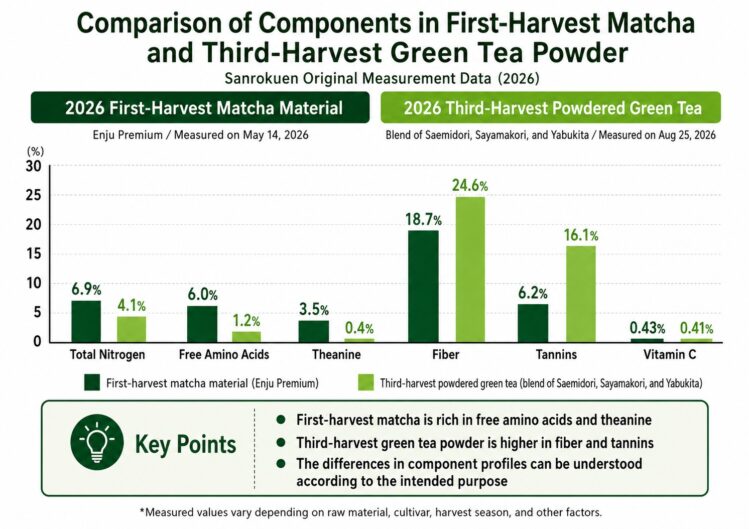
The table below compares the main values measured in the two materials.
| Component | 2026 First-Harvest Matcha Material Enju Premium |
2026 Third-Harvest Powdered Green Tea Saemidori + Sayamakori + Yabukita Blend |
What stands out? |
|---|---|---|---|
| Total nitrogen | 6.9% | 4.1% | Higher in first-harvest matcha material |
| Free amino acids | 6.0% | 1.2% | Much higher in first-harvest matcha |
| Theanine | 3.5% | 0.4% | Very large difference favoring first-harvest matcha |
| Fiber | 18.7% | 24.6% | Higher in third-harvest powder |
| Tannins | 6.2% | 16.1% | Much higher in third-harvest powder |
| Vitamin C | 0.43% | 0.41% | Almost the same |
Sanrokuen original measurement data. First-harvest matcha material (Enju Premium): measured May 14, 2026. Third-harvest powdered green tea (blend of Saemidori, Sayamakori and Yabukita): measured August 25, 2026. Measured values vary depending on raw material, cultivar, harvest season and other conditions.
These figures show that the difference between first and third harvest is not minor. It is large enough to change how the tea tastes and how it may be positioned.
How L-theanine changes from first harvest to third harvest
L-theanine is one of the compounds most closely associated with the mellow, soft and umami-rich character of quality Japanese green tea.
In Sanrokuen's data, first-harvest matcha material contained 3.5% theanine, while the third-harvest powdered green tea contained only 0.4%. That is one of the clearest differences in the entire comparison.
The same pattern appears in free amino acids overall: 6.0% in the first-harvest matcha material, compared with 1.2% in the third-harvest powder.
What this suggests
If your interest is in amino-acid-rich tea with a softer, more umami-oriented profile, first-harvest matcha material is far more suitable than later-harvest green tea powder.
This does not prove a specific health effect from one serving. But it does show that if a reader is specifically interested in theanine, it is not enough to ask whether a product is “green tea” or even “powdered green tea.” The harvest season matters.
How tannins change from first harvest to third harvest
The reverse pattern appears in tannins.
Sanrokuen's first-harvest matcha material measured 6.2% tannins, while the third-harvest powdered green tea measured 16.1%. This is a very large increase.
In practical terms, later-harvest tea often shows a stronger, more astringent character. It can also contain a different balance of polyphenol-related compounds compared with first-harvest matcha selected for umami and softness.
To see how harvest season fits together with catechins, cultivar, shading, steaming and brewing temperature, read Why Is Green Tea Astringent?
What this suggests
If a reader is more interested in tannin-rich or catechin-oriented green tea characteristics, a later-harvest green tea powder may be more relevant than high-grade first-harvest matcha.
Other components: fiber, total nitrogen and vitamin C
Fiber
Fiber was 18.7% in the first-harvest matcha material and 24.6% in the third-harvest powder. This higher fiber value in the third-harvest material fits the broader pattern of more mature leaf material.
Total nitrogen
Total nitrogen was 6.9% in the first-harvest matcha material and 4.1% in the third-harvest powder. In tea evaluation, nitrogen-related values often align with richer amino-acid content and a more premium raw-material profile.
Vitamin C
Vitamin C was 0.43% in the first-harvest matcha material and 0.41% in the third-harvest powder. In this comparison, vitamin C was relatively similar and not the main differentiating factor.
How these differences affect taste and use
First-harvest matcha material
- Higher free amino acids
- Much higher theanine
- Lower tannins
- Softer taste, more umami, less harsh astringency
- Better suited to premium matcha-style positioning
Third-harvest powdered green tea
- Lower amino acids and theanine
- Higher fiber
- Much higher tannins
- Stronger, more astringent profile
- Potentially more suitable where catechin/tannin orientation matters
These differences help explain why two products can both be called “green tea powder” while having very different taste profiles and very different analytical values.
In other words, it is more useful to ask “What kind of green tea powder is it?” than to assume all powders are nutritionally or sensorially similar.
Are tannins the same as EGCG?
No. This point is important.
Tea tannins are related to the broader group of polyphenols and catechin-related compounds, but tannins are not the same thing as EGCG alone.
EGCG is one specific catechin. Tea also contains other catechins such as EGC, ECG and EC. Therefore, when our data show that third-harvest powder has a higher tannin value, the correct interpretation is:
- the third-harvest material is higher in overall tannin-related values,
- which suggests a different polyphenol balance,
- but it does not mean that we measured EGCG alone.
What readers can learn from this comparison
This comparison is useful because it shows that “green tea” is not one single nutritional category.
A person interested in a softer, umami-rich tea and higher theanine values may find first-harvest matcha much more relevant. A person interested in stronger tannin-related values and a more astringent green tea profile may look more closely at later-harvest material.
That distinction can help readers understand not only flavor and price, but also the underlying chemistry of Japanese green tea.
For a broader overview of vitamins, minerals, catechins and caffeine in matcha, see our Matcha Nutrition guide.
Frequently asked questions
Does first-harvest matcha always have more theanine?
Not always in every tea, but in general first-harvest, shade-grown matcha material tends to be richer in theanine and free amino acids than later-harvest tea. Sanrokuen's 2026 data clearly showed this pattern.
Does third-harvest green tea always have more tannins?
Not in every case, but later-harvest tea commonly shows higher tannin-related values and a stronger astringent profile. Our 2026 measurements showed 16.1% tannins in third-harvest powder compared with 6.2% in first-harvest matcha material.
Is third-harvest tea worse than first-harvest tea?
No. It is different. First-harvest tea is often preferred for premium sensory quality and amino-acid richness, while later-harvest tea may be useful when a stronger, more tannin-oriented profile is desired.
Can tannin values be used as EGCG values?
No. Tannins are a broader category related to polyphenols and catechins. EGCG is only one catechin within that broader group.
References
- Sanrokuen original measurement data. First-harvest matcha material (Enju Premium), measured on May 14, 2026. Third-harvest powdered green tea (blend of Saemidori, Sayamakori and Yabukita), measured on August 25, 2026.
- Ministry of Education, Culture, Sports, Science and Technology (MEXT), Japan. Standard Tables of Food Composition in Japan (Eighth Revised Edition, Supplement 2023).
- Kochman J, Jakubczyk K, Antoniewicz J, Mruk H, Janda K. Health Benefits and Chemical Composition of Matcha Green Tea: A Review. Molecules. 2021;26(1):85.
Educational information only. This page discusses measured composition and general tea science for educational purposes. It is not intended to diagnose, treat, cure or prevent disease. Component values vary depending on cultivar, harvest season, growing conditions, processing and storage.