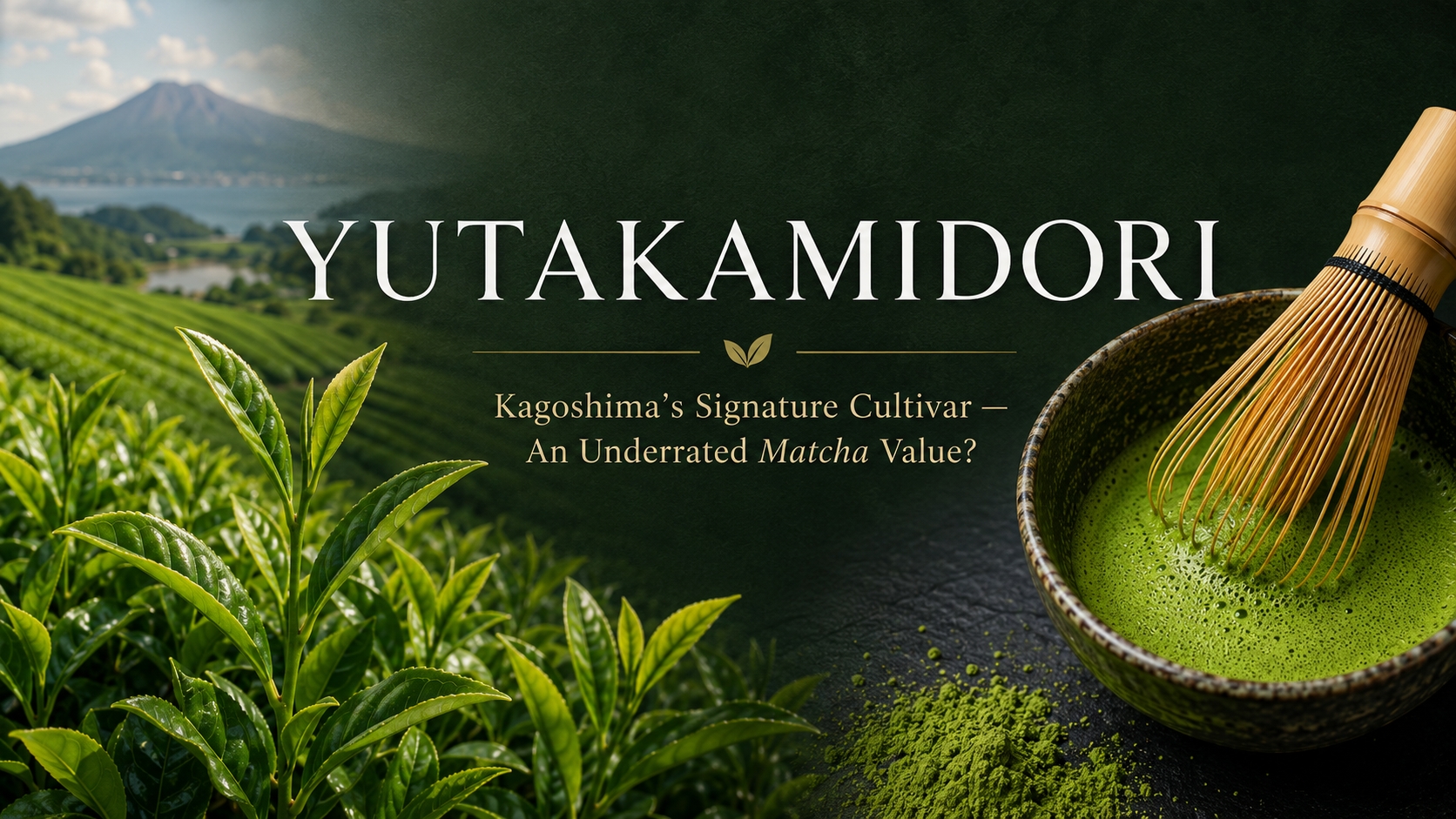
What is Yutakamidori?
Yutakamidori is an early-budding Japanese tea cultivar closely associated with Kagoshima Prefecture. In Kagoshima, where the warm climate allows tea production to begin earlier than in many other Japanese regions, Yutakamidori became one of the prefecture's most important commercial cultivars.
Kagoshima Prefecture describes Yutakamidori as the early-harvest cultivar with the largest growing area in the prefecture. The prefecture also specifically recommends pre-harvest covering followed by deep steaming, which produces rich umami and a full-bodied cup.
Historically, the cultivar was selected as the line known as Y2. NARO's history of Japanese tea breeding notes that this early-budding line did not show its full potential in Kanaya, Shizuoka, but performed well in the warmer conditions of Kagoshima, where it spread widely and became a major cultivar.
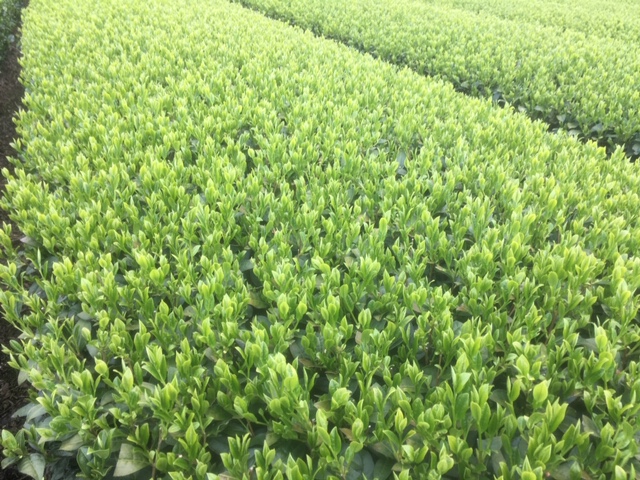
What does Yutakamidori taste like?
Yutakamidori is often associated with a rich, rounded and satisfying green-tea profile rather than a delicate, highly aromatic style. When grown and processed well, it can show:
- strong green-tea body
- good umami and richness
- moderate sweetness
- clear but not necessarily delicate astringency
- a thick, satisfying mouthfeel
- a deep green liquor when processed as fukamushi sencha
Its appeal is often easy to understand in the cup. It can feel generous and substantial, which is one reason it has remained important in Kagoshima despite the rise of newer cultivars.
Why Yutakamidori is so highly regarded for fukamushi sencha
Yutakamidori's strongest reputation is as deep-steamed sencha, or fukamushi sencha. Deep steaming breaks down leaf structure more aggressively than light steaming, producing smaller particles, a deeper liquor color and a fuller sensation in the mouth.
Kagoshima's own cultivar guidance highlights the combination of pre-harvest covering and deep steaming for Yutakamidori, noting the resulting rich umami and full-bodied taste.
This production style suits the cultivar very well. In our practical experience, Yutakamidori does not need to be extremely delicate or high-aroma to be successful. Its strength is the density and richness that become especially attractive in deep-steamed tea.
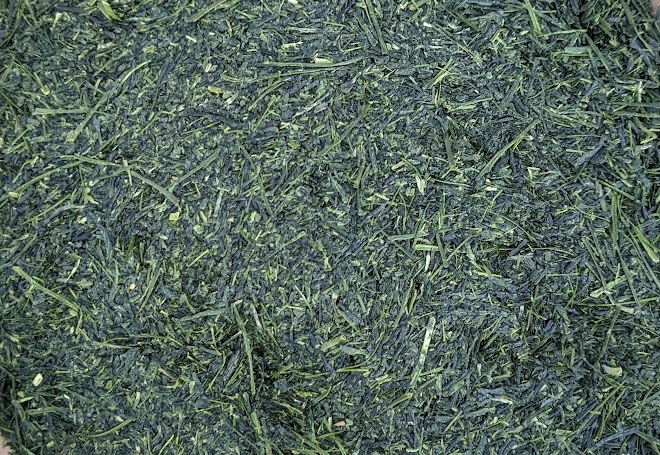
What about lightly steamed sencha?
In the tea trade, Yutakamidori is generally associated much more strongly with deep steaming than with very lightly steamed sencha. Our own view is that its character is often easier to express through deeper steaming, whereas a very light steaming style may place greater emphasis on leaf shape, clarity and fine aroma.
We would not say that Yutakamidori cannot be made as lightly steamed sencha. Rather, it is a cultivar whose commercial strengths have historically been demonstrated most clearly through fukamushi production.
Where Yutakamidori performs best in Kagoshima
Yutakamidori is grown across Kagoshima, but the character of the tea changes considerably with altitude, climate, field management, covering and steaming style. The following is not an official ranking of producing regions. It is Sanrokuen’s practical impression from purchasing and sensory-evaluating Kagoshima tea over many years.
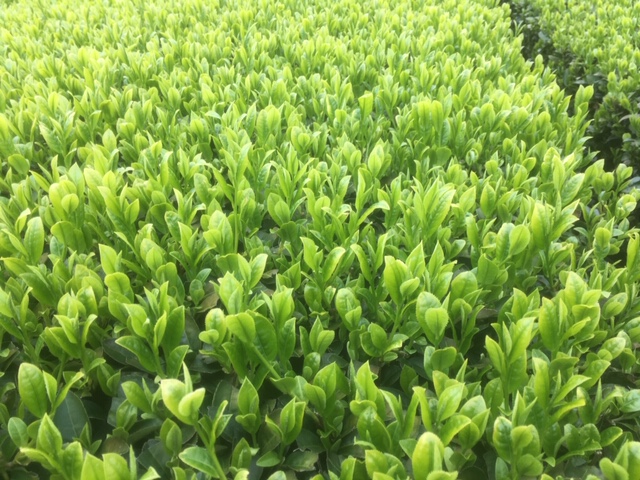
For deep-steamed Yutakamidori, we have generally found the most consistently impressive teas in Minamikyushu. Our average purchasing impression is roughly: Ei Town ≳ Chiran Town > Kawanabe and Makurazaki.
| Area | Sanrokuen’s practical view |
|---|---|
| Ei Town | One of the regions we rate most highly for deep-steamed Yutakamidori. Strong lots often combine rich umami, deep color and body. |
| Chiran Town | Also produces many high-quality covered and deep-steamed Yutakamidori lots and is one of the core areas behind the Chiran Tea name. |
| Kawanabe / Makurazaki | Good teas are produced, although our average purchasing impression places the strongest Ei and Chiran lots slightly higher. Producer and lot variation is significant. |
| Ariake / Shibushi | High-quality Yutakamidori can be found, but rapid conversion from sencha production to tencha and matcha has reduced the amount of sencha material we encounter. |
| Onejime | A less internationally known area where we have also encountered high-quality tea. Individual lot evaluation is especially important. |
| Kirishima / Mizobe | Deep-steamed styles are less dominant. Higher elevation is often used to produce more aroma-focused, lighter-steamed or standard-steamed teas. |
These regional assessments reflect Sanrokuen’s own purchasing and sensory experience, not an official ranking. Weather, farmer, field, harvest date, covering and processing can reverse the order in any particular year.
What about Yutakamidori as matcha?
Yutakamidori has a very different image when it enters the matcha market.
In Kagoshima's raw-tea trade, our experience is that Yutakamidori tends to be relatively inexpensive. It is not usually the cultivar name buyers associate with the most premium matcha, and its powder color is often regarded as less impressive than cultivars selected for vivid green appearance, such as Saemidori or Seimei.
This creates an interesting question:
If Yutakamidori does not carry a luxury matcha image, but its flavor and component values are not necessarily poor, could it be undervalued?
Based on the lots we have handled, our answer is yes, sometimes.
We do not see Yutakamidori as the automatic choice for premium ceremonial matcha where brilliant color, exceptional softness and cultivar prestige are central to the selling proposition.
But for everyday drinking, matcha lattes, desserts and price-sensitive wholesale programs, selected Yutakamidori can offer enough tea flavor, body and component quality to be commercially very useful.
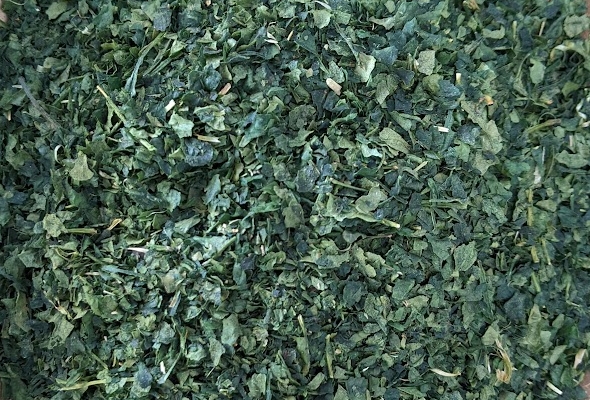
Why might its famous deep-steamed-sencha strength not translate directly into premium matcha?
This is partly our working hypothesis rather than a fixed scientific rule. Yutakamidori became famous because its character works extremely well with covering and deep steaming. Matcha production asks the leaf to perform under a different system: longer shading, tencha processing, drying without rolling, and finally fine milling.
A cultivar that is outstanding when its richness is emphasized by deep steaming does not automatically become the best cultivar for luxury tencha and matcha. That may be one reason its reputation in the two categories is so different.
Tannin may also be part of the picture
Yutakamidori is not necessarily a low-tannin cultivar. Tannin and catechin-related components contribute to astringency and structure. For sencha, that can be part of a satisfying, full-bodied profile.
In premium matcha, however, buyers often prefer lower perceived harshness, especially when the product is positioned around sweetness and umami. This may be another reason Yutakamidori is not automatically regarded as a top luxury matcha cultivar.
Sanrokuen's 2025 component data: inexpensive does not necessarily mean weak
Our own component testing is one reason we remain interested in Yutakamidori. A selected second-harvest Yutakamidori from Chiran produced an AF score of 27 in our internal evaluation.
That result was higher than the AF 24 recorded by a first-harvest Yabukita from Chiran and also higher than the AF 20 of a second-harvest Saemidori from Chiran in the same 2025 comparison.
| Cultivar | Harvest | Origin | AF score | Tannin |
|---|---|---|---|---|
| Yutakamidori | Second harvest | Chiran, Kagoshima | 27* | 11.6–11.8%** |
| Yabukita | First harvest | Chiran, Kagoshima | 24 | 11.3% |
| Saemidori | Second harvest | Chiran, Kagoshima | 20 | 11.7% |
* AF 27 refers to one selected good-quality second-harvest Yutakamidori lot. ** Two second-harvest Yutakamidori samples recorded tannin values of 11.6% and 11.8%. These are individual Sanrokuen 2025 lot-level results, not cultivar-wide averages. AF is Sanrokuen's internal analytical index and is not an official Japanese matcha grade.
How we interpret the result
We do not use this table to claim that Yutakamidori is “better” than Yabukita or Saemidori. The harvest, field, processing and individual lot are different, and tea quality cannot be reduced to one score.
What the data does show is that a relatively inexpensive Yutakamidori lot should not be dismissed simply because the cultivar lacks a premium matcha image. In some cases, its analytical profile can be entirely competitive.
Why Sanrokuen sees Yutakamidori as a value opportunity
In the Kagoshima market, we often find Yutakamidori at relatively attractive prices. That lower price can partly reflect cultivar image and color expectations rather than a complete lack of flavor or useful components.
This creates exactly the type of opportunity we look for when purchasing tea: a cultivar that is not fashionable enough to command a premium, but can still perform well in the cup.
For that reason, Sanrokuen actively evaluates and purchases selected Yutakamidori lots. When the leaf has sufficient flavor, body and acceptable analytical values, the price-to-quality balance can be very attractive.
Yutakamidori vs Yabukita for matcha
| Characteristic | Yutakamidori | Yabukita |
|---|---|---|
| Strongest traditional reputation | Fukamushi sencha, especially Kagoshima | Classic Japanese sencha nationwide |
| Matcha prestige | Generally low to moderate | Moderate; strong regional lots exist |
| Typical Kagoshima raw-material price impression | Often relatively inexpensive | Usually inexpensive to mid-range |
| Matcha color | Often not its strongest point | Lot-dependent; often less vivid than top shading cultivars |
| Tannin / astringency | Can remain clearly present | Can also remain clearly present |
| Value for everyday matcha | Potentially high | Potentially high |
This is Sanrokuen's practical purchasing view, not an official cultivar ranking. Individual lots can differ greatly.
Yutakamidori vs Saemidori for matcha
Saemidori has a much stronger premium image for shaded tea and matcha because of its vivid color, sweetness and generally softer character. If visual impact and premium cultivar branding are the main priorities, Saemidori is usually easier to position.
Yutakamidori competes differently. Its strength is not prestige but cost performance. When a selected lot tastes good and has acceptable composition, it can create a commercially useful matcha at a lower raw-material cost.
Which applications suit Yutakamidori?
| Application | Suitability | Why it can work | Buyer caution |
|---|---|---|---|
| Fukamushi sencha | Excellent | Rich umami, full body and strong compatibility with Kagoshima-style deep steaming. | Quality still depends on field management, harvest and processing. |
| Light-steamed sencha | Conditional | Can be made, but the cultivar's best-known strengths are associated with deeper steaming. | Other cultivars may be more attractive when fine aroma and leaf appearance are the main target. |
| Premium ceremonial matcha | Conditional | A strong shaded lot can still taste good and deliver body. | Color and cultivar prestige may be weaker than premium alternatives. |
| Everyday matcha | High for selected lots | Good price-to-quality balance, recognizable tea flavor and useful body. | Check bitterness, color and current-lot analysis. |
| Matcha latte | High for selected lots | Body and tea character can remain noticeable after milk is added. | Very bitterness-sensitive markets may prefer a softer cultivar or blend. |
| Desserts / baking | High | Cost efficiency and strong tea presence can be valuable in recipes with sugar and fat. | Test color and dosage in the actual formulation. |
| Value wholesale matcha | High | Potentially attractive when raw-material price is low relative to actual flavor and component quality. | Do not buy solely on cultivar name or price. |
What overseas buyers should check before buying Yutakamidori matcha
- Confirm the product type. True matcha should be tencha-based; powdered sencha is a different product.
- Ask whether the leaf was shaded and for how long.
- Check powder color under neutral lighting. Color can vary substantially between lots.
- Taste for body versus harshness. Yutakamidori's strength can become bitterness if the lot is poorly balanced.
- Review component data when available. A low market price does not automatically mean poor composition.
- Test the final latte or dessert recipe. Milk, sugar and dosage can change the commercial result dramatically.
- Compare price against actual performance. This is where Yutakamidori can become especially interesting.
Why Yutakamidori matters to Kagoshima tea
Yutakamidori represents an important part of Kagoshima's tea identity. While Yabukita became the national standard, Kagoshima developed a more diverse cultivar structure suited to its warm climate and long harvesting season.
The cultivar's early budding helped extend the production calendar, and its compatibility with deep steaming helped create the rich style now strongly associated with southern Japanese tea.
This is also why it should not be judged only through the lens of matcha. Yutakamidori has already proven its value over decades in the category where it is strongest: deeply steamed Japanese green tea.
Our conclusion: Yutakamidori may be more useful than its matcha reputation suggests
Yutakamidori is not a fashionable luxury matcha cultivar. In Kagoshima, it is often inexpensive, and its color is not always considered competitive with cultivars designed or selected for vivid shaded-tea appearance.
But that is only part of the story.
As sencha, Yutakamidori is one of Kagoshima's most successful cultivars and performs exceptionally well as fukamushi tea. As matcha material, our own experience suggests that flavor and component values are not necessarily poor, even when the market price is low.
Our selected 2025 second-harvest Chiran lot reached AF 27, demonstrating that an economical Yutakamidori can still compare well analytically with other individual lots. Its tannin was not especially low, so we would not automatically choose it for the softest premium matcha.
However, for everyday matcha, lattes, desserts and cost-conscious wholesale programs, selected Yutakamidori can offer a very attractive balance of price, taste and usable quality.
That is why Sanrokuen sees Yutakamidori not as a cheap substitute, but as a cultivar worth evaluating carefully when the market may be discounting it more than the cup quality justifies.
Frequently asked questions
Is Yutakamidori a good Japanese tea cultivar?
Yes. It is one of Kagoshima's signature cultivars and is particularly highly regarded for rich, deep-steamed sencha.
Why is Yutakamidori associated with Kagoshima?
It is an early-budding cultivar that performs well in Kagoshima's warm climate. Historical NARO material notes that the Y2 line later known as Yutakamidori showed its strengths in Kagoshima and became a major cultivar there.
Is Yutakamidori good for matcha?
It can be, especially for everyday matcha, lattes and value-oriented wholesale use. We would evaluate the actual lot carefully because color, bitterness and shading quality vary.
Why is Yutakamidori matcha often inexpensive?
In our purchasing experience, the cultivar does not carry the same premium matcha image as cultivars such as Saemidori, and its color is often regarded as less exceptional. Market price can therefore be lower even when flavor and components are usable.
Does Yutakamidori have low tannin?
Not necessarily. In Sanrokuen's 2025 testing, two second-harvest Chiran Yutakamidori samples recorded tannin values of 11.6% and 11.8%. Tannin contributes to astringency, but perceived taste depends on the overall balance.
Is Yutakamidori better than Yabukita or Saemidori?
There is no universal ranking. Yabukita is a classic sencha benchmark, Saemidori is highly attractive for color and softness, and Yutakamidori is especially strong in fukamushi sencha and can offer excellent cost performance. The best cultivar depends on the final product.
Compare Yutakamidori with other Japanese matcha cultivars
Cultivar is only one part of matcha quality, but comparing varieties can help buyers understand differences in color, umami, aroma, astringency and application. Explore Sanrokuen’s other cultivar guides.
Looking for Yutakamidori or other Japanese matcha cultivars?
Sanrokuen evaluates tea by cultivar, origin, harvest, sensory quality, component data, price and intended application. For current lot availability, samples or wholesale inquiries, please contact us.
View Wholesale Matcha Request a Sample or QuotationSources and editorial basis
- Kagoshima Prefecture, Main Varieties of Kagoshima Tea: official prefectural PDF
- NARO, history of Japanese tea breeding and the spread of Yutakamidori in Kagoshima: NARO historical review
- Kagoshima Prefecture / Kagoshima Tea Chamber material on steaming styles and major cultivars: Kagoshima tea guide
- NARO research on Japanese tea genetic resources and Yutakamidori: NARO research report
Sections identified as Sanrokuen's view are based on tea and matcha lots handled, purchased and tested by Sanrokuen. The AF and tannin figures shown on this page are individual 2025 lot-level results and should not be interpreted as universal cultivar averages. Statements about market pricing are Sanrokuen's purchasing observations rather than official price statistics.