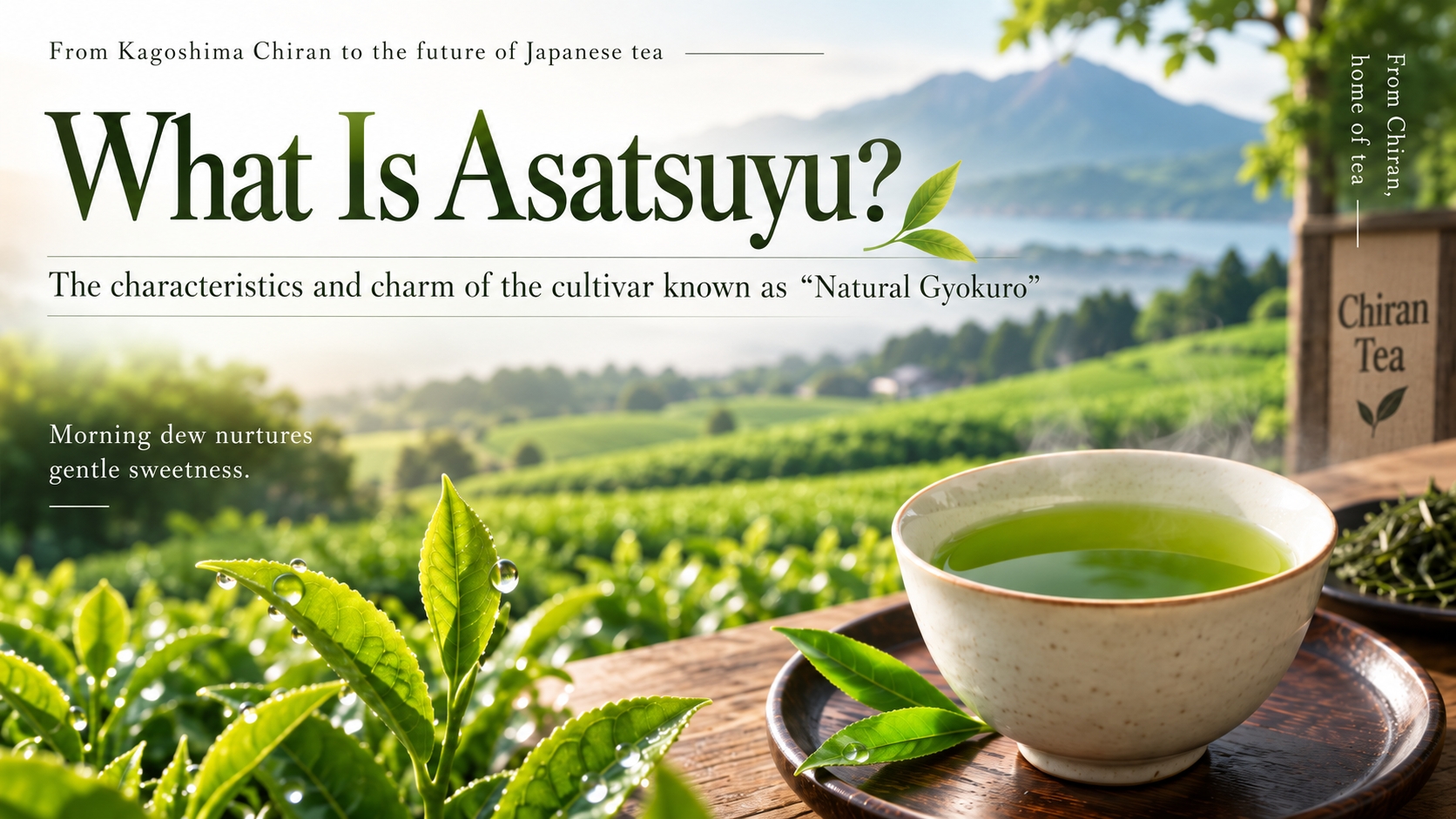
Asatsuyu is a Japanese green-tea cultivar, not a type of Gyokuro. It earned the nickname “Natural Gyokuro” because good Asatsuyu can show unusually strong sweetness and umami with relatively little astringency, even when sold as sencha. Its vivid green color and distinctive aroma make it one of Japan's most recognizable cultivar teas.
Some Japanese teas are easy to recognize by the name of the tea type: Sencha, Gyokuro, Matcha or Hojicha. Asatsuyu is different. Asatsuyu is the name of the cultivar itself.
That distinction matters. A cultivar describes the genetics of the tea plant. Sencha or Gyokuro describes how tea is grown and processed. The same cultivar can therefore taste very different depending on harvest season, shading, steaming, rolling, firing and storage.
Asatsuyu is especially interesting because its cultivar character is unusually easy to notice. In a well-made first-harvest tea, the combination of dense sweetness, rounded umami, low roughness, strong green color and a distinctive aroma can be obvious even before you know the cultivar name.
What kind of cultivar is Asatsuyu?
Asatsuyu (朝露, literally “morning dew”) was selected from seedlings of Uji local tea plants and developed at the tea research station in Kanaya, Shizuoka. It was registered in 1953 as Tea Norin No. 2.
The timing is historically important. Yabukita—the cultivar that later became Japan's dominant standard—was also registered in 1953, as Tea Norin No. 6. Asatsuyu therefore belongs to the early generation of superior cultivars that shaped modern Japanese tea production.
Kagoshima's current tea-industry reference describes Asatsuyu as a medium-season cultivar harvested around two days earlier than Yabukita. Its growth is moderate, and the official quality description highlights a short internode, dense bluish liquor and rich flavor when covering and deeper steaming are used appropriately.
Important: official cultivar characteristics describe tendencies, not guarantees. A cultivar name alone cannot tell you how good a finished tea will be. Field management, harvest timing and manufacturing remain decisive.
Why is Asatsuyu called “Natural Gyokuro”?
The nickname comes from taste, not from legal or manufacturing classification.
Good Asatsuyu sencha can have a dense, almost creamy sweetness and strong umami with comparatively restrained bitterness and astringency. That profile can remind experienced drinkers of shaded high-grade tea, so the nickname “Natural Gyokuro” became widely used.
Asatsuyu and Gyokuro are not the same thing
| Point | Asatsuyu | Gyokuro |
|---|---|---|
| What the name means | A tea plant cultivar | A tea category / production style |
| Possible cultivars | Asatsuyu itself | Saemidori, Gokou, Yabukita, Ujihikari and others |
| Shading | Depends on the product; many premium lots are covered before harvest | Traditionally grown under substantial pre-harvest shading |
| Typical identity | Usually sold as sencha or fukamushi sencha | A premium shaded Japanese green tea |
| Why they seem similar | Both can deliver strong umami, sweetness and restrained astringency. | |
If you are new to Japanese tea categories, our English guide 28 Types of Japanese Tea explains the difference between cultivar, cultivation method and finished tea type.
What does Asatsuyu taste like?
1. Dense sweetness and umami
This is the main attraction. High-quality first-harvest Asatsuyu can feel round and concentrated rather than sharp. The sweetness is not sugar-like; it is the soft, savory-sweet impression created by Japanese green tea's amino acids and overall balance.
2. Relatively low bitterness and astringency
Compared with a more conventionally brisk Yabukita-style sencha, Asatsuyu often feels less rough and less aggressively astringent. That does not mean it cannot become bitter: very hot water, too much leaf or an excessively long steep can still extract bitterness and astringency.
For a deeper explanation of why cultivar, catechins, shading and water temperature change astringency, see Why Is Green Tea Astringent?.
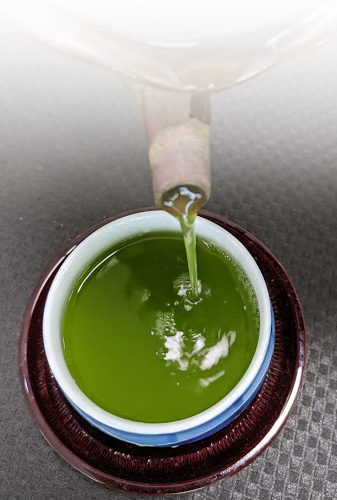
3. An unusually deep green liquor
Asatsuyu is famous for color. When covered before harvest and finished as deep-steamed tea, the infusion can become a dense bluish green that surprises people who expect ordinary sencha to be pale yellow-green.
4. A distinctive cultivar aroma
Asatsuyu does not simply taste like a softer Yabukita. It has a characteristic cultivar aroma of its own. The exact expression changes with origin, shading, steaming and firing, but good lots can combine a sweet green aroma with a rich, concentrated palate.
This personality is also why Asatsuyu is not universally preferred. Drinkers who want a crisp, transparent, classic sencha aroma may prefer Yabukita. Drinkers who enjoy cultivar individuality often find Asatsuyu much more memorable.
Why is Asatsuyu strongly associated with Kagoshima?
Asatsuyu is a relatively minor cultivar nationally, but it remains important in Kagoshima. Kagoshima Prefecture's 2025 cultivar-area data list 441 hectares of Asatsuyu, or 5.4% of the prefecture's tea area.
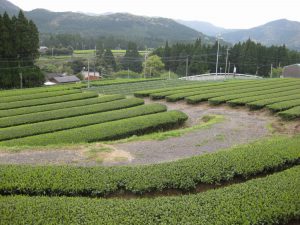
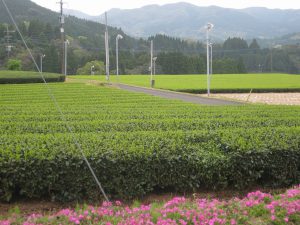
Historical and current production is especially associated with southern Kagoshima, including the Chiran area of Minamikyushu City. The climate suits the cultivar, and the region has extensive experience with covered cultivation and deep steaming—two techniques that can strengthen Asatsuyu's color and rich taste.
Sanrokuen has handled Chiran Asatsuyu for many years. One lesson from buying tea is that the place name alone is never enough. Even within a respected production area, field condition, tree age, harvest timing, covering, steaming, firing and storage can make two teas from the same cultivar taste very different.
Asatsuyu vs Saemidori vs Yabukita
Saemidori is the most natural cultivar to compare with Asatsuyu because Asatsuyu is one of Saemidori's parents. Saemidori was bred from Yabukita as the seed parent and Asatsuyu as the pollen parent.
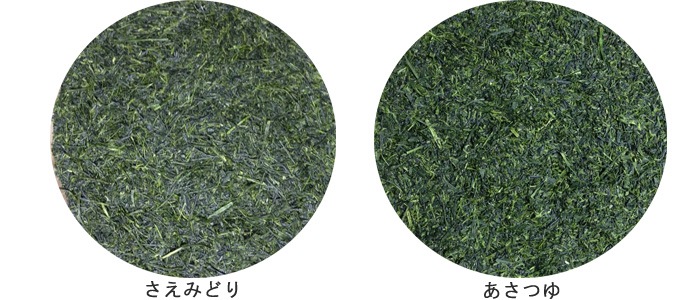
Asatsuyu
Character: dense sweetness, rich umami, low astringency, distinctive cultivar aroma and deep bluish-green liquor. Best for drinkers who like strong cultivar personality.
Saemidori
Character: brighter green, elegant umami, refined aroma and soft mouthfeel. Often feels more polished and delicate than Asatsuyu.
Yabukita
Character: classic Japanese sencha balance, refreshing aroma, umami plus a clearer astringent structure. A useful baseline for cultivar comparison.
Read our dedicated English Saemidori cultivar guide. Saemidori's relationship to Asatsuyu helps explain its vivid color, sweetness and relatively restrained roughness.
Asatsuyu is also a parent of Tsuyuhikari, another cultivar valued for bright color and balanced umami.
“100% Asatsuyu” does not automatically mean high quality
Cultivar names are useful, but they are not quality grades.
A weak Asatsuyu lot can be flat, thin or aromatically dull. The fact that Asatsuyu tends to have low astringency can actually make poor material feel especially empty because there is less briskness to hide the lack of depth.
When evaluating Asatsuyu, check more than the cultivar name:
- Harvest: first harvest usually offers the best chance of concentrated umami and aroma.
- Origin: a clear production area helps establish traceability.
- Shading: short pre-harvest covering can intensify color and umami.
- Steaming: deep steaming often suits Asatsuyu's dense-color character.
- Firing: overly strong firing can hide the cultivar-specific aroma.
- Freshness: poor storage quickly reduces the color and aroma that make Asatsuyu valuable.
The same principle applies across Japanese tea. Our first-harvest vs later-harvest guide explains why harvest season can matter as much as the cultivar name.
Why can deep-steamed Asatsuyu look so broken?
People who are used to beautiful needle-shaped sencha sometimes open a bag of fukamushi Asatsuyu and worry that the leaf is too small or too powdery.
That appearance is not automatically a defect. Longer steaming softens the leaf structure. During later rolling and drying, the leaves break into smaller particles more easily.
Those fine particles also extract quickly, helping create the thick green liquor and full mouthfeel associated with deep-steamed Asatsuyu.
Practical tip: use a kyusu with a fine mesh or a wraparound “obi-ami” filter for fukamushi tea. Very fine filters can clog if you over-steep the tea, so pour promptly and empty the pot completely.
How to brew Asatsuyu
The goal is to preserve the cultivar's sweetness and umami without extracting unnecessary bitterness.
This is a starting point rather than a strict rule. Fukamushi leaf extracts quickly, so taste the tea and adjust according to the particle size and your preferred strength.
For even more sweetness and umami
Try 60–65°C / 140–149°F and extend the steep to roughly 70–90 seconds. Lower temperature suppresses the perception of astringency and makes the sweet, rounded profile easier to notice.
For more aroma and freshness
Raise the water toward 70–75°C / 158–167°F and shorten the steep slightly. This gives the tea a brighter edge without turning it into a harsh brew.
Cold brewing
A useful starting point is 10 g of leaf to 500 ml of cold water, refrigerated for around 2–4 hours. Deep-steamed tea extracts quickly, so check the flavor during the steep rather than assuming longer is always better.
For the general relationship between temperature, umami and astringency, see Best Water Temperature for Japanese Green Tea.
Who is Asatsuyu for?
| You may like Asatsuyu if... | You may prefer another cultivar if... |
|---|---|
| You dislike strongly astringent green tea. | You want a sharp, brisk finish with obvious astringency. |
| You enjoy concentrated sweetness and umami. | You prefer a very transparent, golden shallow-steamed liquor. |
| You like vivid, deep green fukamushi tea. | You dislike fine leaf particles or sediment. |
| You want to compare single-cultivar Japanese teas. | You prefer a neutral, classic sencha aroma over distinctive cultivar character. |
| You enjoy Chiran and Kagoshima green tea. | You mainly want a very forceful roasted or smoky profile. |
Asatsuyu's influence is larger than its acreage
Asatsuyu is not one of Japan's largest cultivars by planting area, but its genetic influence is substantial.
Saemidori, one of today's most important premium cultivars, inherited Asatsuyu as a parent. Tsuyuhikari also uses Asatsuyu in its parentage. Later cultivars descended from Saemidori continue that line of influence.
In other words, Asatsuyu matters not only because people still drink Asatsuyu tea. Its combination of green color, sweetness, umami and low astringency helped shape the breeding direction of later high-quality Japanese cultivars.
Sanrokuen's view
Asatsuyu is one of the easiest cultivars to understand through direct tasting. The color can be dramatic, the sweetness is obvious in good first-harvest material, and the aroma has enough personality to make the cultivar memorable.
At the same time, we would not buy tea simply because “Asatsuyu” is printed on the package. The cultivar has a high ceiling, but quality still depends on the field and the finish.
For readers comparing cultivars, Asatsuyu is especially useful beside Saemidori and Yabukita Kirari 31. The three make the role of genetics and manufacturing much easier to taste.
Frequently asked questions
Is Asatsuyu actually Gyokuro?
No. Asatsuyu is a cultivar. Gyokuro is a tea category defined by cultivation and processing. “Natural Gyokuro” is a nickname that refers to Asatsuyu's rich umami, sweetness and comparatively low astringency.
Does Asatsuyu contain caffeine?
Yes. Asatsuyu is made from Camellia sinensis, so it naturally contains caffeine. The amount in the cup varies with harvest season, cultivation, leaf quantity, water temperature and steeping time.
Why are the leaves sometimes so small?
Deep steaming softens the tea leaf, making it easier for the leaf to break during rolling. Fine particles are therefore common in fukamushi Asatsuyu and do not by themselves mean low quality.
Which is better, Asatsuyu or Saemidori?
Neither is universally better. Choose Asatsuyu for dense sweetness, distinctive aroma and deep green color. Choose Saemidori for more refined sweetness, an elegant aroma and a brighter, polished green appearance.
Is Asatsuyu used for matcha?
Asatsuyu is historically best known as a sencha cultivar, especially for deep-steamed tea in southern Japan. Its relevance to a matcha-focused cultivar library comes mainly from its sensory traits and its importance as a parent of later cultivars such as Saemidori and Tsuyuhikari.
Summary: a historic cultivar with unmistakable sweetness, color and influence
Asatsuyu is a historic Japanese green-tea cultivar registered in 1953 as Tea Norin No. 2. It is known for strong sweetness and umami, comparatively low astringency, deep bluish-green liquor and a distinctive cultivar aroma.
Its nickname, “Natural Gyokuro,” is useful only if understood correctly: it describes the flavor impression, not the tea category.
For the best expression of the cultivar, look beyond the name. First harvest, good field management, appropriate covering, careful deep steaming, restrained firing and fresh storage can all make the difference between an ordinary Asatsuyu and a memorable one.
And if you want to understand why Asatsuyu still matters to modern Japanese tea, compare it with Saemidori. Much of what tea drinkers now value in newer premium cultivars—bright color, low roughness and strong umami—can be traced back to the qualities that made Asatsuyu famous decades ago.
Sources and editorial basis
- Sanrokuen Japanese article: あさつゆとは?天然玉露と称される品種の特徴と魅力
- Kagoshima Prefecture: FY2026 Tea Industry Promotion Data
- Ministry of Agriculture, Forestry and Fisheries of Japan: Tea industry and tea culture data
- Kagoshima Tea Industry Council: Characteristics of Kagoshima Tea
- MAFF: Types of Japanese green tea
- National Diet Library Collaborative Reference Database: Origin and characteristics of Asatsuyu
Sensory descriptions identified as Sanrokuen's view are based on teas handled and evaluated by Sanrokuen. They should not be treated as a universal specification for every Asatsuyu field, harvest or finished product.