How to Brew Japanese Green Tea: Sencha, Fukamushi, Gyokuro & Hojicha
Japanese green tea does not have one universal brewing method. Sencha, deep-steamed sencha (fukamushi sencha), gyokuro and hojicha are all Japanese teas, but the ideal water temperature, steeping time and amount of water can be very different.
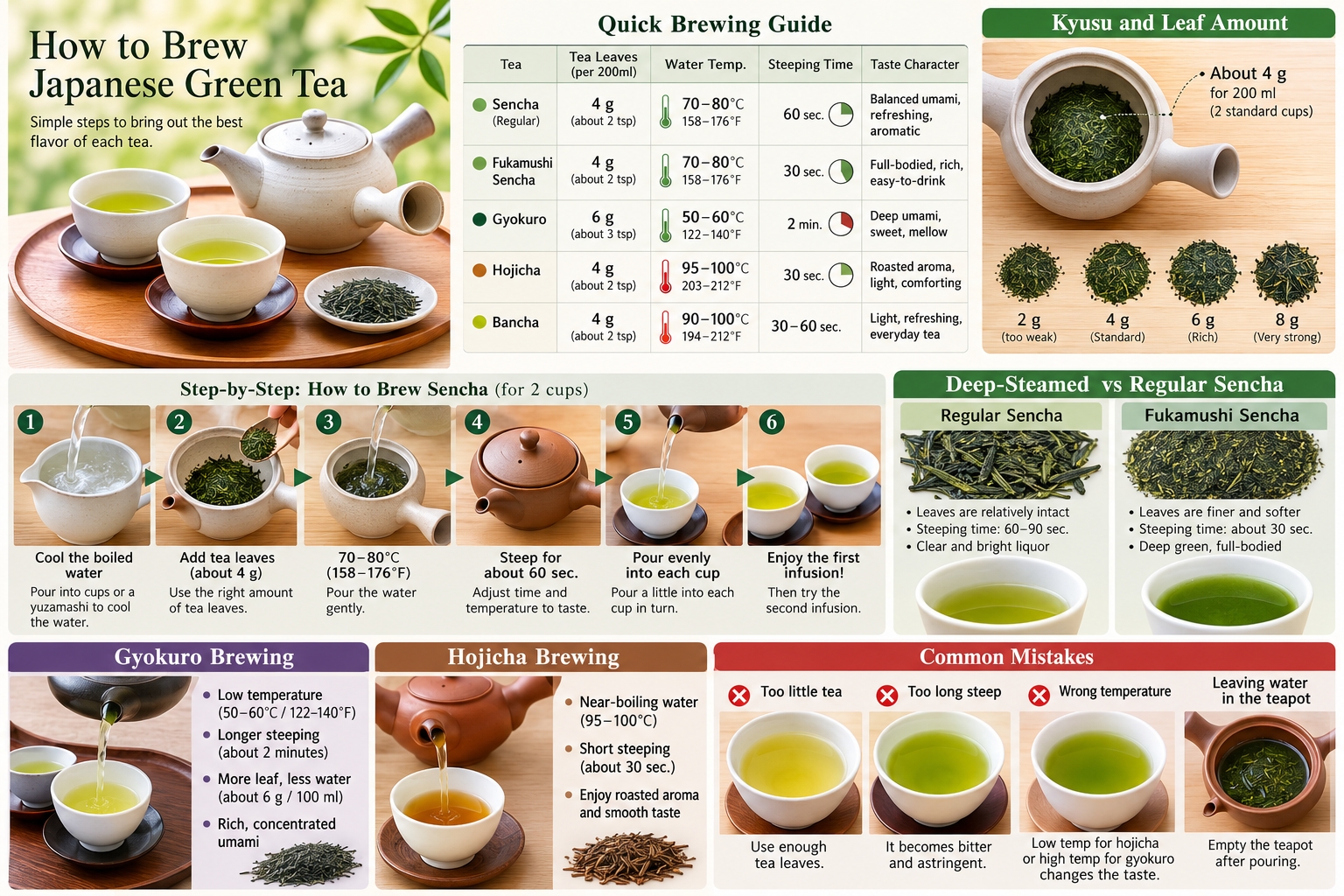
A delicate gyokuro is usually brewed slowly with low-temperature water to emphasize umami. Hojicha, on the other hand, benefits from near-boiling water because high temperature releases its roasted aroma quickly. Deep-steamed sencha also needs a shorter infusion than many standard sencha because its leaves are softer and more fragmented.
This guide explains practical starting points for brewing Japanese tea, based on Japanese tea practice and our experience handling and selling tea in Kumamoto, Japan.
Quick Answer: How Do You Brew Japanese Green Tea?
The most important rule is simple: change the brewing method according to the tea.
| Tea | Tea Leaves | Water | Temperature | Steeping Time |
|---|---|---|---|---|
| Sencha | About 4 g | 200 ml | 70–80°C / 158–176°F | About 60 seconds |
| Premium Sencha | About 4 g | 150–200 ml | 60–75°C / 140–167°F | 60–90 seconds |
| Fukamushi Sencha | About 4 g | 150–200 ml | 70–80°C / 158–176°F | About 30 seconds |
| Gyokuro | About 6 g | About 100 ml | 50–60°C / 122–140°F | About 2 minutes |
| Hojicha | About 4 g | 200 ml | 95–100°C / 203–212°F | About 30 seconds |
| Bancha | About 4 g | 200 ml | 90–100°C / 194–212°F | 30–60 seconds |
These numbers are starting points, not absolute rules. Cultivar, harvest season, leaf size, steaming level, water quality and personal preference all change the result.
If you would like to understand why water temperature changes sweetness, umami, bitterness and astringency, see our detailed guide: Why Water Temperature Changes the Taste of Japanese Green Tea.
If your main question is why one Japanese green tea tastes much more drying or puckering than another, see Why Is Green Tea Astringent? Catechins, Cultivars, Harvests and Smoother Brewing.
The Basic Japanese Method for Brewing Leaf Tea
In Japan, loose-leaf green tea is commonly brewed in a teapot called a kyusu.
You do not need expensive equipment. A kyusu or small teapot, cups, tea leaves, hot water and a timer are enough.
1. Boil fresh water
Start with freshly boiled water. You can then cool it to the temperature appropriate for the tea.
For sencha or gyokuro, the water is often poured first into teacups or a yuzamashi, a Japanese water-cooling vessel. This both cools the water and helps measure the amount needed.
2. Measure the tea leaves
Too little tea is one of the most common reasons Japanese green tea tastes thin.
For two small cups of sencha, about 4 g of leaves is a practical starting point. For gyokuro, more leaf and less water are normally used.
3. Adjust the water temperature
Lower temperatures generally make umami and sweetness easier to notice because bitterness and astringency are more restrained.
Higher temperatures produce stronger extraction and make aroma, bitterness and refreshing astringency more noticeable.
For a detailed explanation of the chemistry and sensory differences, see our Japanese green tea temperature guide.
4. Pour the water over the leaves and wait
Steeping time depends greatly on the tea. A standard sencha may need around one minute, while deep-steamed sencha can often be ready in about 30 seconds. Gyokuro is normally brewed much more slowly.
5. Pour evenly into each cup
If serving several people, do not fill the first cup completely and then move to the next.
Instead, pour a small amount into each cup in sequence, then repeat in the opposite direction. In Japan, this technique is often called mawashitsugi. It helps keep the strength and flavor of each cup similar.
6. Pour out the last drop
Do not leave water sitting in the teapot after the first infusion. Remaining liquid continues extracting the leaves and can make the second infusion unnecessarily strong or bitter.
How to Brew Sencha
Sencha is the most widely consumed style of Japanese green tea.
It can combine fresh aroma, umami, sweetness, bitterness and a refreshing astringency. The best brewing method therefore depends partly on which of these characteristics you want to emphasize.
A balanced starting recipe for sencha
- Tea leaves: about 4 g
- Water: about 200 ml
- Temperature: 70–80°C / 158–176°F
- Steeping time: about 60 seconds
For a high-quality, umami-rich sencha, you can lower the temperature to around 60–75°C and allow a slightly longer infusion.
For an everyday sencha where you want more aroma and refreshing astringency, try somewhat hotter water and a shorter infusion.
Regular Sencha and Fukamushi Sencha Should Not Be Brewed Exactly the Same Way
This is an important point that is sometimes missed in simple Japanese tea guides.
Fukamushi sencha, or deep-steamed sencha, is steamed for longer than regular sencha during production.
The longer steaming softens the leaves. During later rolling and drying, the leaves therefore tend to break into smaller pieces and fine particles. As a result, water reaches the tea material quickly and the infusion becomes strong faster.
| Regular Sencha | Fukamushi Sencha | |
|---|---|---|
| Leaf appearance | Usually more intact and needle-like | More broken leaves and fine particles |
| Extraction | Relatively gradual | Fast |
| Typical temperature | 70–80°C | 70–80°C |
| Typical first infusion | About 45–90 seconds | About 30 seconds |
| Cup appearance | Often clearer | Often deeper green and more opaque |
With fukamushi tea, a long steep can easily produce an unnecessarily heavy cup. Start short, taste it, and adjust from there.
For more on how sencha, gyokuro, matcha, tencha and other teas differ, see our Guide to 28 Types of Japanese Tea.
How to Change the Taste of Sencha
You can change the character of the same tea simply by adjusting temperature and time.
| If you want... | Try... |
|---|---|
| More umami and sweetness | Lower temperature and slightly longer steeping |
| More aroma | Slightly hotter water |
| More refreshing astringency | Hotter water and a relatively short infusion |
| Less bitterness | Lower the temperature or shorten the steep |
| A stronger cup | Use more tea before dramatically increasing steeping time |
There is no rule that says expensive tea must always be brewed at the lowest possible temperature. Brewing is about deciding which character of the tea you want to taste.
Tea Cultivar Also Affects Flavor
Brewing technique matters, but the tea cultivar also changes aroma, umami, sweetness, bitterness and color. Two sencha teas brewed at the same temperature can taste very different if they are made from different cultivars.
For example, cultivars such as Yabukita, Saemidori, Saeakari, Seimei and Tsuyuhikari each have their own characteristics. If you want to understand these differences in more detail, see our Guide to Japanese Tea and Matcha Cultivars.
How to Brew Gyokuro
Gyokuro is very different from ordinary sencha.
The tea plants are shaded before harvest. This cultivation method helps create the concentrated umami, sweetness and distinctive shaded-tea aroma associated with high-quality gyokuro.
Because the goal is usually to emphasize this rich umami while keeping bitterness restrained, gyokuro is traditionally brewed with low-temperature water, a relatively large amount of leaf and a small amount of water.
A practical starting recipe
- Tea leaves: about 6 g
- Water: about 100 ml
- Temperature: 50–60°C / 122–140°F
- Steeping time: about 2 minutes
More concentrated traditional preparations may use even less water.
Gyokuro can taste surprisingly rich and brothy to someone drinking it for the first time. That concentrated character is intentional.
Not all Yame gyokuro is the same
Yame in Fukuoka Prefecture is one of Japan's best-known gyokuro-producing regions.
Within Yame, there is an important distinction between ordinary gyokuro and Traditional Authentic Yame Gyokuro (Dento Hon Gyokuro).
Traditional Authentic Yame Gyokuro is produced under defined traditional conditions, including traditional shading and cultivation practices. The designation should therefore not be treated simply as another name for all gyokuro produced in Yame.
This difference in cultivation also matters when understanding why premium gyokuro can vary so widely in price, aroma, umami and brewing style.
For a deeper explanation of gyokuro, including cultivation, shading, Yame gyokuro and Traditional Authentic Yame Gyokuro, see: What Is Gyokuro? A Detailed Guide to Japanese Shade-Grown Tea.
How to Brew Hojicha
Hojicha is brewed very differently from delicate sencha and gyokuro.
Hojicha is green tea that has been roasted at high heat. The roasting produces its characteristic brown color and warm toasted aroma.
Because aroma is one of the main attractions of hojicha, near-boiling water works well.
A practical starting recipe
- Tea leaves: about 4 g
- Water: about 200 ml
- Temperature: 95–100°C / 203–212°F
- Steeping time: about 30 seconds
Pour the hot water directly onto the leaves, wait briefly and serve.
Unlike gyokuro, there is usually little reason to cool the water extensively before brewing hojicha.
There Is More Than One Type of Hojicha
Hojicha is not a single cultivar or fixed grade of tea.
Different green-tea materials can be roasted to make very different styles of hojicha.
| Raw Material | Typical Character |
|---|---|
| Bancha or mature leaves | Light, clean and suitable for everyday drinking or meals |
| Stems | Often fragrant, sweet and aromatic |
| Sencha | Can retain more tea character beneath the roasted aroma |
| First-harvest material | Can have greater body and sweetness, useful when stronger tea presence is desired |
The roasting level also changes the final aroma and taste.
For more about raw materials, roasting and the different styles of Japanese roasted tea, visit our Hojicha Guide.
What About Hojicha Powder?
Hojicha powder is different from loose-leaf hojicha.
Loose hojicha is infused in water and the leaves are removed. Hojicha powder is finely milled roasted tea, so the tea material itself remains in the drink or food.
It is widely used for hojicha lattes, ice cream, cakes, chocolate and other desserts.
Because milk and sugar can mask a weak tea, the raw material and roasting style that work well for a hojicha latte may be different from those preferred for a light hojicha served with a Japanese meal.
Learn more here: What Is Hojicha Powder? Uses, Taste and How It Is Made.
How to Brew the Second Infusion
Good Japanese green tea can normally be infused more than once.
The second infusion should usually be hotter and much shorter than the first.
During the first infusion, the leaves absorb water and begin to open. By the second infusion they are already wet, so extraction starts almost immediately.
For sencha
A practical second infusion may take only about 10–30 seconds. Use somewhat hotter water than for the first infusion and pour promptly.
After the first infusion
Always empty the teapot completely. You can also slightly move or open the lid after serving so the wet leaves are not continuously steamed inside a closed hot teapot.
Why Japanese Tea Is Often Poured Little by Little
When making tea for several people in Japan, tea is traditionally poured into each cup a little at a time rather than filling one cup completely before moving to the next.
For example, with three cups you might pour:
1 → 2 → 3 → 3 → 2 → 1
This method helps distribute the stronger later part of the infusion between all cups. It is a small technique, but it makes a noticeable difference when serving several people from one small teapot.
Does Water Quality Matter?
Yes.
Most Japanese tap water is relatively soft, and Japanese green tea is generally well suited to soft water.
In areas with very hard water, calcium and magnesium can change the clarity, aroma and perceived taste of delicate green tea.
If your sencha tastes unexpectedly dull or heavy overseas, try brewing the same leaves with a low-mineral bottled water before deciding that the tea itself is poor.
Our detailed temperature guide also explains the relationship between tea and water: Why Water Temperature Changes the Taste of Japanese Green Tea.
Common Brewing Mistakes
Using the same temperature for every Japanese tea
Gyokuro and hojicha are almost opposite examples. One is normally brewed very cool and slowly; the other very hot and quickly.
Steeping fukamushi tea for too long
Deep-steamed leaves extract quickly. Start with about 30 seconds before trying a longer infusion.
Using too little tea
If the cup tastes thin, adding more leaves can often produce a better result than simply steeping the same small amount for several minutes.
Leaving water in the kyusu
This continues extracting the tea and can make later infusions harsh.
Assuming lower temperature is always better
Low temperature is useful when you want to emphasize umami and reduce bitterness, but some teas show their aroma and refreshing character better at higher temperatures.
How Should Beginners Choose a Japanese Green Tea?
Brewing becomes easier once you choose a tea that matches the flavor you actually enjoy.
- Freshness and balance: start with sencha.
- Deep green color and fuller body: try fukamushi sencha.
- Concentrated umami: try gyokuro.
- Roasted aroma and an easy-drinking character: try hojicha.
- A regional Kyushu style: try tamaryokucha or kamairicha.
Japan has many more tea styles than these. For the larger picture, see our Guide to 28 Types of Japanese Tea.
Frequently Asked Questions
Can I brew sencha with boiling water?
Yes. It is not “wrong.” However, boiling water extracts bitterness and astringency quickly, so use a shorter steep if you prefer a balanced cup.
Why does deep-steamed sencha need less time?
Longer steaming softens the leaves and makes them more likely to break during processing. The smaller leaf particles allow water to extract flavor quickly.
Why is gyokuro brewed at such a low temperature?
Gyokuro is valued for concentrated umami and sweetness. Lower-temperature brewing makes these characteristics easier to perceive while limiting strong bitterness and astringency.
Why is hojicha brewed with very hot water?
Hojicha is valued especially for its roasted aroma. Hot water releases that aroma quickly.
How many times can Japanese green tea be brewed?
Sencha and gyokuro are commonly enjoyed for two or more infusions. The second and later infusions are usually hotter and shorter because the leaves are already hydrated.
Do I need a Japanese kyusu?
No. A small teapot with enough room for the leaves to open can work. However, a kyusu is convenient because it is designed for Japanese leaf tea and normally includes a filter suitable for the leaves.
Is matcha brewed the same way?
No. Matcha is powdered tencha suspended directly in water and consumed, rather than leaf tea that is infused and filtered. You can learn where matcha fits among Japanese teas in our Japanese Tea Guide.
In Short
The best way to brew Japanese green tea depends on the tea itself.
- Sencha: moderate temperature for balance.
- Fukamushi sencha: shorter infusion because the leaves extract quickly.
- Gyokuro: low temperature, more leaf and less water for concentrated umami.
- Hojicha: very hot water and a short infusion to release roasted aroma.
Once you understand these differences, brewing Japanese tea becomes much easier. Temperature, time, leaf quantity and water volume are not rigid rules—they are tools you can use to change the cup to suit the tea and your own taste.
If you want to understand the science behind these differences, continue with our guide to how water temperature changes the taste of Japanese green tea.
Sources and Further Reading
- NPO Nihoncha Instructor Association — guidance on brewing sencha, bancha, hojicha and gyokuro
- Ministry of Agriculture, Forestry and Fisheries of Japan (MAFF) — guidance on Japanese green tea and tea production
- Japan Tea Central Public Interest Incorporated Association — information on Japanese tea types and preparation
Brewing recommendations are practical starting points. Results vary with cultivar, harvest season, steaming level, leaf size, storage, water quality and personal preference.
Written by Norifumi Kai, SANROKUEN Co., Ltd.
Sanrokuen is a Japanese tea company based in Kumamoto, Japan. We handle Japanese green tea from selection and finishing to roasting, grinding, retail and business supply. This guide combines established Japanese tea-brewing practice with practical experience handling different styles of Japanese tea.