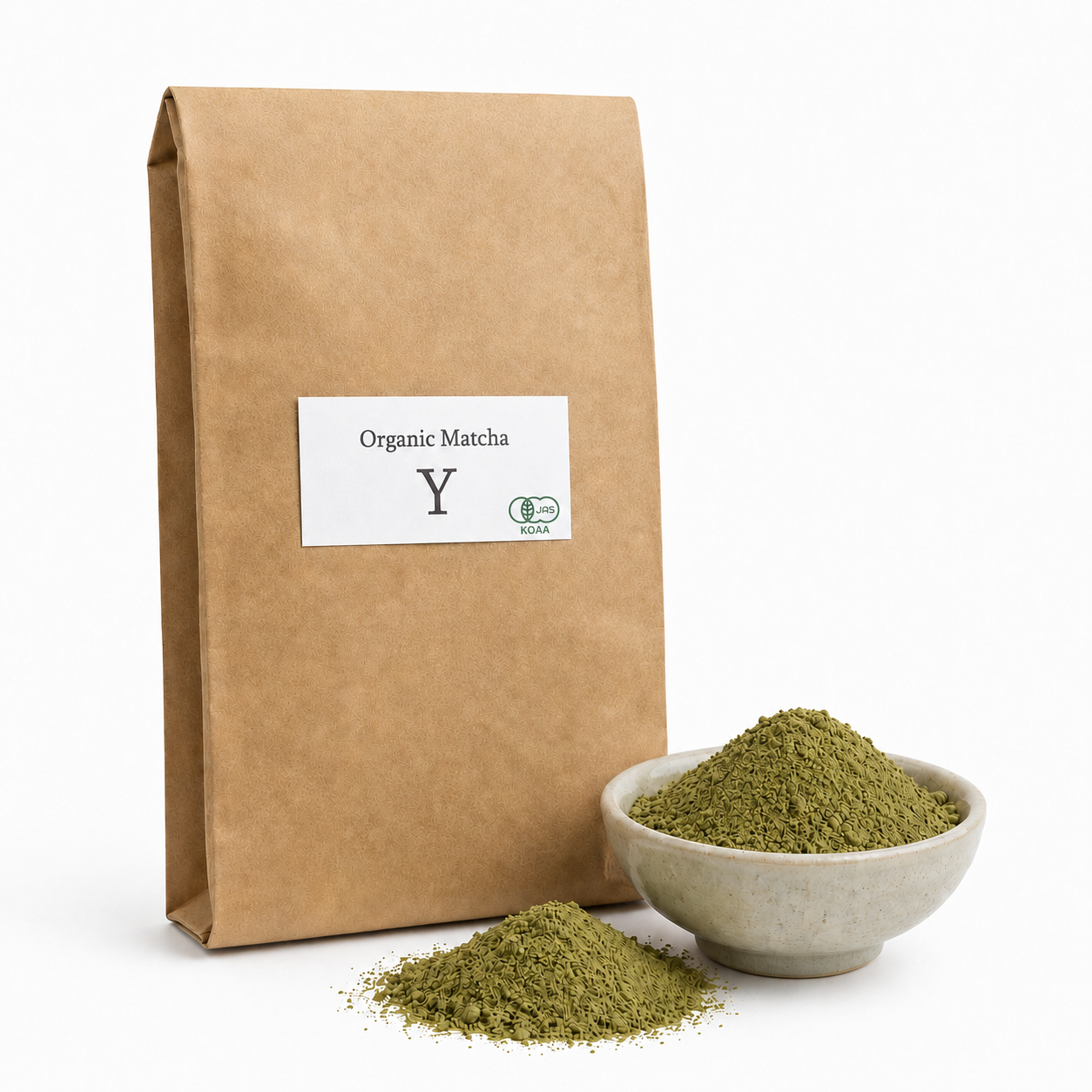
Our objective is simple: make organic matcha easier for businesses to use without reducing it to an anonymous low-quality powder. Organic tea production is costly, and organic matcha has become especially expensive. Organic Matcha Y therefore uses autumn-flush material to improve affordability, but adds a cultivation step—approximately 7 days of shading—to improve the qualities needed for matcha.
Planned 2026 harvest, price and release schedule
Organic Matcha Y is planned as a 2026 autumn-flush organic matcha. Harvest is currently scheduled for October 2026, with commercial release targeted for around November 2026 after harvest and final quality evaluation.
The planned wholesale reference price is JPY 7,500 per kg. The product is packed in 1 kg business-use bags, and the minimum order is one bag.
Because the crop has not yet been harvested, weather and growing conditions may reduce the available volume, and in some cases production may not be possible. Price, release timing, specification and supply volume therefore remain subject to the 2026 crop and final quality evaluation.
Why we developed a business-use organic matcha
Organic matcha is attractive to cafés, retailers and food manufacturers, but the cost of premium organic first-harvest matcha can make continuous commercial use difficult. In many applications, such as lattes, ice cream, baking and cooking, using the most expensive drinking-grade matcha is not economically efficient.
Organic Matcha Y was planned as a more practical alternative: real Japanese organic matcha from Kumamoto, designed around business-use cost and application performance. The lower-cost raw material base comes from autumn-flush tea, but we do not leave the autumn material completely unmodified.
Designed for buyers who need organic matcha in recurring commercial quantities.
Uses later-season organic tea to create a more practical commercial price structure.
The tea is covered before harvest to strengthen green color and umami.
Not just low-cost organic matcha: autumn tea is shaded for about 7 days
Autumn tea is commonly produced without the shading used for higher-grade shaded teas. For Organic Matcha Y, however, the field is intentionally covered for approximately 7 days before harvest.
The purpose is to improve two qualities that matter strongly in matcha: green color and umami. This does not turn autumn tea into premium first-harvest ceremonial matcha, and we do not present it that way. Instead, the goal is to make an organic business-use grade that performs better than simply milling ordinary unshaded autumn tea.
Sanrokuen's approach: affordability should come from designing the grade around its intended use, not from ignoring the quality of the raw material. Even in a value-focused organic matcha, we try to improve the leaf before harvest.
Organic JAS and Japanese origin
Organic Matcha Y is positioned as Japanese organic matcha from Kumamoto.
The product is intended for buyers who require an organic Japanese matcha for commercial use. Certification and export-document requirements can differ by destination market, so buyers should tell us the importing country and required documentation when requesting a quotation.
For overseas buyers, “organic” requirements are not always identical between Japan and the destination country. Please confirm the required certification, labeling, importer requirements and documentation before commercial shipment.
Product specifications
| Product name | Organic Matcha Y |
|---|---|
| Category | Organic Japanese matcha / commercial-use matcha |
| Origin | Kumamoto Prefecture, Japan |
| Certification | Organic JAS |
| Harvest season | Autumn flush — harvest planned for October 2026 |
| Planned release | Around November 2026, after harvest and final quality evaluation |
| Shading | Approximately 7 days before harvest |
| Product concept | A more practical organic matcha for commercial use, with added shading to improve green color and umami. |
| Net weight | 1 kg per business-use bag |
| MOQ | 1 bag (1 kg) |
| Domestic delivery | Shipping is charged separately. Up to 20 bags can be shipped as one parcel within Japan, subject to carrier and destination conditions. |
| Price | Planned wholesale reference price: JPY 7,500/kg. Final quotation will be confirmed after the 2026 harvest and quality evaluation. |
| Recommended applications | Organic matcha latte, café drinks, baking, cakes, confectionery, ice cream, desserts, cooking, food service and food manufacturing. |
| Storage | Store sealed in a cool, dry place away from heat, light and moisture. After opening, reseal carefully and use as promptly as practical. |
| Availability note | Weather and crop conditions may reduce the harvest volume. If growing conditions are unfavorable, production may be limited or may not be possible. |
Final specification, current lot, price, certification documents and export-related documents are confirmed at quotation. Tea is an agricultural product, so color, aroma and flavor may vary by year and lot.
Recommended uses and business applications
Organic Matcha Y is primarily designed for applications where organic positioning is important, but the cost of premium organic drinking matcha would make the finished product difficult to price competitively.
Organic matcha latte
A practical option for cafés and beverage brands that want to offer an organic Japanese matcha latte without relying on very high-cost ceremonial matcha.
Organic desserts
Suitable for ice cream, soft serve, pudding, tiramisu, creams and dairy desserts where both organic positioning and matcha identity matter.
Baking & confectionery
Can be used in cakes, cookies, bread, chocolate, fillings and other products where premium drinking-grade matcha would be unnecessarily expensive.
Cooking & savory food
Can be evaluated for noodles, doughs, sauces, dressings and other foods requiring organic Japanese matcha as an ingredient.
Organic food manufacturing
Suitable for commercial product development where cost, organic documentation and repeat supply must be considered together.
Small commercial trials
MOQ starts at one 1 kg bag, allowing buyers to evaluate the current lot in the actual recipe before moving to larger orders.
Why not use premium organic ceremonial matcha for everything?
Premium organic first-harvest matcha can be excellent for direct drinking, but many of its delicate qualities are reduced once milk, sugar, butter, flour or other ingredients are added. For commercial recipes, the best ingredient is often the one that balances organic certification, Japanese origin, color, flavor, supply and cost.
- Kumamoto-grown organic Japanese matcha.
- Organic JAS positioning for business use.
- Autumn-flush raw material for better cost control.
- Approximately 7 days of shading before harvest.
- Improved focus on green color and umami.
- MOQ of only one 1 kg bag.
Compare Organic Matcha Y with Sanrokuen's other business grades
| Grade | Main concept | Best use |
|---|---|---|
| Business Grade A | Second-harvest Saeakari + first-harvest Yabukita; restrained bitterness and good green color | Premium latte, cafés, desserts |
| Business Grade B | Mainly two-week-shaded second-harvest Saemidori; moderate bitterness + umami | Latte, baking, cooking, food processing |
| Business Grade C | 7-day-shaded Kumamoto autumn tea; farmer-developed value matcha | High-volume food and beverage use |
| Organic Matcha Y | Organic autumn tea shaded about 7 days to improve color and umami | Organic latte, desserts, cooking, organic food manufacturing |
Quality information beyond the word “organic”
“Organic” describes the production standard; it does not by itself guarantee vivid color, high umami or suitability for a specific recipe. That is why Organic Matcha Y is developed with an additional cultivation objective: improve the autumn leaf through short-term shading before harvest.
Related information: Organic Matcha Farming, Kumamoto Matcha, How Sanrokuen Develops Matcha, Kumamoto Matcha Component Analysis, and Japanese Matcha Wholesale.
Start with one 1 kg bag.
Organic Matcha Y is planned at JPY 7,500/kg. The 2026 autumn crop is scheduled for harvest in October, with release targeted for around November after final quality evaluation. Because this is an agricultural product, weather may reduce the available volume and, in some cases, production may not be possible. Once released, buyers can begin with one 1 kg bag. Domestic shipping is charged separately, and up to 20 bags can be shipped as one parcel within Japan.
Frequently asked questions
Why did Sanrokuen develop Organic Matcha Y?
Organic matcha has become very expensive, making premium organic grades difficult to use in large quantities for lattes, desserts and food manufacturing. Organic Matcha Y was developed as a more practical business-use organic matcha from Kumamoto.
What makes it different from ordinary low-cost organic matcha?
The autumn-flush tea is intentionally shaded for about 7 days before harvest. Autumn tea is often produced without shading, so this extra cultivation step is intended to improve green color and umami.
Is it Organic JAS?
The product is positioned as Organic JAS-certified Japanese matcha. Buyers requiring specific certification or export documents should confirm the required documents with Sanrokuen before ordering.
What is the MOQ?
The minimum order is one 1 kg bag. Shipping is charged separately.
What applications are recommended?
Organic Matcha Y is intended mainly for organic matcha lattes, desserts, baking, ice cream, cooking, food service and food manufacturing.
Is this a premium ceremonial organic matcha?
No. Organic Matcha Y is designed primarily for commercial use. Its objective is to provide a more practical organic matcha while improving autumn-tea color and umami through approximately 7 days of shading.
Can overseas buyers inquire?
Yes. Please tell us the destination country, intended use, expected quantity, packaging requirements and required organic or import documents. International freight and compliance costs are quoted separately.
When will Organic Matcha Y be available?
The 2026 autumn crop is planned to be harvested in October 2026, with release targeted for around November 2026 after final quality evaluation.
Can the 2026 supply be guaranteed?
No. Tea is an agricultural product, and the crop has not yet been harvested. Weather and growing conditions may reduce the available volume, and in some cases production may not be possible. Final availability will be confirmed after harvest and quality evaluation.
What is the planned wholesale price?
The planned wholesale reference price is JPY 7,500/kg. The final quotation will be confirmed after the 2026 harvest and quality evaluation.