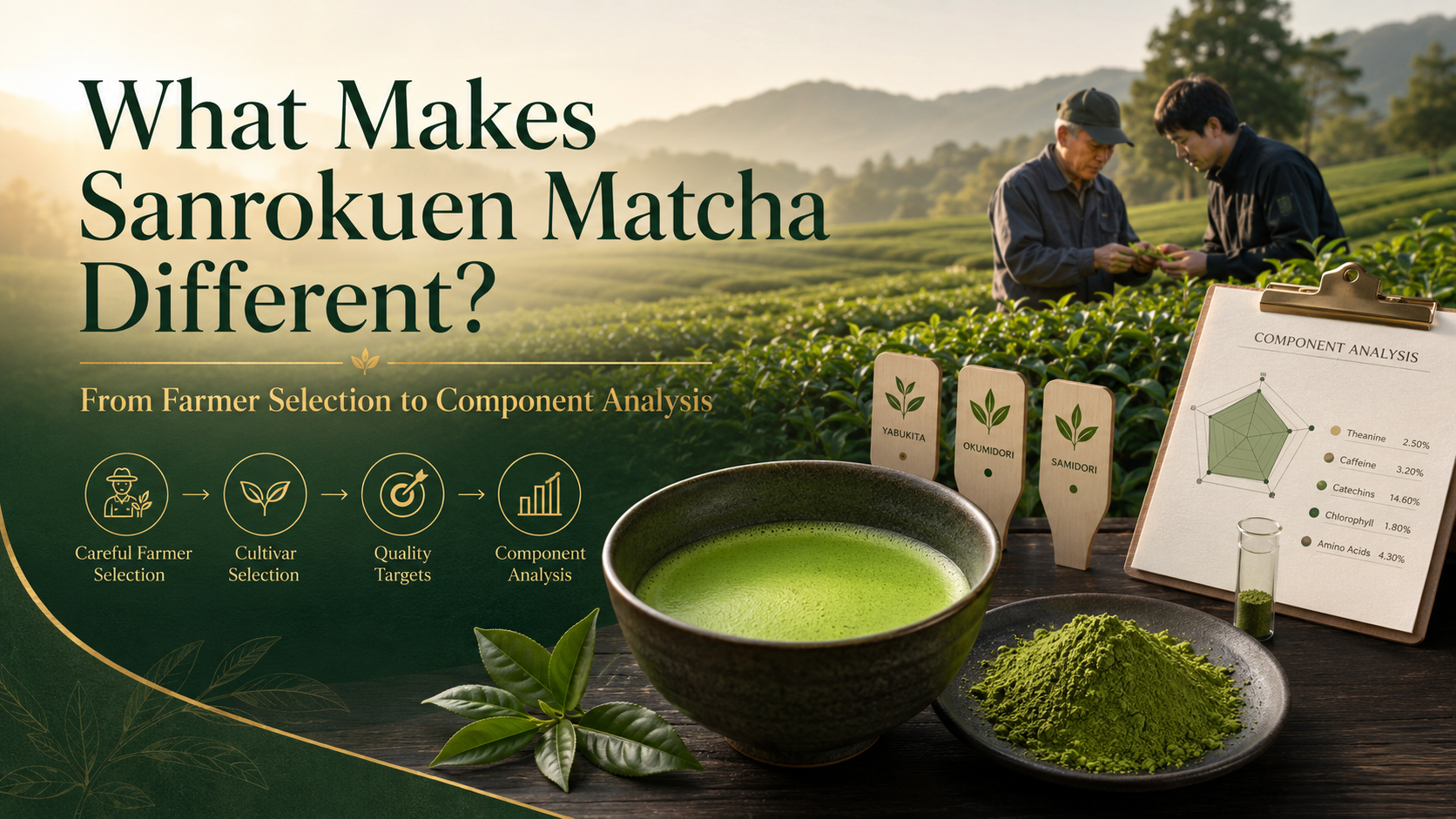
Matcha does not begin at the mill. Cultivar, field, shading, harvest timing, leaf maturity, tencha processing, refining, firing, storage and milling all affect the final powder.
To see why the field stage matters, read our Matcha vs Green Tea guide, which compares open-field sencha, kabusecha, gyokuro and tencha through shading, leaf chemistry, aroma and processing.
There is no single correct way to procure matcha. Skilled merchants can select excellent finished tea from markets and build outstanding products through refining and blending. Sanrokuen adds another layer: we become involved before harvest.
Two valid but different sourcing models
One common Japanese tea-distribution model begins after a farmer or producer organization has made aracha. Tea merchants examine color, aroma, taste and appearance, and purchase suitable lots through auctions, markets or negotiated transactions.
This model offers breadth and flexibility. Sanrokuen's commissioned production begins earlier: we discuss the farmer, cultivar, intended use, field conditions, target quality and purchasing framework before harvest.
| Point | Selection after production | Sanrokuen's commissioned production |
|---|---|---|
| Starting point | Select finished lots | Plan the raw material before harvest |
| Cultivar | Choose from the season's available tea | Select for color, aroma, taste, agronomy and use |
| Growing plan | Evaluate the producer's result | Set targets and discuss the field plan with the farmer |
| Purchasing | Buy selected lots at market or negotiated prices | Purchase the full commissioned volume, with quality-based price tiers |
| Evaluation | Appearance, aroma and taste | Sensory review plus component and color analysis |
| Supply flexibility | Easier to seek substitutes | Limited by the selected farmer, field and annual crop |
Our process
- Select the producerField condition, cultivars, production skill, equipment, communication and continuity.
- Define the applicationStraight matcha, usucha, latte, dessert and food processing require different profiles.
- Select the cultivarSaemidori, Saeakari, Seimei, Tsuyuhikari, Kirari and others have different strengths.
- Set quality targetsShading, harvest timing, leaf maturity, components, color and intended grade.
- Set purchasing conditionsFull-volume purchase of the commissioned tea, with quality-based pricing.
- Test and feed backComponents, color and sensory quality are reviewed and returned to the next field plan.
What the full-volume purchase guarantee means
Sanrokuen purchases the full volume that we commissioned.
If a lot falls below the component or quality targets, we do not reject it. We purchase it as a lower-grade or different-use raw material at a lower price. If a lot exceeds the target and performs especially well in components, color, aroma and sensory evaluation, we may pay a premium and classify it in a higher tier.
The farmer's experience still matters
Sanrokuen does not design cultivation from a desk. Soil, plant age, vigor, climate and equipment differ by field. We present the quality target, while the actual shading, harvest and field plan are discussed with the farmer.
The same cultivar does not become the same matcha in every field. “Who produced it” is part of the raw-material decision.
Why we use component and color analysis
Taste cannot be reduced to a laboratory report. Analysis does, however, make lot differences visible and creates a common language for the next season.
Japanese research has reported that higher-priced matcha tends to contain more theanine, and that measurable green-color indicators help describe matcha characteristics. Total nitrogen and free amino acids are also used as tea-quality indicators.
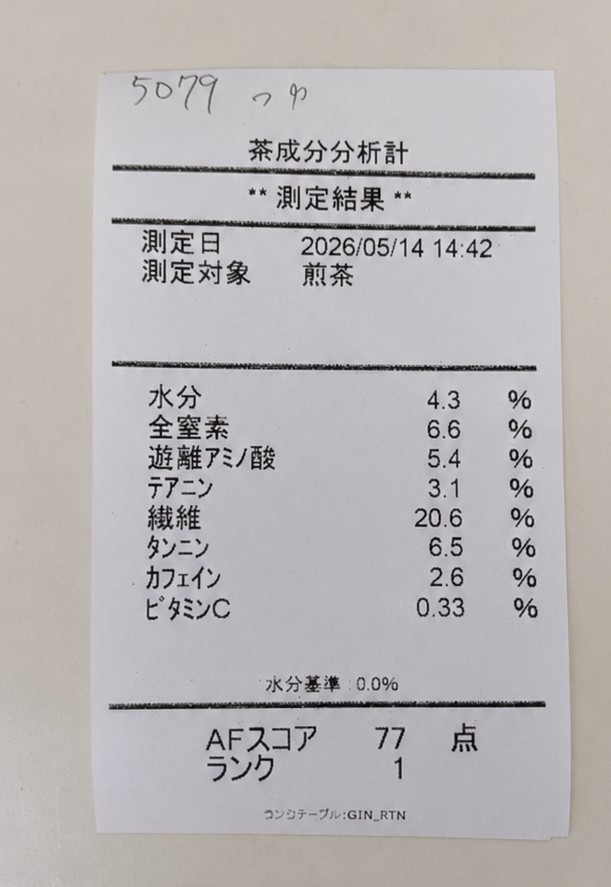
A real example from our quality evaluation
This printout is an actual example from a tea component analyzer used by Sanrokuen. It shows moisture, total nitrogen, free amino acids, theanine, fiber, tannin, caffeine, vitamin C and an AF score.
The numbers help us compare lots and discuss the next production season with the farmer. They do not replace tasting, aroma evaluation or color assessment.
Advantages
- We can explain the farmer, cultivar, quality target and production background.
- We can design toward an application rather than only search for a finished lot.
- The farmer knows that the full commissioned volume has a buyer.
- Exceptional quality can receive a premium.
- Component, color and sensory results can return to the next field plan.
- Cultivar-specific and application-specific products become easier to develop.
The limitations are real
- Weather and crop conditions can reduce expected quantity.
- We cannot rapidly increase exactly the same tea when demand rises.
- Replacing a shortage with unrelated tea would weaken traceability.
- Analysis, trials and communication require time and cost.
- Sanrokuen carries inventory and sales risk because we purchase the full commissioned volume.
A merchant sourcing broadly from the market may have more options for replacement and volume. Our method is not universally superior.
What we do not claim
We are not claiming that every Sanrokuen matcha tastes better than every other matcha. Preference changes with umami, firing, covered aroma, bitterness, color, price and final use.
The process returns to the field
Analysis is not only for grading the finished tea. We ask what the result tells us about cultivar, shading, harvest timing and leaf maturity, then use that feedback when planning the next season.
Matcha development becomes a cycle: producer selection, field planning, harvest, testing, grading, feedback and another season.
Primary references
- MAFF: tea-market negotiated transactions and the market's role.
- MAFF: Uji tea auction and tencha trading.
- NARO: relationship between Japanese matcha prices and chemical components.
- NARO: total nitrogen, free amino acids, tannin and measurable green color.
Descriptions of Sanrokuen's purchasing and production process are based on our actual practice. Measurements are useful indicators, not guarantees of universal sensory superiority.