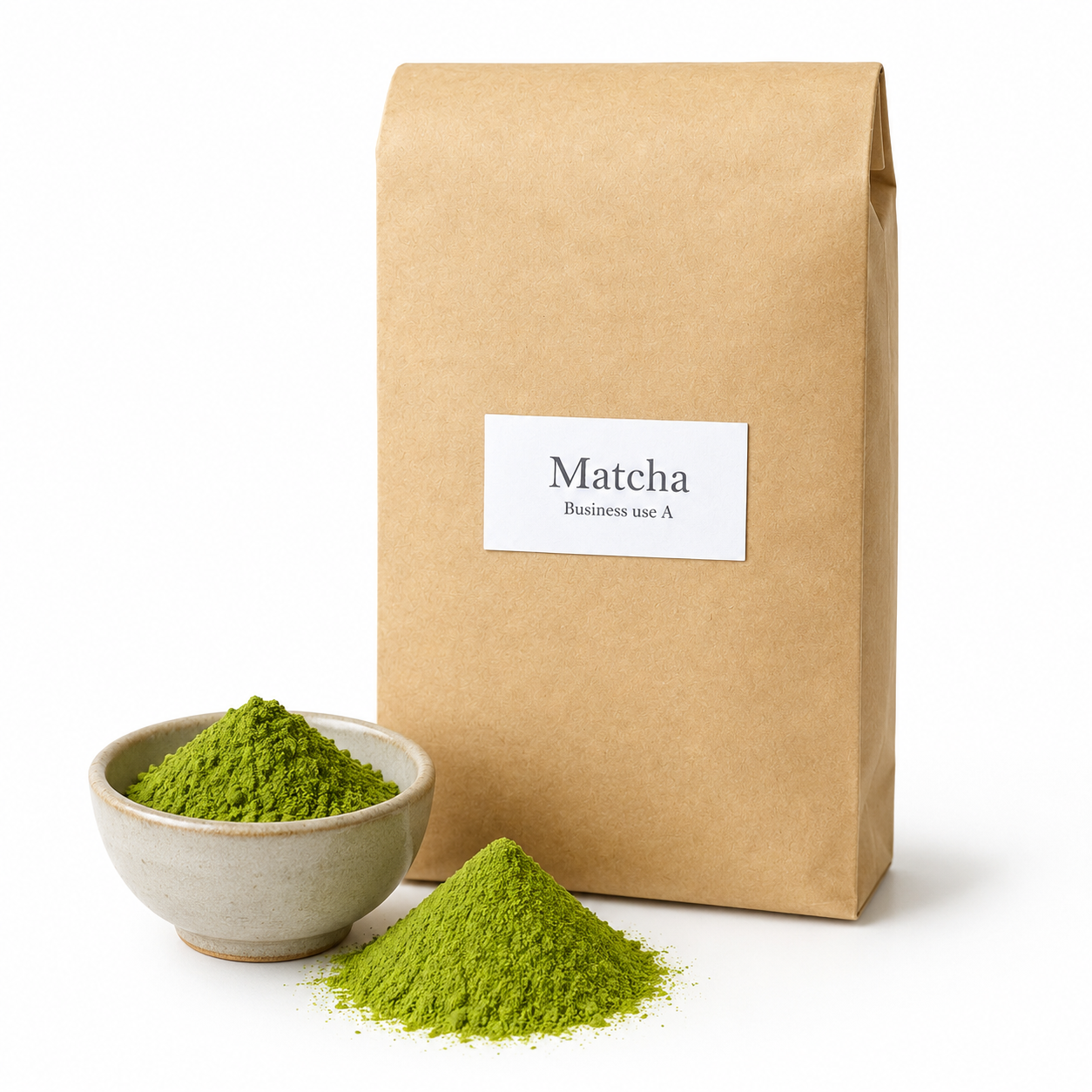
Business Grade A is not designed simply to be the cheapest matcha. It is designed to give commercial users a practical balance of green color, recognizable Japanese matcha character, controlled bitterness and cost. For cafés and food businesses, performance in the final recipe is often more important than cultivar name or ceremonial positioning alone.
Why we blend second-harvest Saeakari with first-harvest Yabukita
Business Grade A combines two different Kumamoto tea materials instead of relying on a single cultivar or harvest. We use second-harvest Saeakari together with first-harvest Yabukita to create a more useful commercial balance. The finished blend is designed to keep bitterness from becoming excessive while preserving a clear matcha-like taste and strong green appearance.
Selected as part of the blend for its useful green appearance and smoothness. The actual contribution depends on the current harvest lot, so we evaluate the finished blend rather than cultivar name alone.
Adds first-harvest material and familiar Japanese tea character to the blend, helping create a fuller and more recognizable matcha profile for commercial use.
Our blending philosophy: the objective is not cultivar purity. We blend to improve the result in the cup or recipe—color, taste, bitterness, body and cost must work together for the buyer's actual application.
Learn more about the cultivars used in this product: Saeakari Matcha Guide and Yabukita Matcha Guide.
Taste, color and practical character
Business Grade A is positioned above a cost-first baking grade. Its purpose is to provide enough green color and tea character to remain attractive after milk, sugar or other ingredients are added, while avoiding unnecessarily strong bitterness.
The profile above is a practical Sanrokuen positioning guide, not a laboratory specification. Agricultural products vary by year and lot. Current color, aroma and taste should be confirmed with the current sample.
Product specifications
| Product name | Business Grade A Matcha |
|---|---|
| Category | Japanese matcha / commercial-use matcha |
| Origin | Kumamoto Prefecture, Japan |
| Cultivars | Saeakari + Yabukita |
| Harvest composition | Second-harvest Saeakari blended with first-harvest Yabukita |
| Net weight | 1 kg per business-use bag |
| MOQ | 1 bag (1 kg) |
| Domestic delivery | Shipping is charged separately. Up to 20 bags can be shipped as one parcel within Japan, subject to carrier and destination conditions. |
| Reference price | From JPY 8,000/kg, EXW factory handover. Current quotation should be confirmed before ordering. |
| Recommended applications | Matcha latte, café drinks, soft serve, ice cream, desserts, cakes, confectionery, blended beverages and food service. |
| Storage | Store sealed in a cool, dry place away from heat, light and moisture. After opening, reseal carefully and use as promptly as practical. |
Final specification, current lot, price and documentation are confirmed at quotation. Matcha is an agricultural product, so color, aroma and flavor can vary slightly by harvest lot.
Recommended uses and serving situations
Business Grade A is most useful when the final product needs both visual green color and a recognizable matcha flavor. It is particularly suitable for cafés, restaurants, confectionery businesses and product-development teams.
Matcha latte
Designed to keep a clear tea character after milk is added. Suitable for hot or iced café drinks where both color and matcha flavor matter.
Soft serve & ice cream
The vivid green appearance and moderate bitterness work well in dairy-based desserts, where delicate matcha can become difficult to notice.
Cakes & confectionery
Suitable for cakes, cookies, sponge, cream, chocolate applications, tiramisu and other products that require a clearly recognizable matcha identity.
Cafés & food service
A practical 1 kg format for cafés, restaurants, hotels and commercial kitchens that need a Japanese matcha with consistent positioning and manageable cost.
Product development
Suitable for trial production of beverages, desserts and processed foods. We recommend testing the current lot in the buyer's actual recipe before full-scale production.
Daily drinking evaluation
It can also be evaluated for everyday whisked matcha, but it is positioned primarily as a commercial grade rather than a premium ceremonial product.
Why Business Grade A instead of ceremonial matcha?
In milk, ice cream, baked goods and desserts, the most expensive drinking-grade matcha is not always the most efficient choice. Delicate aroma and refined umami can be masked by milk, sugar, fat or heat. Business Grade A is designed around final-product performance rather than ceremonial positioning alone.
- Better cost control for recurring commercial use.
- Strong enough green color for drinks and desserts.
- Moderate bitterness rather than an aggressively bitter culinary profile.
- A recognizable Japanese matcha flavor after blending with other ingredients.
- MOQ of only one 1 kg bag, allowing businesses to evaluate the product before larger orders.
Quality evaluation beyond the grade name
“Business Grade A” is Sanrokuen's own practical grade name for buyer communication; it is not a legally defined Japanese matcha grade. We prefer to explain what the actual product is made from, how it tastes, how it performs and what it costs.
Sanrokuen evaluates matcha through color, aroma, taste, bitterness, powder texture and actual-use performance. Depending on the product and lot, our broader quality work also includes component analysis and milling evaluation.
Related technical information: Kumamoto Matcha Component Analysis, Particle Size & Milling, and Japanese Matcha Cultivar Guide.
MOQ is only one 1 kg bag.
Businesses can begin with a small commercial order and evaluate the matcha in their actual latte, dessert or food recipe. Domestic shipping is charged separately. Up to 20 bags can be shipped as one parcel within Japan.
Frequently asked questions
What is the MOQ for Business Grade A?
The minimum order is one 1 kg bag. This makes it possible for cafés, restaurants and product developers to test a commercial quantity before committing to a larger order.
Is shipping included in the price?
No. Shipping is charged separately. For domestic shipments in Japan, up to 20 bags can be shipped as one parcel, subject to the applicable carrier and destination.
What cultivars are used?
Business Grade A is blended from Kumamoto-grown second-harvest Saeakari and first-harvest Yabukita.
Why use both first- and second-harvest material?
The blend is designed around practical performance rather than harvest label alone. Combining the two selected materials helps Sanrokuen balance bitterness, matcha character, green color and commercial cost.
Is it suitable for matcha latte?
Yes. Latte is one of the primary intended uses. The product is designed to retain visible green color and recognizable matcha flavor after milk is added.
Can it be used for cakes and desserts?
Yes. It is suitable for cakes, cookies, creams, tiramisu, ice cream, soft serve and other food-service or confectionery applications. Actual dosage should be tested in the buyer's recipe because sugar, fat and heat affect color and flavor.
Is Business Grade A ceremonial grade?
No. “Business Grade A” is Sanrokuen's commercial-use grade name. It is positioned mainly for cafés, lattes, desserts and food service, while premium ceremonial matcha is selected primarily for drinking quality.
Can overseas buyers inquire?
Yes. Please tell us the destination country, intended use, quantity, packaging requirements and required import documents. International freight and compliance costs are quoted separately.