Particle size is not a decorative specification. It can change mouthfeel, sediment, dispersion, powder flow, dusting, processing behavior and the way matcha performs when whisked or mixed with milk.
For wholesale buyers, the practical question is not simply, “Which mill is better?” It is, “Which particle-size profile is appropriate for my product?”
Sanrokuen’s practical answer: when maximum smoothness and a fine, controlled distribution are the priority, we generally favor cyclone milling. When visible foam and a more traditional whisking response are important, a ball-milled profile may be suitable. This is not a universal rule: the raw material, soluble tea components, preparation method and final recipe also affect foam and sensory performance.
Our measured particle-size results
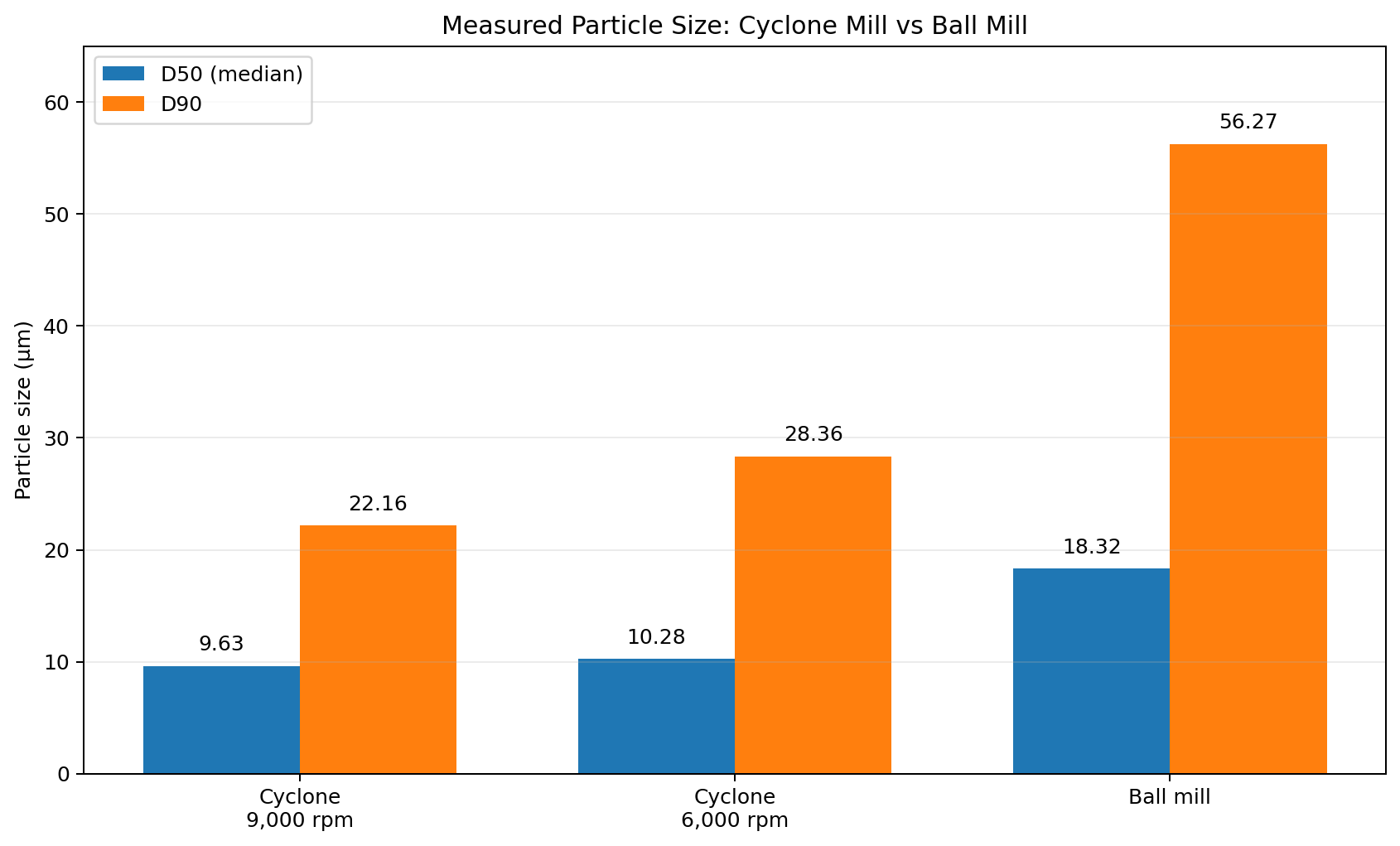
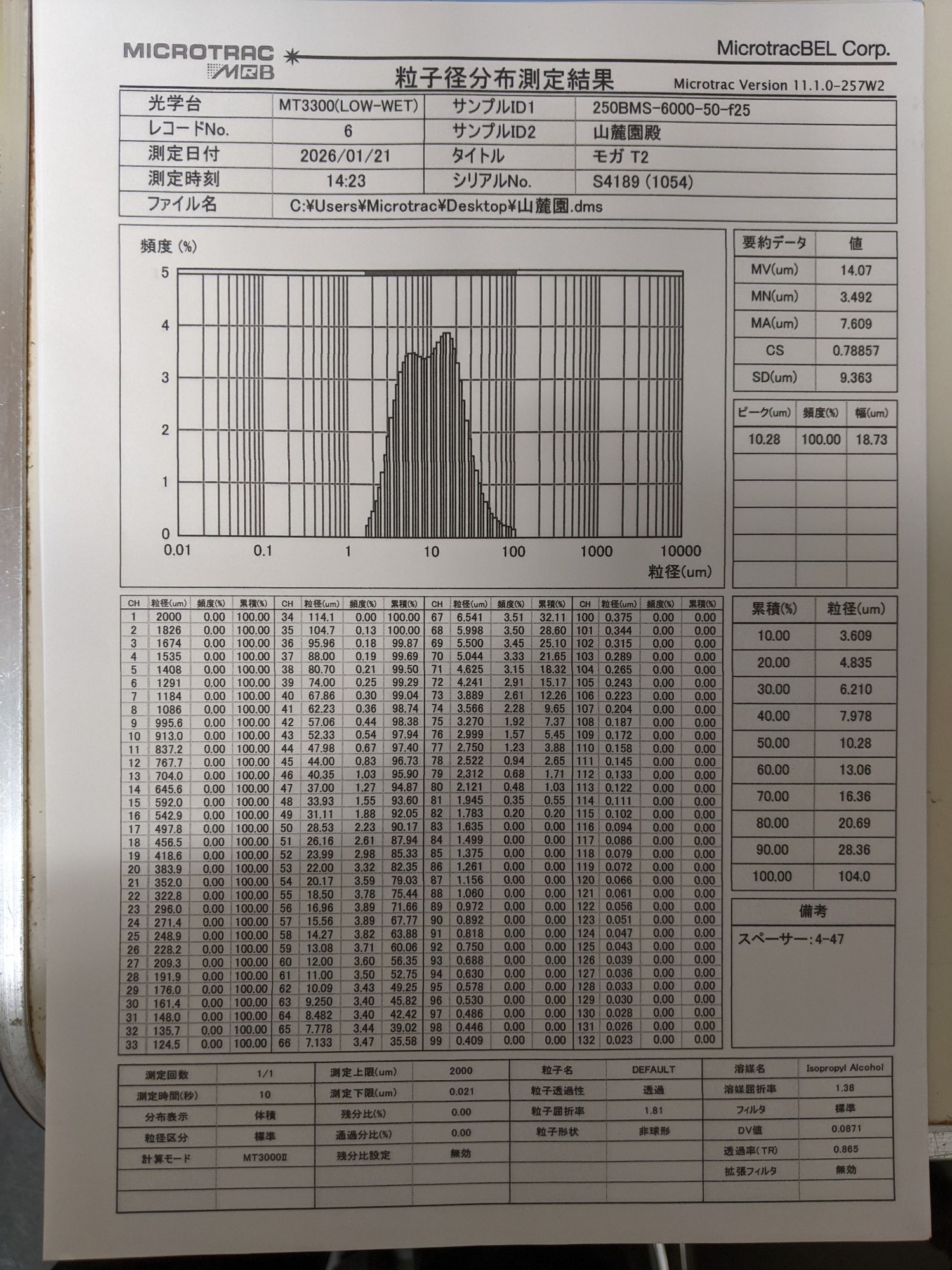
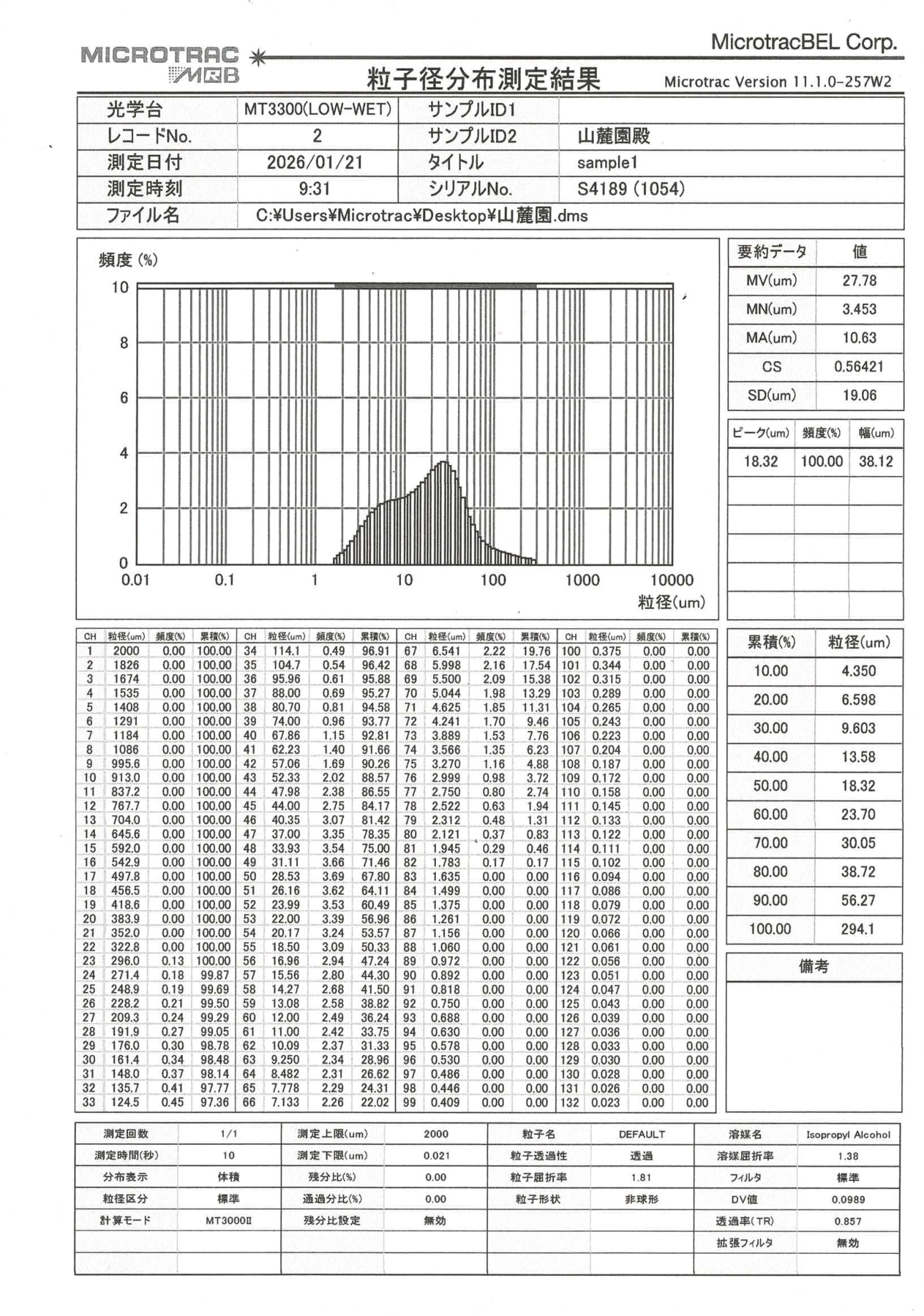
On January 21, 2026, the same tea raw material was divided and processed by three milling conditions: cyclone milling at 6,000 rpm, cyclone milling at 9,000 rpm, and ball milling. All three powders were measured using the same Microtrac MT3300 laser diffraction particle-size analyzer and the same wet-analysis method. Because the raw material was the same, the differences shown below primarily reflect the milling method and operating condition rather than differences in cultivar, harvest or source material.
at 9,000 rpm
at 6,000 rpm
measured sample
| Measured profile | D10 | D50 | D90 | Volume mean | Reported upper end |
|---|---|---|---|---|---|
| Cyclone mill, 9,000 rpm | 3.49 μm | 9.63 μm | 22.16 μm | 11.49 μm | 43.89 μm |
| Cyclone mill, 6,000 rpm | 3.61 μm | 10.28 μm | 28.36 μm | 14.07 μm | 104.0 μm |
| Ball mill | 4.35 μm | 18.32 μm | 56.27 μm | 27.78 μm | 294.1 μm |
The median size of the cyclone-milled samples was close to half that of the ball-milled sample. The difference was even clearer at D90: 22.16–28.36 μm for cyclone milling versus 56.27 μm for ball milling.
Because these powders were produced from the same tea raw material, the comparison provides direct evidence that the cyclone-milling conditions produced a smaller median particle size and a substantially smaller coarse-particle tail than the ball-milled condition in this test. The principal advantage was therefore not only a smaller D50, but also a more tightly controlled fine-powder distribution.
Important limitation: this was a controlled comparison using the same tea raw material, but it still represents one material and one set of test conditions. The results do not guarantee identical particle-size values for every cultivar, harvest, moisture level or production lot. We do not publish all operating parameters because feed rate, material condition, temperature control and detailed machine settings are part of Sanrokuen’s production know-how.
How cyclone milling works
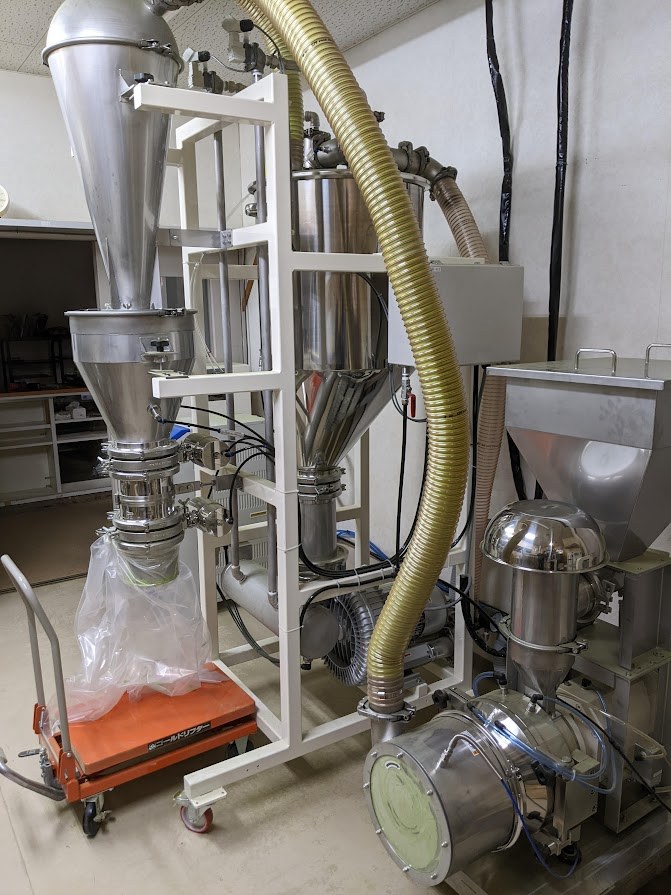
Sanrokuen cyclone milling system
The Japanese-developed cyclone mill uses high-speed airflow, shear, impact and particle-to-particle friction. Centrifugal behavior helps separate larger and finer particles during continuous operation.
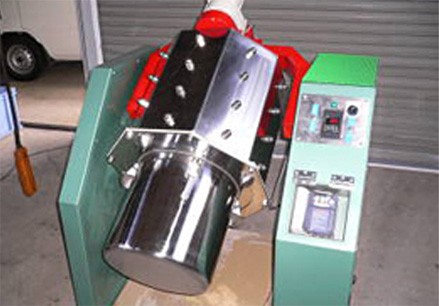
Ball mill
Ball milling reduces particle size through repeated impact and friction from grinding media. It is a proven method and remains useful when the required sensory profile and cost do not demand the narrowest ultrafine distribution.
Reference image supplied by the equipment manufacturer. Confirm publication permission with the rights holder before public use.
The cyclone mill manufacturer describes a dual-impeller system that creates strong fluid shear inside the grinding chamber. The manufacturer also lists broad material compatibility, relatively uniform particle-size distribution, reduced heat generation and comparatively simple cleaning among its features.
At Sanrokuen, the cyclone mill is operated with a chiller-assisted cooling system. Managing temperature during grinding matters because temperature is one of the process variables that can influence the aroma and physical behavior of green tea powder.
- Fine median particle size around 10 μm in the measured samples
- Smaller D90 and fewer coarse particles than the measured ball-milled sample
- Capable of processing firm or hard tea material, not only very soft leaf tissue
- Continuous processing with strong production efficiency
- Cooling support to reduce unnecessary temperature rise during milling
What ball milling offers
A ball mill rotates a chamber containing grinding media. The repeated rolling, impact and friction gradually reduce the tea material. Longer milling generally reduces particle size, but processing time also affects color, bitterness, aroma and manufacturing cost.
Our measured ball-milled sample had a D50 of 18.32 μm and a D90 of 56.27 μm. This is a broader and coarser distribution than the cyclone-milled samples, but “coarser” does not automatically mean “inferior.” A broader distribution may still be suitable for whisked tea, café drinks, baking, chocolate, ice cream and other applications where the complete formula matters more than the smallest possible particle size.
Foam versus smoothness: avoid a simple myth
Buyers often assume that finer powder must always create better foam. Research on matcha foam shows a more complicated picture: foaming involves both soluble tea components and fine tea particles, while foam stability was not explained by particle size alone.
In Sanrokuen’s practical product selection, the ball-milled profile can be considered when visible whisked foam is a priority, while the cyclone-milled profile is selected when smoothness, reduced coarse-particle sensation and fine dispersion are more important. However, this choice must be tested with the actual tea and recipe.
| Buyer priority | Likely starting point | Reason |
|---|---|---|
| Very smooth straight drinking | Cyclone-milled profile | Smaller D50 and D90 can reduce coarse-particle sensation. |
| Premium cold matcha or smooth latte | Cyclone-milled profile | Fine distribution can support smoother suspension and mouthfeel. |
| Visible foam from whisking | Test ball-milled and cyclone-milled samples | Particle size alone does not determine foam; soluble components and preparation also matter. |
| Bakery, chocolate or ice cream | Ball mill may be sufficient | Fat, sugar, flour and heating can reduce the sensory benefit of ultrafine milling. |
| Strict particle-size specification | Cyclone-milled profile | The measured distribution is finer and has a smaller coarse tail. |
Which method fits commercial matcha applications?
Tea ceremony and straight drinking
Smoothness is important, but aroma, raw material, harvest, shading and milling temperature must also be considered. Particle size should support the tea rather than replace raw-material quality.
Café matcha latte
Test the powder in the actual milk, plant milk and serving ratio. A fine powder can improve mouthfeel, while a stronger and slightly broader profile may remain more noticeable through milk.
Bakery and confectionery
Color after heating, flavor strength and cost per batch may be more important than achieving a D50 near 10 μm. Ball milling can be a practical option.
Cold beverages and processed drinks
Dispersion, sediment and production handling become important. A finer and narrower distribution may help, but very fine powder can also increase dusting, adhesion and lump formation.
Why “finer” is not always “better”
Ultrafine powder can improve smoothness, but excessive fineness may create other problems: dust, adhesion to equipment and packaging, reduced flowability, lump formation, moisture sensitivity, lower throughput and higher processing cost.
For this reason, Sanrokuen does not select a grinding method from one number alone. We consider the raw material, aroma, color, bitterness, intended recipe, required volume, particle-size specification and target cost.
Questions wholesale buyers should ask
- Is the quoted particle size D50, mean size, peak size or a maximum specification?
- What is the D90? A median alone may hide a large coarse-particle tail.
- How was the powder measured: dry or wet analysis, and with which instrument?
- Was the actual sale lot measured, or only a development sample?
- How is temperature managed during grinding?
- Has the powder been tested in the buyer’s real application?
- Does the finer powder justify its processing cost in the final product?
Original measurement reports
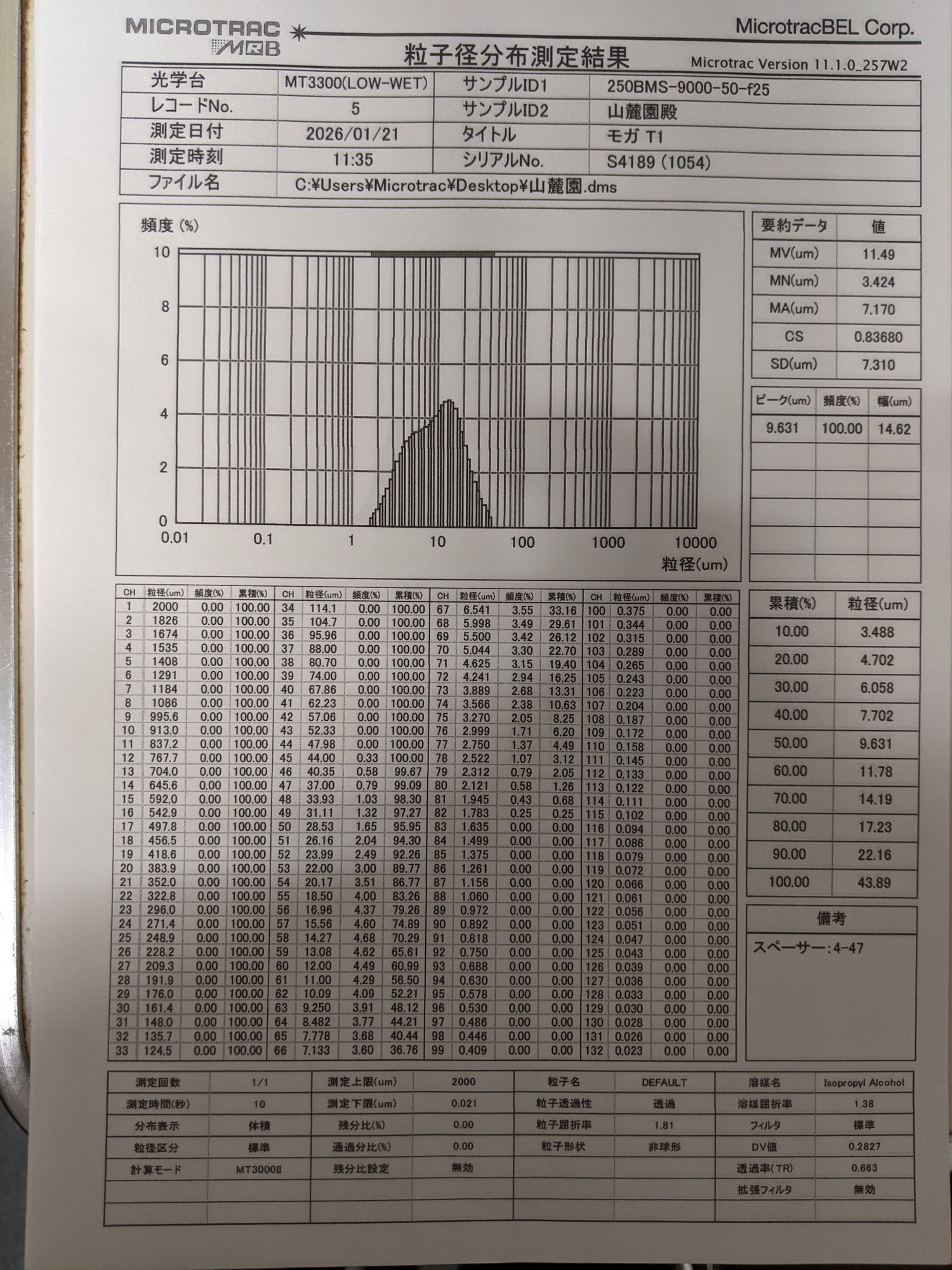
The original Japanese measurement sheets are shown below for transparency. The reports were produced using a Microtrac MT3300 particle-size analyzer. Click an image to view the full report.
Choose the powder for the product—not the label
For business buyers, we recommend testing matcha under the actual serving or manufacturing conditions. Tell us whether the priority is straight drinking, latte strength, smoothness, foam, baking, color, particle-size specification or cost. We can use those requirements to narrow the appropriate grade and milling profile.
Sources and technical references
- Shizuoka Plant — Cyclone mill principle, features, system and particle-size examples
- Shizuoka Plant — Company history and development of cyclone milling equipment
- Sawamura et al. — Foaming Property and Foam Diameter of Matcha Varies with Particle Size
- Zhou et al. — Process parameters and physicochemical and sensory metrics of green tea powder
- Hosokawa Micron — Ball mill grinding principle
- Hosokawa Micron — Why particle-size targets must balance mouthfeel, flow, adhesion and processing efficiency
Sanrokuen’s measured values are specific test results and are not universal specifications for all products or production lots.