Sanrokuen manufactures and sells organic matcha in Kumamoto, Japan. When buyers ask us about organic matcha, one of the most common areas of confusion is the meaning of the word organic itself.
Does organic mean that no pesticide can ever be used? Does it mean that farmers do not use fertilizer? And how can a buyer know what actually happened in a tea field?
Rather than answering those questions only with general explanations, this page looks at real Japanese organic certification and farm production documents.
The 2025 cultivation record shown on this page is a real record from an organic tea farm in Kumamoto, but it is not the production record for a specific Sanrokuen matcha product or lot.
The recorded cultivar is Saeakari. We use the document here as a real-world example of how organic Japanese tea cultivation is recorded and managed.
Names, detailed addresses, certification numbers, field numbers and other identifying information have been masked.
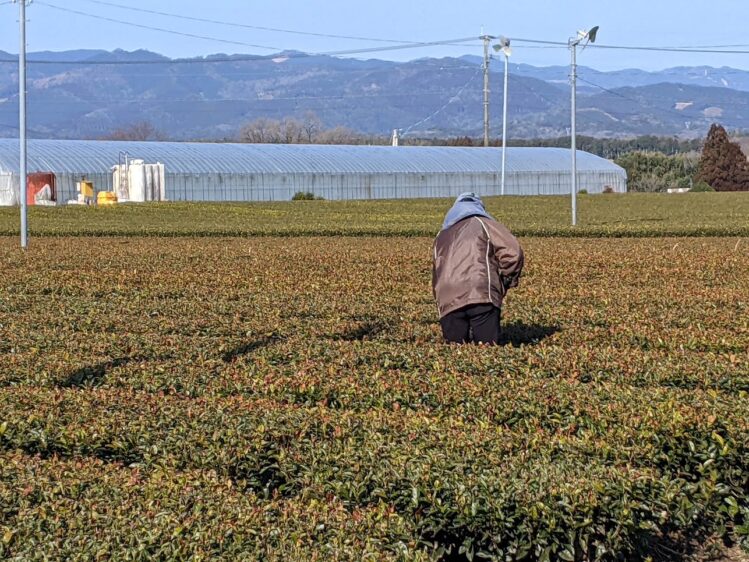
What does “organic matcha” mean in Japan?
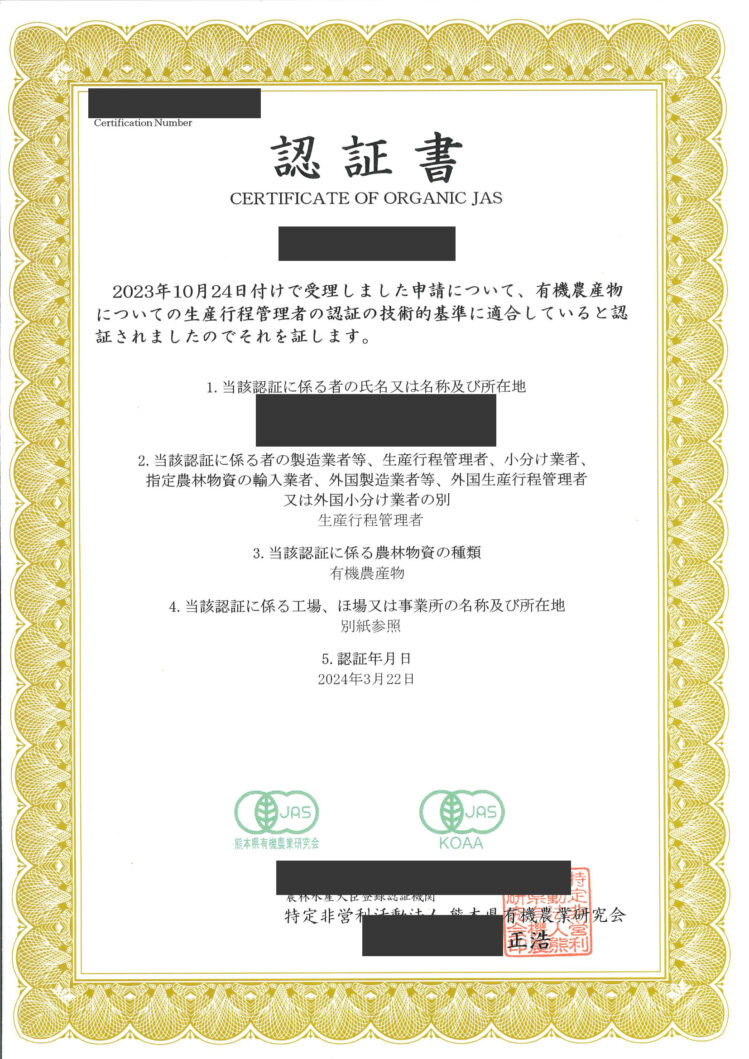
In Japan, organic agricultural products are governed by the Organic JAS system.
Japan's Ministry of Agriculture, Forestry and Fisheries (MAFF) states that organic plant production is based on maintaining the natural cyclical function of agriculture while avoiding the use of chemically synthesized fertilizers and agricultural chemicals.
Organic JAS is therefore much more specific than the simple idea that “organic means absolutely no agricultural chemicals under any circumstances.”
MAFF also states that the Organic JAS logo can be applied only by certified business entities that verify that organic foods are produced in compliance with JAS.
Official reference: MAFF — Organic JAS
Can pesticides be used in Organic JAS farming?
The current Organic JAS standard provides a useful answer.
Pest and disease control in the field must first be carried out using cultural control, physical control, biological control, or a combination of these methods.
However, if harmful organisms cannot be controlled effectively using those methods and there is an imminent risk of significant crop damage, agricultural chemicals listed in the Organic JAS standard may be used.
This means that:
- Organic JAS is not identical to a blanket “pesticide-free” claim.
- Farmers cannot simply use any conventional agricultural chemical.
- Non-chemical control methods are the basic approach.
- Only agricultural chemicals permitted by the standard may be used when the specified conditions are met.
This distinction is especially important for international matcha buyers because “organic,” “pesticide-free,” and “no pesticide detected” are different statements.
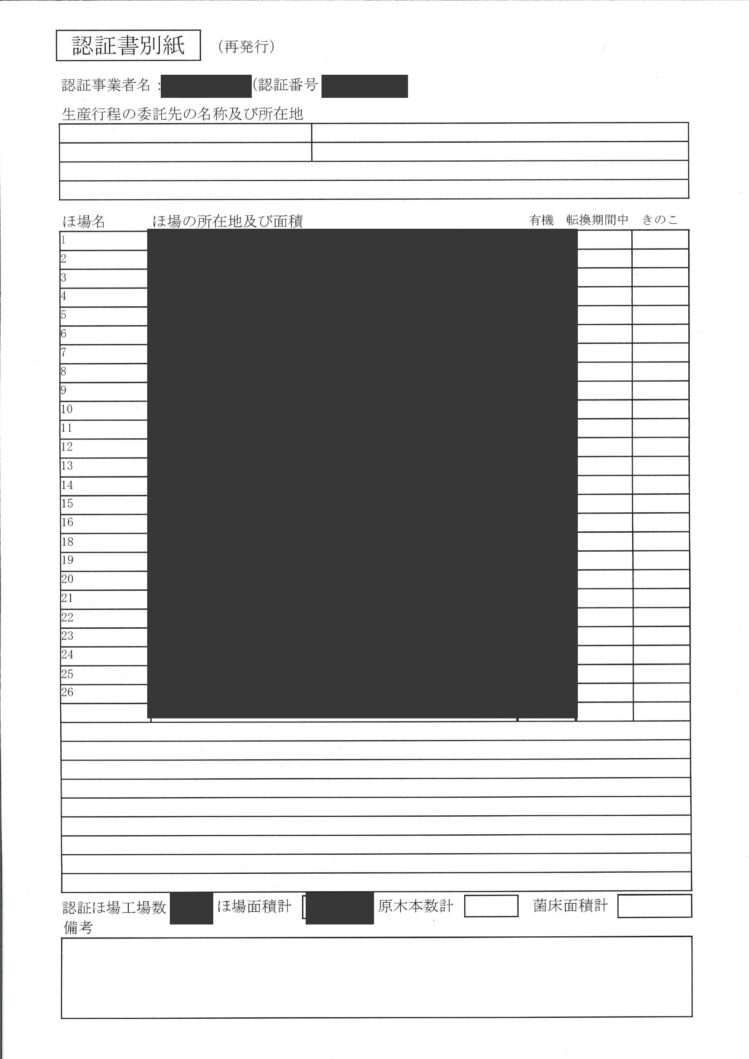
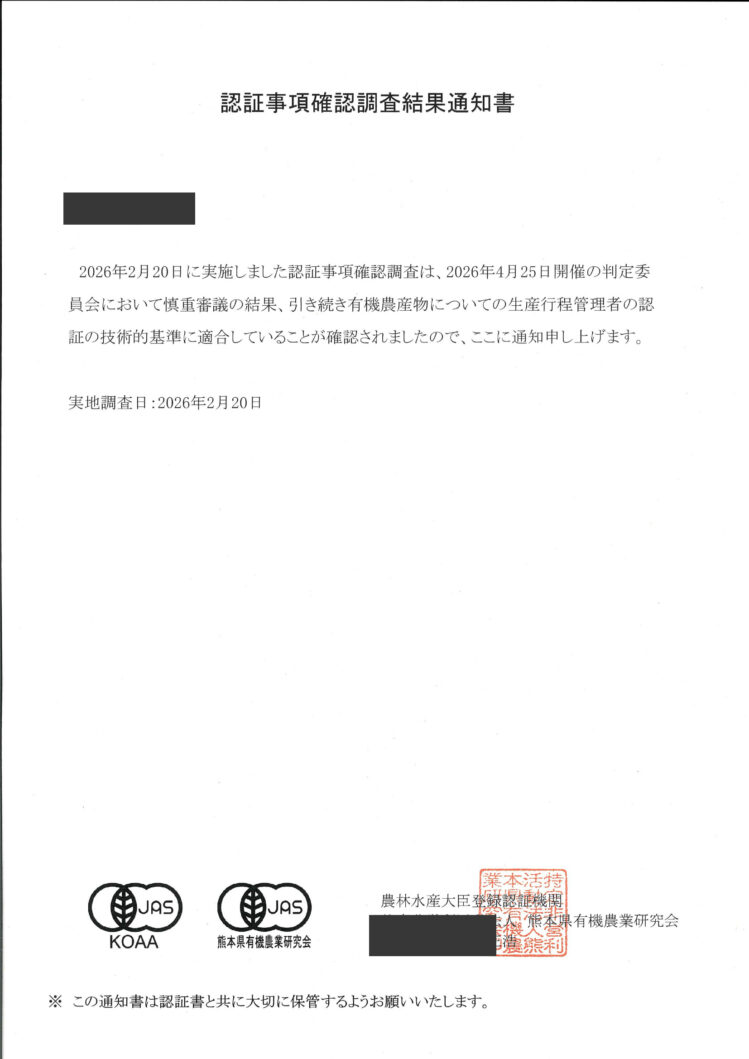
Actual Organic JAS certification documents
The following are actual Organic JAS certification-related documents provided in connection with the organic tea producer.
Personal names, detailed addresses, certification numbers and other information that could identify the producer or individual fields have been masked before publication.
A real 2025 organic tea production record
Certification tells us that the producer is operating within an organic certification system. A farm production record gives us a different kind of information: what was actually recorded during cultivation.
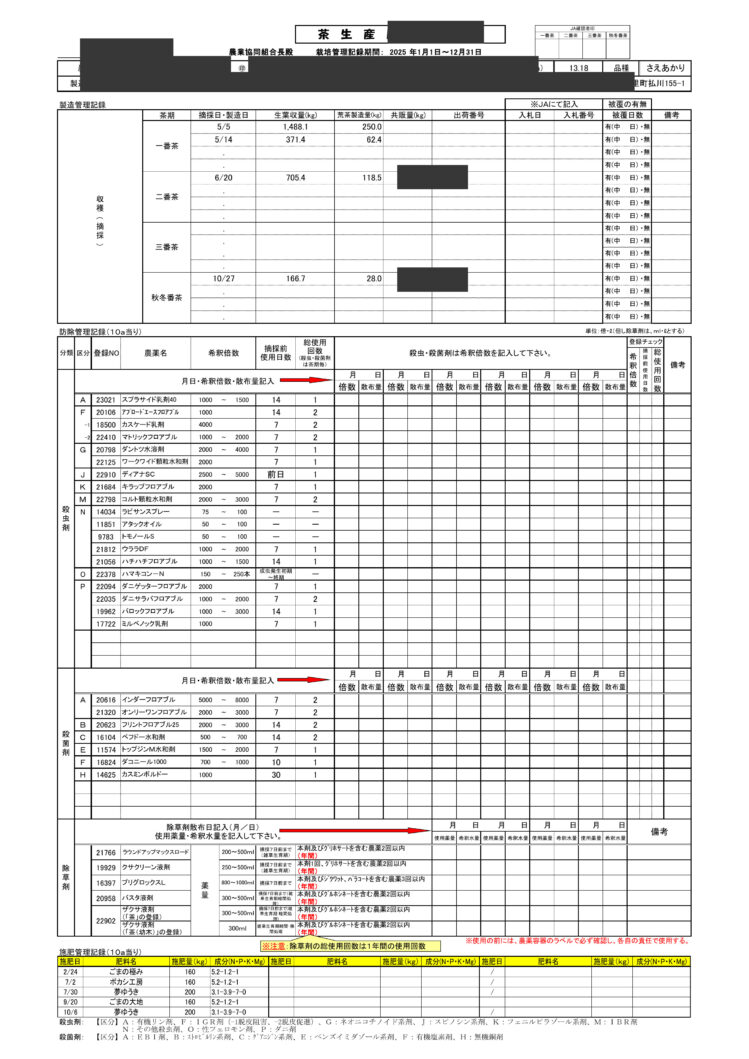
Why are so many pesticide names printed on the document?
This is one of the most useful parts of the record for people who are not familiar with Japanese agricultural documentation.
Looking at the form, you can see the names of numerous insecticides, fungicides and herbicides.
No.
The names are printed on the form as part of the standard record-keeping format. The presence of a pesticide name on the sheet does not, by itself, mean that the pesticide was applied to this crop.
When a pesticide is actually used, information such as the following is recorded:
- application date
- agricultural chemical used
- dilution rate
- application volume
- number of applications
- required interval before harvest
In the 2025 production record shown here, the pesticide-application fields are blank.
Based on this document, we found no recorded application of insecticides, fungicides or herbicides for the documented 2025 production period.
The agricultural chemical names printed on this general tea production record should not be interpreted as a list of agricultural chemicals approved for Organic JAS production.
The record form and the Organic JAS permitted-substance rules are separate matters.
A second farm-management record supports the same picture
We also examined a separate production process management record for the same organic tea cultivation.
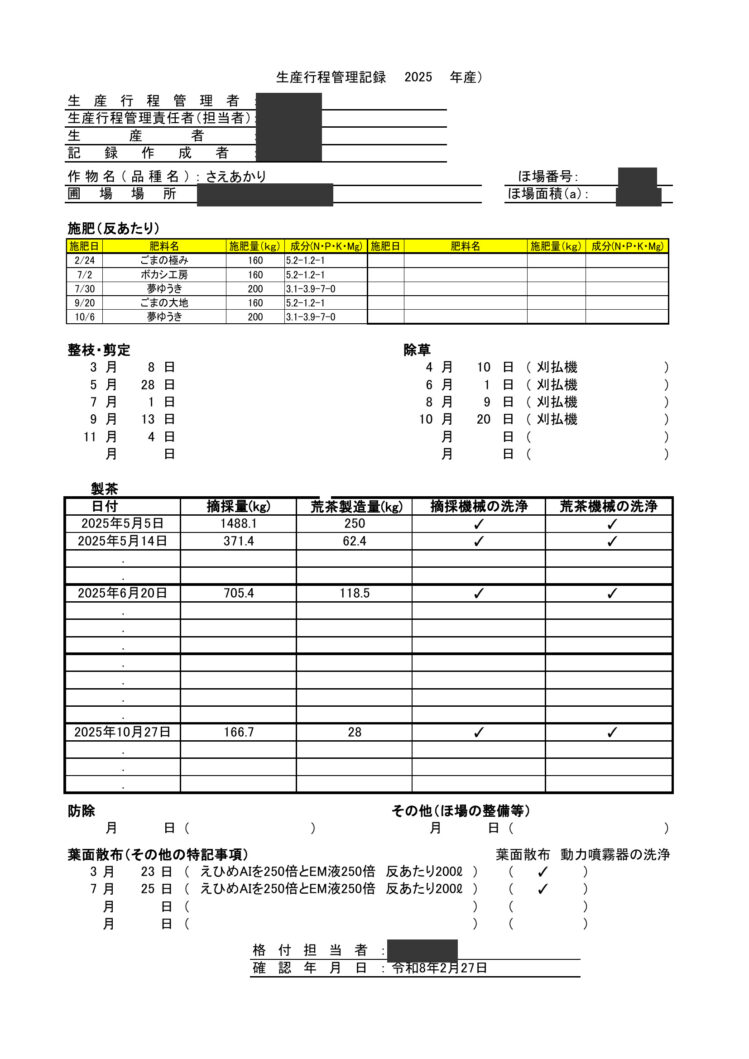
This document records several different types of farm activity, including:
- fertilization
- pruning and field maintenance
- weed control
- harvesting and tea processing
- pest and disease control
- foliar application
The pest- and disease-control section again contains no recorded pesticide application.
But the rest of the document makes something equally important clear: organic farming does not mean that the farmer simply leaves the tea field alone.
How were weeds controlled?
Weed control is a good example.
The farm-management record shows four separate weed-control operations during 2025.
| Date | Recorded method |
|---|---|
| April 10 | Brush cutter |
| June 1 | Brush cutter |
| August 9 | Brush cutter |
| October 20 | Brush cutter |
In other words, weeds were mechanically cut four times during the year rather than being recorded as treated with herbicide.
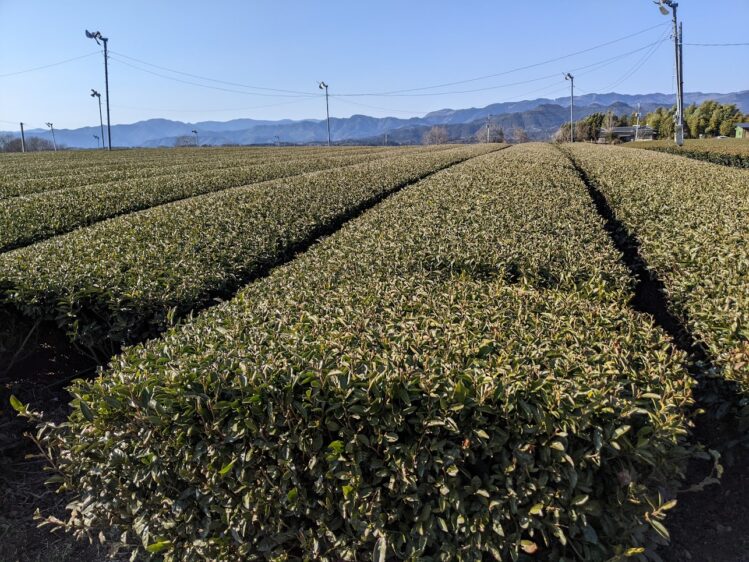
This illustrates one practical aspect of organic cultivation: when certain chemical inputs are avoided, mechanical or manual work may take their place.
Does organic tea farming use fertilizer?
Yes.
Organic tea farming does not mean growing tea without nutrients. Tea is a perennial crop and maintaining soil fertility is an important part of long-term tea production.
The 2025 management record contains five fertilizer applications.
| Date | Fertilizer name recorded | Application per 10a |
|---|---|---|
| February 24 | ごまの極み | 160 kg |
| July 2 | ボカシ工房 | 160 kg |
| July 30 | 夢ゆうき | 200 kg |
| September 20 | ごまの大地 | 160 kg |
| October 6 | 夢ゆうき | 200 kg |
10a means 10 ares, or 0.1 hectare. Japanese product names are reproduced as they appear in the original production record.
The important point is not the trade name of each fertilizer. Organic JAS suitability cannot be determined from a product name alone. The ingredients, manufacturing method and applicable standard must also be considered.
What the record clearly demonstrates is that organic tea cultivation still involves active soil and nutrient management.
Other field-management activities were recorded
The farm record also includes two foliar applications:
- March 23 — Ehime AI diluted 250 times and EM solution diluted 250 times, 200 L per 10a
- July 25 — Ehime AI diluted 250 times and EM solution diluted 250 times, 200 L per 10a
These entries appear in the section for foliar application and other special notes, rather than in the pesticide-control section.
We list them here simply because they appear in the actual production record. This article does not make a claim regarding the effectiveness of these materials.
What did the 2025 record actually show?
| Management activity | 2025 record |
|---|---|
| Pesticide-based pest and disease control | No application recorded |
| Herbicide application | No application recorded |
| Mechanical weed control | 4 operations with a brush cutter |
| Fertilization | 5 applications |
| Foliar application | 2 applications |
| Pruning / field maintenance | Multiple operations recorded |
This is a useful real-world example because it shows why “no recorded pesticide application” does not mean “nothing was done in the field.”
Organic tea still requires labor, soil management, weed control, pruning, harvesting and documentation.
Does this prove that all organic matcha is pesticide-free?
No.
This is one organic tea field in one production year. It cannot be generalized to every Organic JAS farm or every organic matcha in Japan.
The Organic JAS standard itself allows agricultural chemicals listed in its permitted table when cultural, physical and biological control methods cannot effectively prevent an imminent risk of significant crop damage.
It is therefore more accurate to distinguish between:
- Organic JAS certified — production is managed under the applicable Japanese organic standard.
- Pesticide-free cultivation — a separate statement about whether pesticides were used during a defined production period.
- Residue testing — laboratory analysis of whether specified pesticide residues are detected in a sample.
Why this matters when sourcing organic matcha from Japan
For a consumer, the word “organic” may be enough to make a purchase decision.
For an importer, cafe, distributor, specialty retailer or food manufacturer, it is often useful to ask more detailed questions.
- What is the country and region of origin?
- Is the raw material actually tencha if the product is sold as matcha?
- Is organic certification available for the relevant product and supply chain?
- Are production and processing records maintained?
- What cultivar and harvest period are used?
- What laboratory tests or product specifications are available?
- Can the supplier explain the difference between certification, cultivation records and residue testing?
- Can the supplier provide the documentation required by the destination market?
A certificate is important, but a buyer can understand a product more clearly when certification is supported by traceability, production records and realistic product information.
From an organic tea field to organic matcha
There is another important distinction.
The cultivation record shown above is an organic tea farming example. Matcha itself must be made from tencha—shade-grown tea that is steamed and dried without the rolling process used for sencha or tamaryokucha—before being finely milled.
This is why Sanrokuen distinguishes true matcha from ordinary Japanese green tea powder throughout our English website.
For an organic matcha product, organic control also matters after harvest, during the relevant handling and processing stages.
The reliability of organic matcha therefore begins in the field, but it does not end there.
Sanrokuen Organic Matcha from Kumamoto
SANROKUEN Co., Ltd. is a Japanese tea company in Kumamoto. We manufacture and sell Japanese matcha, including organic matcha, and work with tea producers on origin, cultivar, tea quality and practical product use.
Hirakawa no Mukashi — Organic Kumamoto Matcha
Our premium organic Kumamoto matcha Hirakawa no Mukashi is made from 100% organic Seimei tencha.
It is positioned primarily for premium drinking, specialty retail and buyers looking for an organic Japanese matcha with a clearly explained origin and raw-material identity.
Organic matcha for wholesale and business use
Organic matcha availability can vary by harvest, current lot, quantity and reservation status.
For cafes, importers, retailers, distributors and food businesses, please tell us:
- destination country
- intended use
- estimated order quantity or monthly volume
- preferred package size
- whether organic documentation is required
- any laboratory tests or import documents required by your importer
We can then discuss the current product, sample options and realistic supply conditions.
Japanese Matcha Wholesale Information
Frequently asked questions
Is organic matcha completely pesticide-free?
Not necessarily. Organic JAS prioritizes cultural, physical and biological pest-control methods. If these methods cannot effectively control pests and there is an imminent risk of significant crop damage, certain agricultural chemicals listed in the Organic JAS standard may be used.
Were pesticides used on the farm shown on this page?
In the 2025 cultivation documents presented here, we found no recorded application of insecticides, fungicides or herbicides during the documented period.
Why are pesticide names printed on the farm record?
They are part of the pre-printed record format. Their presence does not mean that they were used. Actual applications are recorded with information such as application date, dilution rate and application volume.
Does organic tea farming use fertilizer?
Yes. Organic farming still requires soil fertility management. Fertilizers and soil-improvement substances may be used when they satisfy the applicable Organic JAS requirements.
Is this the production record for Sanrokuen's Hirakawa no Mukashi matcha?
No. The record shown here is from an organic Saeakari tea field and is used as an actual example of Japanese organic tea farm management. It should not be interpreted as the cultivation record of a particular Sanrokuen matcha product or lot.
Does Sanrokuen supply organic matcha to overseas buyers?
Organic matcha can be discussed for overseas and business customers, subject to current availability, quantity, destination, shipping arrangement and required documentation. Please contact us with your country and intended use.
Conclusion: organic is a production system, not just a marketing word
Organic matcha is often discussed in simple terms: organic or conventional, pesticide or no pesticide.
Actual tea production is more detailed.
The real 2025 organic tea records examined here show no recorded pesticide or herbicide application, but they do show repeated mechanical weed control, fertilizer applications, foliar applications and other field-management work.
That does not mean every organic tea farm follows exactly the same practices.
What it demonstrates is why certification and actual production records provide a more useful picture than assumptions about the word “organic.”
For buyers sourcing Japanese organic matcha, understanding the difference between organic certification, field records, product specifications and laboratory testing can help make supplier evaluation more meaningful.
Sources & related pages
- Ministry of Agriculture, Forestry and Fisheries of Japan — Organic JAS
- Japanese Agricultural Standard — Organic Products of Plant Origin
- Hirakawa no Mukashi — Organic Kumamoto Matcha
- Sanrokuen Japanese Matcha
- Wholesale Japanese Matcha & Green Tea Powder
- Japanese article — 有機栽培では農薬を使う?肥料は?実際のお茶の生産履歴で検証
The farm documents reproduced on this page were supplied to Sanrokuen. Personal information and details that could identify the individual producer or field have been masked before publication.