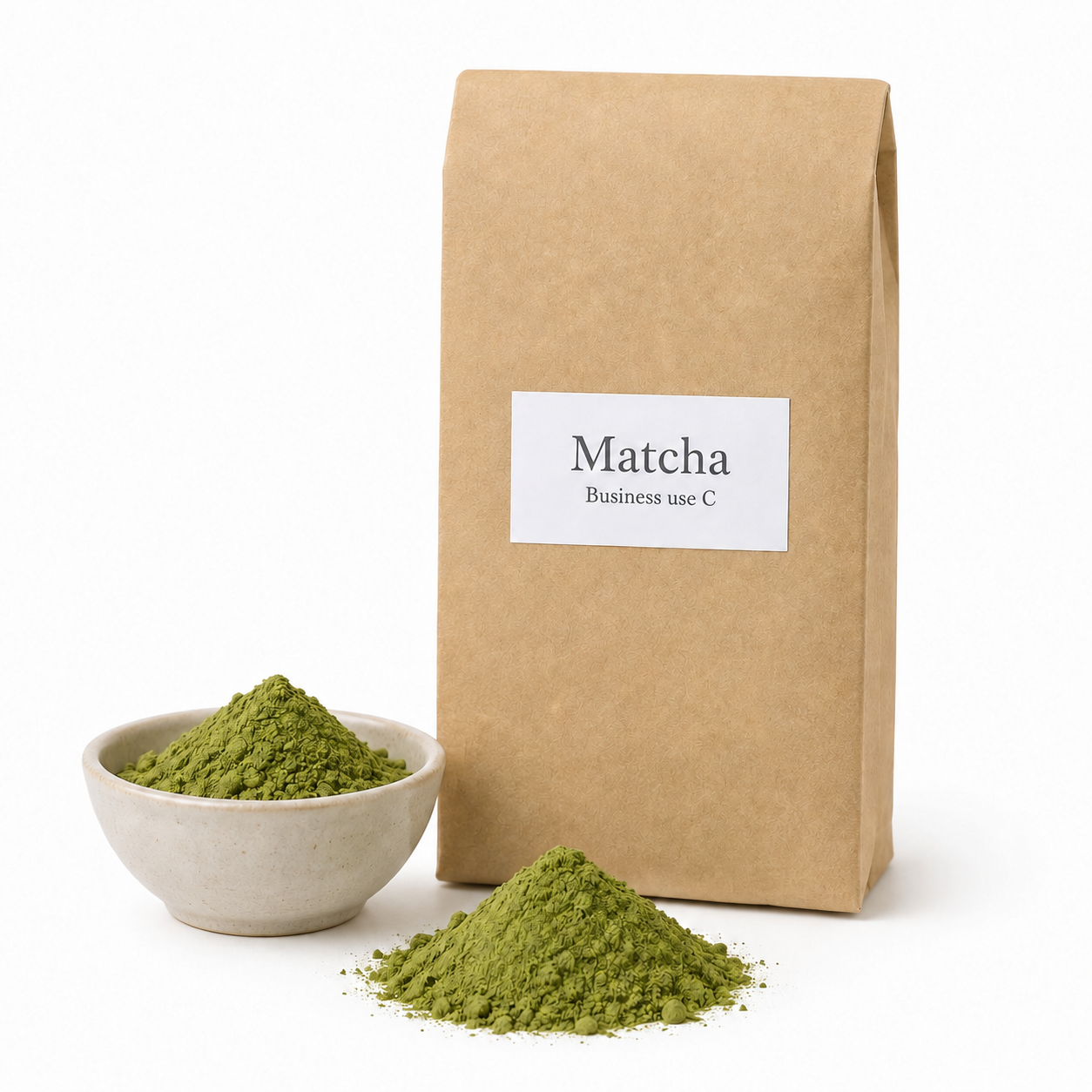
Business Grade C starts with a different question: can autumn tea be cultivated specifically for better matcha? Rather than using ordinary autumn material as-is, Sanrokuen works with farmers before harvest to change the cultivation conditions and create a leaf better suited to matcha production.
Planned 2026 harvest, price and release schedule
Business Grade C is a 2026 autumn-flush development lot. The tea is currently planned to be harvested in October 2026, with commercial release targeted for around November 2026.
The planned wholesale reference price is JPY 6,000 per kg. The product is packed in 1 kg business-use bags, and the minimum order is one bag.
Because the 2026 autumn crop has not yet been harvested, the price, release timing, final specification and available volume are planned values and may change depending on weather, crop condition, yield and final quality evaluation.
The key difference: we shade autumn tea for 7 days
Autumn-flush tea is commonly produced without the type of pre-harvest shading used for premium shaded tea. For Business Grade C, however, the tea field is intentionally covered for 7 days before harvest. This extra cultivation step is designed to strengthen the green appearance and increase the sense of umami in the finished matcha.
The point is not simply to take an inexpensive autumn tea and mill it into powder. We first change how the tea is grown, then evaluate the harvested material for matcha use. This makes Business Grade C a purpose-developed autumn matcha rather than a generic late-season powder.
Uses Kumamoto autumn-grown tea as the raw material base.
The field is intentionally covered before harvest to improve color and umami.
Cultivar, shading duration and production goals are discussed before the tea is grown for this use.
Sanrokuen's practical approach: lower-cost matcha does not have to mean accepting the raw material exactly as it is. We believe cultivation can be adjusted to improve the balance between commercial price, green color, umami and matcha character.
Developed together with tea farmers—not selected only after harvest
One of the biggest differences in this product is that Sanrokuen becomes involved before the tea is harvested. We do not simply buy a finished autumn tea and decide afterward whether it can be used as matcha.
Instead, we work with farmers on details such as cultivar selection, shading duration and the intended quality target. The goal is to make autumn-flush tea more suitable for matcha from the cultivation stage.
Discuss the intended matcha use
We begin with the required balance of color, flavor, umami, bitterness, cost and commercial application.
Select suitable cultivars and fields
Rather than treating every autumn field the same, the producer and Sanrokuen discuss which material is most promising for matcha.
Shade for 7 days before harvest
The autumn tea is intentionally covered to improve the leaf characteristics needed for greener, more umami-forward matcha.
Evaluate the finished material
Color, taste, bitterness, aroma and suitability for business use are evaluated after production so the next crop can be improved further.
This same philosophy is explained in more detail in How Sanrokuen Develops Matcha with Farmers.
Why shade autumn tea?
Autumn tea generally has a different balance from first- or second-harvest tea. If the material is intended for commercial matcha, color and taste can become limiting factors. We therefore use short-term shading as a practical cultivation tool rather than relying only on post-harvest processing.
For Business Grade C, the 7-day shading is intended to improve two qualities that matter especially in food and beverage applications: green color and umami. The result is still positioned as a practical business grade, but the raw material has been intentionally cultivated for matcha rather than treated as ordinary autumn tea.
Tea is an agricultural product. The actual color, aroma, umami and bitterness vary with cultivar, field, weather, harvest timing and lot. Buyers should evaluate the current sample in their actual recipe before larger production.
Product specifications
| Product name | Business Grade C Matcha |
|---|---|
| Category | Japanese matcha / commercial-use matcha |
| Origin | Kumamoto Prefecture, Japan |
| Harvest season | Autumn flush — harvest planned for October 2026 |
| Planned release | Around November 2026, after harvest and final quality evaluation |
| Shading | 7 days before harvest |
| Product development | Developed in cooperation with tea farmers, including discussion of cultivar, shading duration and matcha-oriented quality targets. |
| Product concept | Improve the green color and umami of autumn tea while maintaining practical commercial value. |
| Net weight | 1 kg per business-use bag |
| MOQ | 1 bag (1 kg) |
| Domestic delivery | Shipping is charged separately. Up to 20 bags can be shipped as one parcel within Japan, subject to carrier and destination conditions. |
| Price | Planned wholesale reference price: JPY 6,000/kg. Final quotation will be confirmed after the 2026 autumn harvest and quality evaluation. |
| Recommended applications | Matcha latte, blended beverages, baking, cakes, confectionery, ice cream, desserts, cooking, food service and food manufacturing. |
| Storage | Store sealed in a cool, dry place away from heat, light and moisture. After opening, reseal carefully and use as promptly as practical. |
Recommended uses and business applications
Business Grade C is intended for buyers who need true Japanese matcha for commercial recipes while also paying close attention to cost and practical supply. The 7-day shading gives the autumn material a better foundation for applications in which visual green color and matcha identity still matter.
Matcha latte
Suitable for value-focused café drinks where true matcha identity is required but the cost of premium first- or second-harvest grades is unnecessary.
Baking & confectionery
Suitable for cakes, cookies, bread, fillings, creams, chocolate and other processed foods where matcha is blended with multiple ingredients.
Ice cream & desserts
A practical option for soft serve, ice cream, pudding, tiramisu and dairy desserts where both cost and recognizable matcha character are important.
Cooking & savory foods
Can be evaluated for noodles, sauces, seasonings, doughs and other savory products that benefit from Japanese matcha flavor and green appearance.
Food manufacturing
Intended for commercial users who need repeatable bulk ingredients and want a lower-cost matcha developed specifically for food use.
Product development
MOQ starts at one 1 kg bag, allowing buyers to test the current lot in their own formulation before larger-volume purchasing.
How Business Grades A, B and C differ
All three products are designed for commercial use, but the raw materials and development priorities differ. The best choice depends on the finished product, target cost and desired balance of color, umami and tea strength.
Second-harvest Saeakari + first-harvest Yabukita. Designed for restrained bitterness, good green color and a clear matcha taste.
View Grade A →Mainly second-harvest Saemidori shaded for about two weeks. Moderate bitterness with Saemidori umami for lattes and food use.
View Grade B →Specially developed autumn-flush tea shaded for 7 days. Designed with farmers to improve color and umami while maintaining commercial value.
Current pageA lower-cost grade with cultivation behind it
For many commercial applications, simply moving to a later harvest can reduce cost, but it can also reduce the qualities buyers expect from matcha. Business Grade C takes a different approach: we try to improve the autumn raw material before harvest rather than accepting the seasonal limitations unchanged.
- Kumamoto-grown autumn-flush tea.
- 7 days of intentional shading before harvest.
- Cultivar and cultivation details discussed with farmers.
- Developed specifically for matcha rather than generic autumn tea powder.
- Improved focus on green color and umami.
- MOQ of only one 1 kg bag for commercial testing.
Quality information beyond the grade name
“Business Grade C” is Sanrokuen's own practical product name; it is not an official Japanese grade. We therefore explain the actual harvest season, cultivation method, shading period and intended use instead of relying only on a grade label.
Related information: How Sanrokuen Develops Matcha, Kumamoto Matcha, Kumamoto Matcha Component Analysis, Japanese Matcha Cultivars, and Japanese Matcha Wholesale.
Start with one 1 kg bag.
Business Grade C is planned at JPY 6,000/kg, with the 2026 autumn harvest scheduled for October and release targeted for around November. Buyers can begin with one 1 kg bag once the lot is released. Domestic shipping is charged separately, and up to 20 bags can be shipped as one parcel within Japan.
Frequently asked questions
What is special about Business Grade C Matcha?
It uses Kumamoto autumn-flush tea that is intentionally shaded for 7 days before harvest. The product is developed together with tea farmers to improve color and umami for matcha use.
Is autumn tea normally shaded?
In conventional autumn tea production, shading is often omitted. For Business Grade C, Sanrokuen specifically requests 7 days of shading as part of the matcha-oriented cultivation design.
Why use autumn-flush tea?
Autumn tea can offer practical commercial value for food and beverage applications. Rather than using ordinary autumn material unchanged, we modify the cultivation by shading it before harvest to improve the qualities needed for matcha.
How do you work with the farmers?
Sanrokuen discusses details such as cultivar selection, shading duration and the intended quality target with producers before harvest. The goal is to develop raw material specifically suited to matcha rather than simply buy finished tea afterward.
What is the MOQ?
The minimum order is one 1 kg bag. Shipping is charged separately.
What applications are recommended?
Business Grade C is intended mainly for lattes, baking, desserts, ice cream, cooking, food service and food manufacturing where true Japanese matcha is desired at a practical commercial cost.
How is it different from Business Grade A and B?
Grade A uses second-harvest Saeakari blended with first-harvest Yabukita. Grade B is based mainly on second-harvest Saemidori shaded for about two weeks. Grade C uses specially cultivated autumn-flush tea shaded for 7 days, with the cultivation conditions developed together with farmers.
Can overseas buyers inquire?
Yes. Please tell us the destination country, intended use, expected quantity, packaging requirements and any required import documents. International freight and compliance costs are quoted separately.
When will Business Grade C be available?
The 2026 autumn-flush tea is planned to be harvested in October 2026, with release targeted for around November 2026 after final quality evaluation. Timing and available volume may change depending on crop conditions.