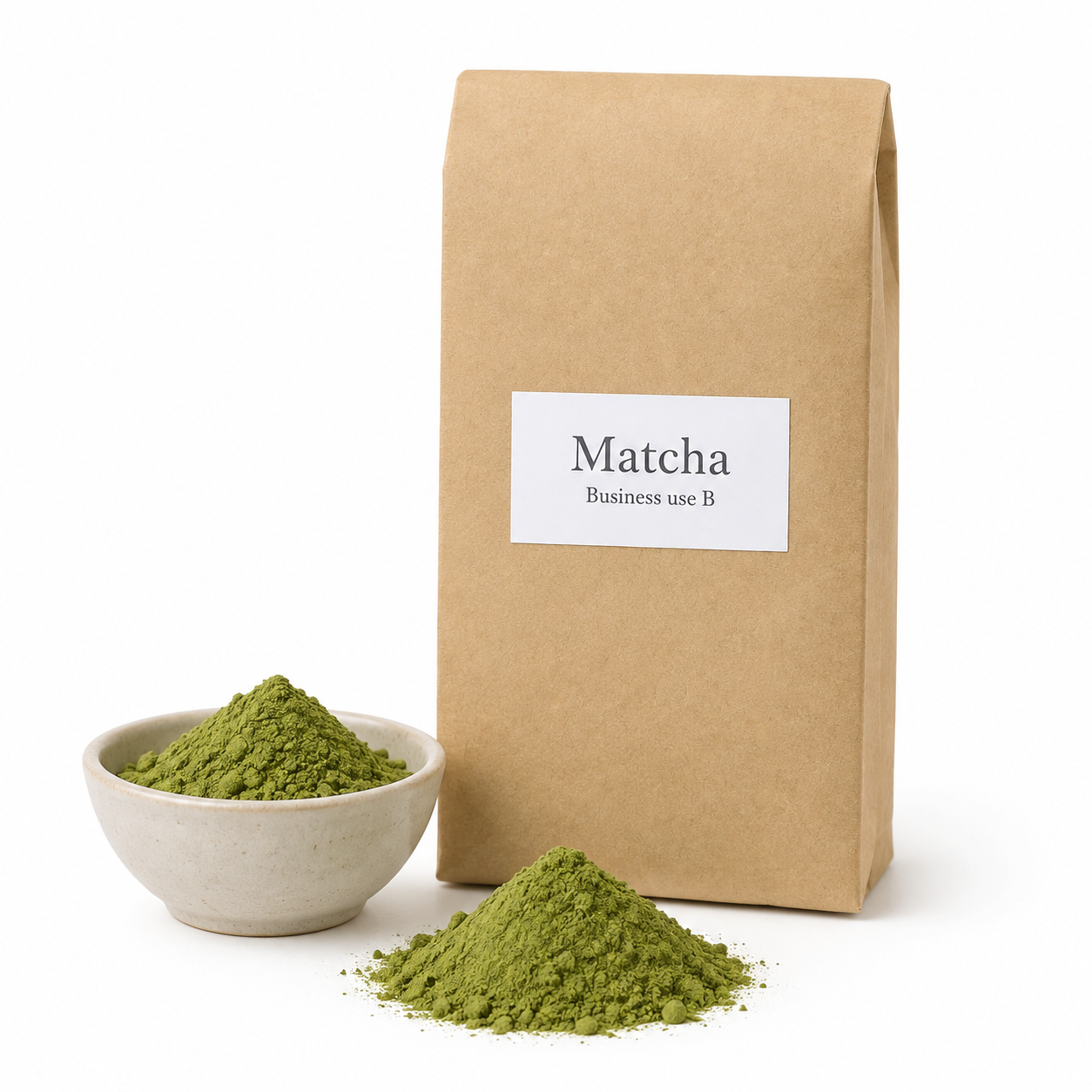
Business Grade B is designed for applications where matcha needs enough bitterness to remain recognizable, but should not become harsh. By using shaded second-harvest Saemidori as the main material, we aim to retain useful umami and green-tea richness while keeping the grade practical for repeated commercial use.
Saemidori-based matcha with about two weeks of shading
The main material in Business Grade B is second-harvest Saemidori grown in Kumamoto. Before harvest, the tea is shaded for approximately two weeks. Shading is used to change the balance of the leaf before processing and is especially relevant when the finished tea is intended for matcha or other shaded-tea applications.
Rather than selling the Saemidori alone, we blend it with several selected tea materials. The objective is to create a stable commercial profile in which the natural umami associated with Saemidori is supported by enough bitterness and tea strength to remain useful after milk, sugar, oil, flour or other ingredients are added.
Kumamoto-grown Saemidori is the principal tea material in the blend.
The main Saemidori material is covered before harvest for approximately two weeks.
Designed to work with milk, sugar and food ingredients rather than disappear behind them.
Why blend several teas? For commercial matcha, the best result is not always a single-cultivar product. We use blending to balance umami, bitterness, color, tea strength, cost and consistency for the intended application.
Learn more about the main cultivar in our Saemidori Matcha Buyer Guide.
Flavor profile: moderate bitterness with Saemidori umami
Business Grade B is intended to have a little more practical bitterness than a delicate drinking matcha. This is an advantage in many commercial recipes: milk, sugar, cream and fat can reduce the perception of tea flavor, so a matcha that is too delicate may become difficult to recognize.
At the same time, Saemidori contributes a softer umami impression, preventing the product from becoming a purely bitter culinary powder. The resulting balance makes Business Grade B particularly useful for buyers who need both recognizable matcha character and reasonable cost.
What it is designed to provide
Moderate bitterness, useful umami, green-tea presence in milk and food, and practical wholesale pricing.
What it is not designed to be
A delicate ceremonial-style matcha selected primarily for usucha, refined aroma or luxury retail positioning.
Product specifications
| Product name | Business Grade B Matcha |
|---|---|
| Category | Japanese matcha / commercial-use matcha |
| Origin | Kumamoto Prefecture, Japan |
| Main cultivar | Saemidori |
| Harvest | Mainly second-harvest tea |
| Shading | Approximately two weeks for the main Saemidori material |
| Blend | Saemidori-based blend with several selected tea materials |
| Flavor positioning | Moderate bitterness with Saemidori umami and a clear matcha character |
| Net weight | 1 kg per business-use bag |
| MOQ | 1 bag (1 kg) |
| Domestic delivery | Shipping is charged separately. Up to 20 bags can be shipped as one parcel within Japan, subject to carrier and destination conditions. |
| Reference price | From JPY 7,000/kg, EXW factory handover. Current quotation should be confirmed before ordering. |
| Recommended applications | Matcha latte, blended beverages, baking, cakes, confectionery, ice cream, desserts, savory cooking, food service and food manufacturing. |
| Storage | Store sealed in a cool, dry place away from heat, light and moisture. After opening, reseal carefully and use as promptly as practical. |
Final specification, current lot, price and documentation are confirmed at quotation. Agricultural products vary naturally by year and lot, so current color, aroma and flavor should be confirmed with the current sample.
Recommended uses and business applications
Grade B is especially useful when matcha is combined with other ingredients. Its balance of moderate bitterness and Saemidori umami makes it versatile across beverage, dessert and cooking applications.
Matcha latte
One of the strongest applications for this grade. The tea retains enough bitterness and body to remain recognizable after milk and sweetener are added, while Saemidori helps soften the overall impression.
Baking & confectionery
Suitable for sponge cake, cookies, bread, creams, chocolate, fillings and other confectionery where matcha needs to remain noticeable after heating or mixing.
Ice cream & desserts
A practical option for ice cream, soft serve, pudding, tiramisu and dairy desserts, where very delicate matcha can be overwhelmed by milk fat and sweetness.
Cooking & savory foods
Can be evaluated for noodles, sauces, seasonings, dressings, doughs and other savory applications where a clear Japanese green-tea flavor and color are desirable.
Cafés & restaurants
The 1 kg format and low MOQ make it practical for cafés and restaurants that want to test a Japanese matcha before moving to larger-volume purchasing.
Food manufacturing
Suitable for prototype development and commercial food applications where repeat purchasing, cost balance and performance with other ingredients matter more than ceremonial positioning.
Business Grade A or Business Grade B?
Both are Kumamoto commercial-use matcha, but they are designed for slightly different priorities. Buyers should choose based on the actual recipe rather than assuming that a higher grade is always the best choice.
| Comparison | Business Grade A | Business Grade B |
|---|---|---|
| Main concept | Stronger color balance and restrained bitterness with clear matcha character | Moderate bitterness plus Saemidori umami for versatile food use |
| Main tea materials | Second-harvest Saeakari + first-harvest Yabukita | Mainly shaded second-harvest Saemidori + selected tea blend |
| Best use | Premium latte, cafés, desserts, food service | Latte, baking, desserts, cooking, food processing |
| Reference price | From JPY 8,000/kg | From JPY 7,000/kg |
See Business Grade A or return to the complete wholesale matcha range.
Why Business Grade B instead of a premium drinking matcha?
A premium drinking matcha may offer delicate aroma and refined umami, but those qualities can become less noticeable once the powder is combined with milk, sugar, butter, flour or savory ingredients. For many food applications, a slightly firmer bitterness and a lower raw-material cost can produce a better final product.
- Japanese matcha produced from Kumamoto tea.
- Saemidori-based blend rather than a cost-only anonymous powder.
- Approximately two weeks of shading for the main second-harvest Saemidori material.
- Moderate bitterness that works with milk and food ingredients.
- Umami from Saemidori for a more rounded flavor profile.
- MOQ of only one 1 kg bag for recipe testing and small business use.
Quality information beyond the grade name
“Business Grade B” is Sanrokuen's own practical grade name for buyer communication; it is not a legally defined Japanese matcha grade. We prefer to explain the actual origin, cultivar, harvest, shading, taste and intended use rather than rely only on grade terminology.
Related technical and cultivar information: Saemidori Matcha Guide, Kumamoto Matcha Component Analysis, Particle Size & Milling, and Japanese Matcha Cultivar Guide.
Start with one 1 kg bag.
Buyers can evaluate Business Grade B in their actual latte, dessert, bakery or cooking recipe before moving to larger quantities. Domestic shipping is charged separately. Up to 20 bags can be shipped as one parcel within Japan.
Frequently asked questions
What is the MOQ for Business Grade B?
The minimum order is one 1 kg bag. Shipping is charged separately.
What tea is used in Business Grade B?
The main material is second-harvest Saemidori grown in Kumamoto and shaded for approximately two weeks. Several selected tea materials are blended with it to create the final commercial balance.
Why is Saemidori used?
Saemidori is valued for its umami and green appearance. In this grade, its umami helps round out the moderate bitterness needed for latte and food applications.
Is it suitable for matcha latte?
Yes. Matcha latte is one of the primary intended uses. The moderate bitterness helps the tea remain noticeable after milk and sweetener are added.
Can it be used for cooking?
Yes. It can be evaluated for savory dishes, noodles, sauces, dressings, doughs and other food applications as well as desserts and beverages. The appropriate dosage depends on the recipe.
How is it different from Business Grade A?
Business Grade A is positioned around stronger color balance, restrained bitterness and clear matcha character. Grade B is more cost-conscious and uses shaded second-harvest Saemidori as the main material to combine moderate bitterness with useful umami for lattes, baking and cooking.
Can overseas buyers inquire?
Yes. Please tell us the destination country, intended use, expected quantity, packaging requirements and required import documents. International freight and compliance costs are quoted separately.