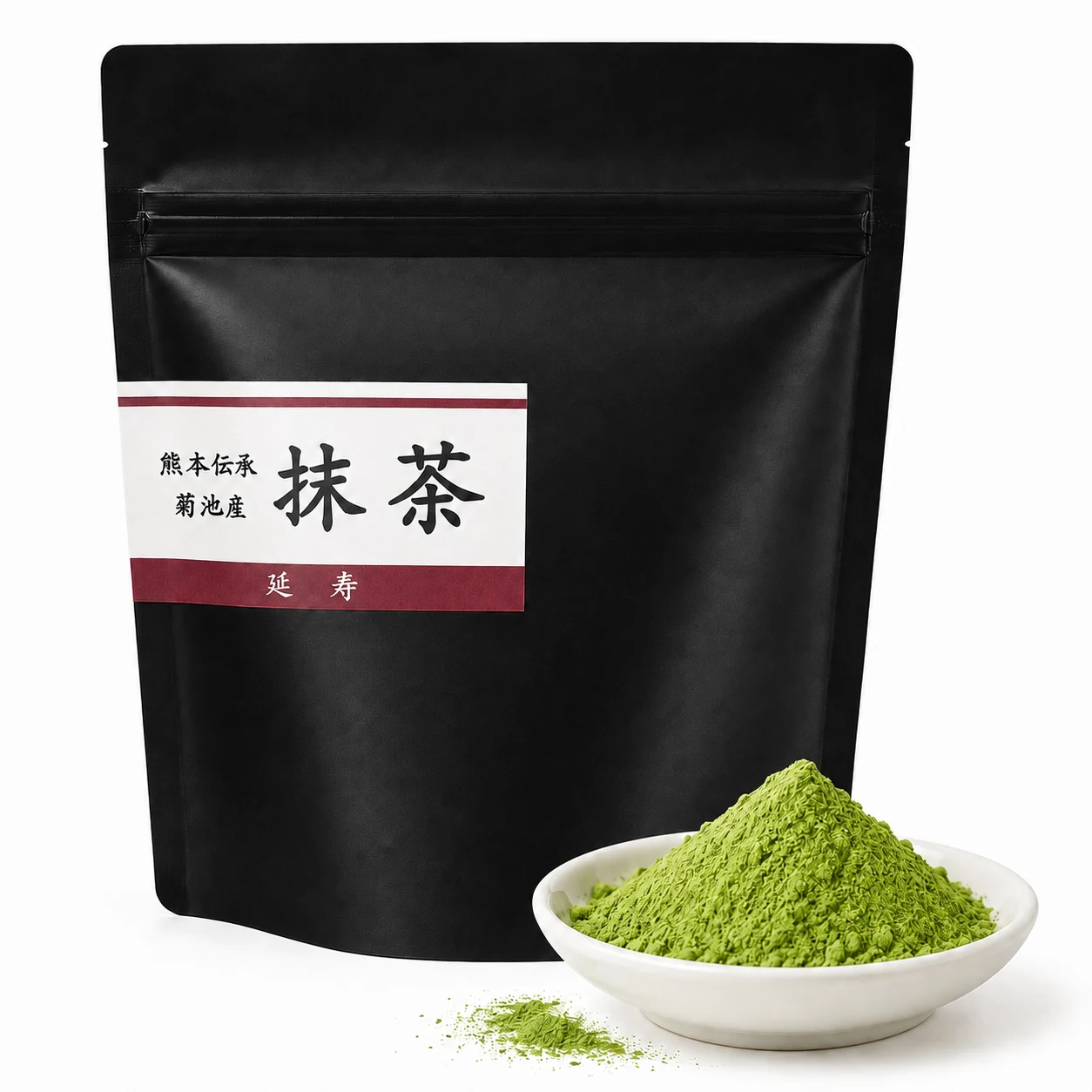
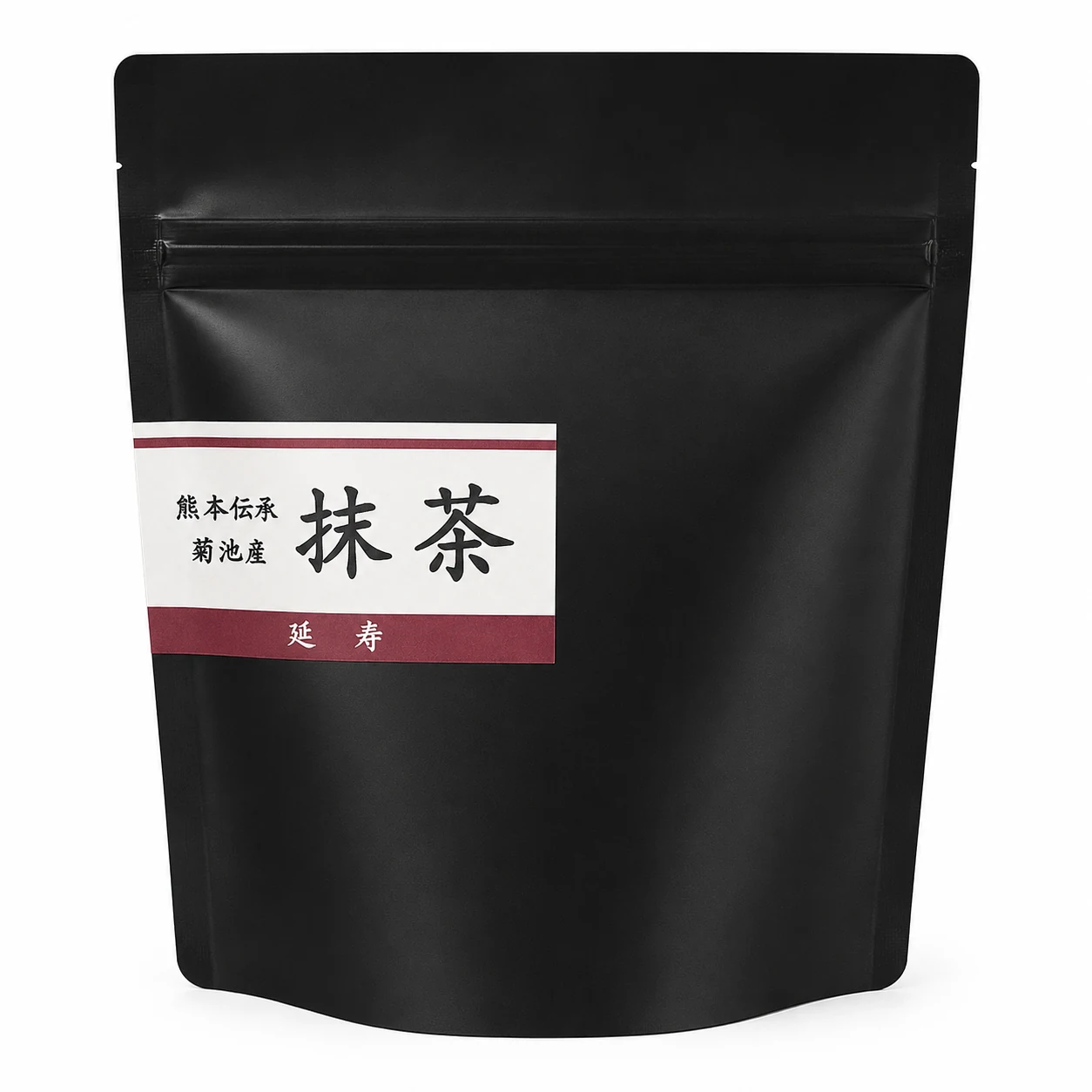
Kikuchi Enju is part of Sanrokuen's Kumamoto Densho Matcha (熊本伝承抹茶 / Kumamoto Heritage Matcha) series. It is a 2026 first-harvest matcha from Kikuchi City, Kumamoto, built around three cultivars with deliberately different roles: Sayamakaori for power and body, Tsuyuhikari for clarity and a clean cutting profile, and Saemidori for refinement and balance.
Strength for latte, balance for drinking
Kikuchi Enju is not designed only to look green in a cup. Its purpose is to create a recognizable tea flavor with enough structure to remain present in milk, without pushing the blend so far toward bitterness that it becomes unsuitable for direct drinking.
The result is a versatile style: stronger and more assertive than a delicate premium-only matcha, yet still supported by first-harvest umami and a cleaner finish than a typical low-cost culinary powder.
Three cultivars, three roles
The flavor design of Kikuchi Enju uses a sword-inspired metaphor rooted in Kikuchi history. This is Sanrokuen's modern blending concept: the historical story gives the product an identity, while the actual taste is created through cultivar selection, sensory evaluation and component analysis.
Sayamakaori forms the blend's forceful core. In Sanrokuen's evaluation, selected shaded material can provide substantial tea flavor, aroma and body that remain noticeable after milk is added.
Tsuyuhikari is used to sharpen the blend rather than simply make it stronger. We use its cleaner profile and high-performing selected lots to create definition, umami and a finish that does not feel unnecessarily heavy.
Saemidori adds the element that keeps power from becoming roughness: vivid color, softer refinement and an elegant umami impression. In this blend, it provides poise and balance.
Sanrokuen does not disclose the exact blend ratio. The ratio is adjusted by evaluating the actual harvested lots, including taste, aroma, color, body, component data and performance in both water and milk.
Covered cultivation matched to each cultivar
All three cultivars used for Kikuchi Enju are first-harvest teas grown under shading before harvest. The shading period is adjusted by cultivar rather than forced into a single specification.
Approximately 18–20 days of shading. This supports the body, depth and tea presence that form the blend's powerful core.
Approximately 18–20 days of shading. The selected material is used for clarity, definition and strong umami performance.
20 days or more of shading. The longer covered period supports the refined umami and vivid color that soften and balance the blend.
Why the name “Enju”?
Enju (延寿) carries two meanings that fit this product. As Japanese characters, the name has an auspicious sense: 延 means to extend, while 寿 evokes longevity, celebration and good fortune. Together, the name naturally suggests long life and an auspicious future.
At the same time, Enju is deeply connected with the history of Kikuchi. Medieval Kikuchi was home to the Enju school of swordsmiths, whose story is tied to the Kikuchi clan and the era of the Mongol invasions.
Sanrokuen chose the name to connect a modern Kikuchi-grown matcha with both meanings: good fortune in the name itself, and strength rooted in the region's history.
Kikuchi, Enju and the making of a powerful local identity
Kikuchi City's official historical site traces the beginning of the Kikuchi clan to Fujiwara Noritaka, who came to the area in 1070 and is traditionally regarded as the clan's first generation. The city also notes that there are multiple theories about the clan's precise origins. According to the local tradition presented by the city, Noritaka took the name Kikuchi from the place where he established his base.
Fujiwara Noritaka established himself in the area and, in the local account, adopted the place-name Kikuchi as his family name.
Kikuchi City's account says the Enju tradition began around the Bun'ei era, close to the Mongol invasions, when Kikuchi Takefusa sought stronger weapons.
Some smiths from the Enju lineage later moved and became associated with the Dotanuki tradition, famous for practical strength.
The Enju school and the Mongol-invasion era
Kikuchi City's official account states that the Enju school is traditionally said to have begun in the Bun'ei era, during the time of Kikuchi clan leader Takefusa and the Mongol invasions. The story says that Takefusa, seeking stronger swords, invited a smith connected with Kyoto's prestigious Rai school to Kikuchi. That smith, Enju Taro Kunimura, is presented as the founder of the Enju tradition in the region.
The Enju smiths then served the Kikuchi clan and produced swords in the area. Kikuchi City's account also points to the Kikuchi River system and locally available iron sand as part of the environment that supported swordmaking.
From Enju to Dotanuki
After the decline of the Kikuchi clan, some smiths connected with the Enju tradition moved elsewhere. Kikuchi City's historical account identifies Dotanuki Kiyokuni and Masakuni among those who moved to the Tamana area and describes Dotanuki as a later lineage connected to Enju.
The same account says that Kato Kiyomasa, lord of Higo, valued the practical toughness of Dotanuki swords and had many made for Kumamoto Castle. In later memory, Dotanuki became known as a rugged, practical blade—a reputation Kikuchi City summarizes with the image of a sword that would not easily break or bend.
How that history becomes a modern matcha blend
Kikuchi Enju does not claim that tea and swordmaking share a direct historical production lineage. Instead, Sanrokuen uses the regional story as a design language for flavor.
Sayamakaori represents the strength of the blade. Tsuyuhikari represents its clean edge and definition. Saemidori represents dignity, finish and refinement. The goal is a matcha with enough force to stand up to milk, but enough quality and umami to remain satisfying when prepared simply with water.
Selected 2026 source-material component indicators
Sanrokuen uses component analysis together with sensory evaluation, color, aroma and actual preparation performance when selecting raw material. For Kikuchi Enju, the following values are published as reference indicators measured on selected raw aracha before final refining, blending and milling.
| Selected indicator | Sayamakaori raw aracha |
|---|---|
| Moisture | 1.6% |
| Total nitrogen | 6.2% |
| Free amino acids | 4.6% |
| Theanine | 2.6% |
| Fiber | 21.0% |
| Tannin | 7.5% |
| Caffeine | 2.4% |
| Vitamin C | 0.31% |
| AF score | 60 |
measured before final refining and milling
These numbers illustrate why Kikuchi Enju is not built from one quality dimension alone. Sayamakaori contributes flavor structure even without being the highest-scoring material by AF score, while selected Tsuyuhikari can contribute exceptionally strong amino-acid-to-fiber performance. Saemidori is used for the refinement and balance it brings to the finished cup rather than being presented here through a single numerical score.
Component numbers alone do not determine matcha quality. Sanrokuen also evaluates powder color, aroma, astringency, aftertaste, mouthfeel, milling texture and actual performance in water, milk and food applications.
How we recommend using Kikuchi Enju
The blend's main advantage is flavor presence. Sayamakaori provides enough structure to remain recognizable with milk, while Tsuyuhikari and Saemidori keep the drink from becoming one-dimensional.
First-harvest umami and the balancing cultivars make Kikuchi Enju suitable for everyday direct drinking when you prefer a matcha with more body rather than an extremely delicate profile.
A practical choice for regular tea practice, ice cream, baked goods and desserts when a clear matcha character is desired without moving down to a purely culinary green tea powder.
For very heavy milk ratios, strongly sweetened drinks or industrial food production, a more economical commercial matcha or green tea powder may be more appropriate. See Sanrokuen's current wholesale matcha and green tea powder options →
Product profile
| Product name | Kikuchi Enju / 菊池 延寿 |
|---|---|
| Series | Kumamoto Densho Matcha / Kumamoto Heritage Matcha |
| Origin | Kikuchi City, Kumamoto Prefecture, Japan |
| Harvest year | 2026 |
| Harvest season | First harvest / ichibancha |
| Cultivars | Sayamakaori, Tsuyuhikari and Saemidori blend |
| Shading | Sayamakaori: approximately 18–20 days; Tsuyuhikari: approximately 18–20 days; Saemidori: 20 days or more |
| Blend ratio | Proprietary; adjusted by lot evaluation |
| Taste concept | Power and body from Sayamakaori, clarity from Tsuyuhikari, refinement and balance from Saemidori |
| Color | Deep, vivid green |
| Recommended uses | Premium latte, usucha, tea practice, everyday drinking, desserts |
| Japanese retail size | 50 g |
| Japanese retail reference price | JPY 1,080 (tax included, current listing) |
| Name meaning | “Enju” evokes extended longevity, celebration and good fortune |
| Historical inspiration | The Enju swordsmith tradition associated with the medieval Kikuchi clan, and its later connection to Dotanuki |
Frequently asked questions
What is Kikuchi Enju?
It is Sanrokuen's Kumamoto Heritage Matcha from Kikuchi City, made as a blend of Sayamakaori, Tsuyuhikari and Saemidori. It is designed for both direct drinking and applications that need stronger flavor, especially matcha latte.
Why is it called Enju?
“Enju” has an auspicious meaning that evokes extended longevity. The name also connects the product with Kikuchi's medieval Enju swordsmith tradition, giving the matcha a specific local identity.
Which cultivars are used?
The blend uses Sayamakaori, Tsuyuhikari and Saemidori. Sanrokuen uses Sayamakaori for power and body, Tsuyuhikari for clarity and definition, and Saemidori for refinement and balance.
How long are the tea plants shaded before harvest?
For the 2026 Kikuchi Enju source material, Sayamakaori and Tsuyuhikari are shaded for approximately 18–20 days before harvest. Saemidori is shaded for 20 days or more.
Are the published component values for the finished matcha?
No. The published Sayamakaori component values and the selected Tsuyuhikari AF score were measured on raw aracha before final refining, blending and milling. They are source-material reference data, not finished-product specifications or nutrition-label values.
Is Kikuchi Enju good for matcha latte?
Yes. The blend was specifically designed so that the matcha flavor remains noticeable with milk while still keeping enough umami and balance for drinking with water.
Can I use it for usucha?
Yes. It is a stronger style than a very delicate premium matcha, but it uses first-harvest material and is balanced for everyday direct drinking, usucha and tea practice.
Does Sanrokuen claim a direct historical connection between Enju swords and this matcha?
No. The sword history is used as regional and creative inspiration for the modern blend concept. The product does not claim that the tea itself descends from, was produced by, or has a direct material connection with the historical swordsmiths.
Interested in Kikuchi Enju?
For retail purchase in Japan, use our Japanese online store. Business and overseas buyers can contact Sanrokuen regarding samples, current availability, quantities, packaging and documentation requirements.
Japanese Retail Product Contact Sanrokuen Wholesale InformationSources and editorial basis
- Kikuchi City: The arrival of Fujiwara Noritaka and the origin of the Kikuchi name — presents the city's historical account of Noritaka's arrival in 1070 and notes that multiple theories exist regarding the clan's precise origins.
- Kikuchi City: Enju, ancestor of the Dotanuki tradition — describes the Enju swordsmiths, the era of the Mongol invasions, Enju Taro Kunimura and the relationship with the Kikuchi clan.
- Kikuchi City: From Enju to Dotanuki — describes the later Enju/Dotanuki connection and Kato Kiyomasa's evaluation of Dotanuki's practical strength.
- Kikuchi City: Saigo Takamori and the Kikuchi name — explains the Saigo family genealogy tradition and Saigo's use of the alias Kikuchi Gengo.
- Kikuchi City: A note on the uncertainty of the Saigo lineage — explicitly cautions that the claimed ancestry cannot now be independently verified.
- Sanrokuen: Sayamakaori Matcha Guide — Sanrokuen's practical evaluation of Sayamakaori for body, aroma, blending and latte performance.
- Sanrokuen: Tsuyuhikari Matcha Guide — Sanrokuen's practical evaluation of Tsuyuhikari for clean flavor, umami and blending.
- Sanrokuen: Saemidori Matcha Guide — Sanrokuen's practical evaluation of Saemidori for vivid color, elegant umami and premium blending.
- Sanrokuen: Kumamoto first-harvest matcha raw-material component analysis — explains Sanrokuen's component-testing approach for raw material used in Kikuchi Enju and other Kumamoto matcha.
- Sanrokuen Japanese online store: Kikuchi Enju 50 g — current Japanese retail product listing and reference price.
Product-specific 2026 harvest information, cultivar-specific shading periods, blend design, cultivar roles, the Sayamakaori raw-aracha component values, the selected Tsuyuhikari raw-aracha AF score and sensory positioning on this page are first-party data supplied by Sanrokuen. The analytical figures were measured before final refining, blending and milling and are not finished-matcha specifications. The historical sources are used as regional context and creative inspiration; they are not presented as evidence of a direct production lineage between medieval swordsmithing and modern tea.