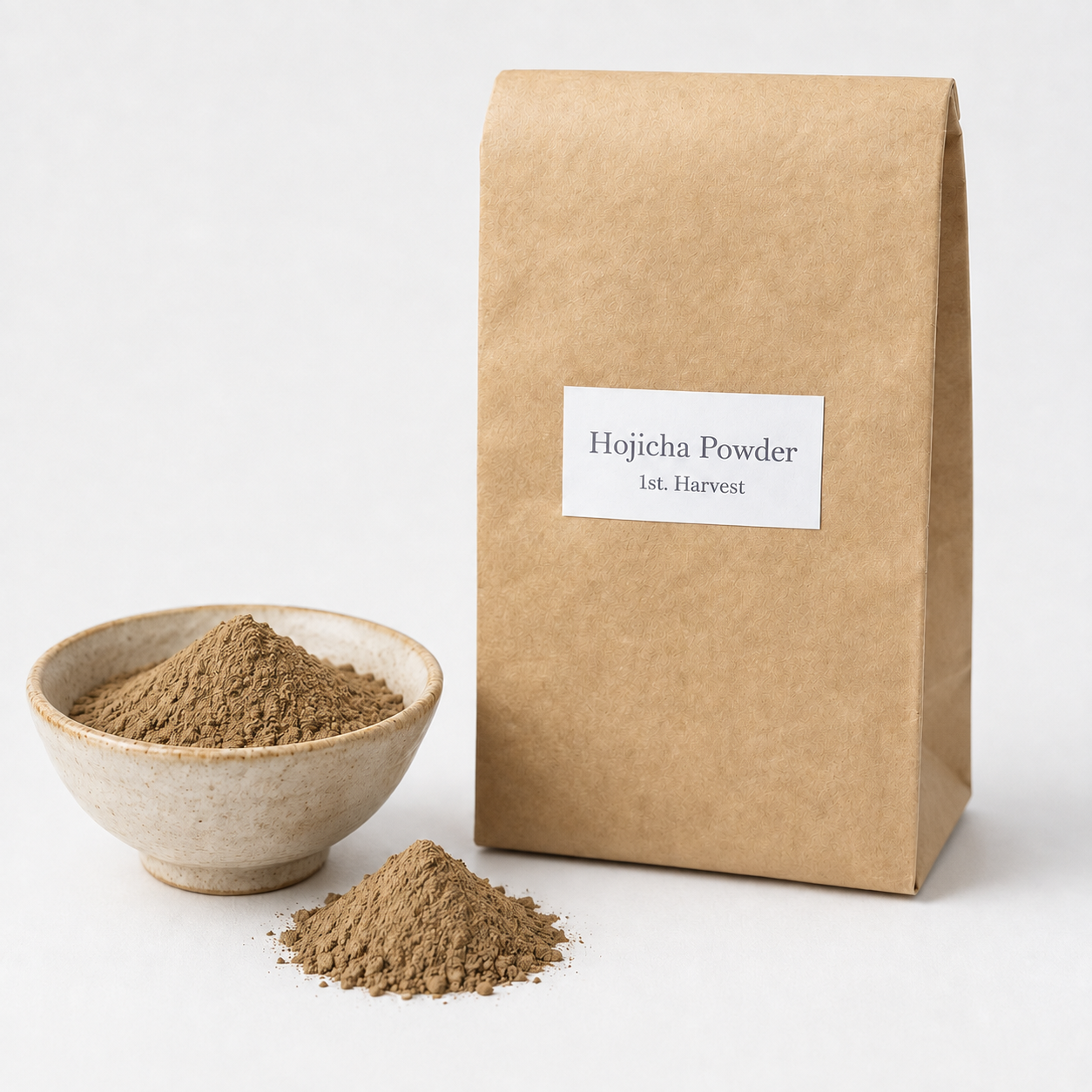
The quality of hojicha begins with the tea before roasting. Roasting creates the characteristic hojicha aroma, but it cannot fully replace the quality of the original leaf. This product therefore starts with first-harvest tencha—high-quality shaded tea originally intended as raw material for matcha.
Why use first-harvest tencha for hojicha powder?
Many ordinary hojicha products are made from bancha, stems or later-season tea. These materials can be excellent for creating a strong roasted aroma at an economical price, but their natural umami level is generally lower than high-quality first-harvest shaded tea.
Our Kagoshima hojicha powder takes a different approach. We roast first-harvest tencha material that was originally produced for matcha. Before roasting, the leaf therefore begins with a richer taste foundation. After roasting, the objective is not only a strong aroma but a more balanced combination of roasted fragrance, sweetness and umami.
Starts from shaded tea material originally produced for matcha rather than ordinary bancha.
Higher-quality first-harvest material provides a richer base before roasting.
Designed for a refined roasted aroma with natural sweetness rather than only aggressive roast intensity.
Ordinary bancha hojicha vs first-harvest tencha hojicha
The difference is already present before the roasting begins.
Hojicha is often discussed mainly in terms of roasting, but the original tea strongly influences the final taste. First-harvest tencha has a different quality profile from ordinary later-harvest bancha, allowing us to create a hojicha powder with both roasted aroma and a more substantial taste underneath it.
| Comparison | Typical economical hojicha | Sanrokuen First-Harvest Hojicha Powder |
|---|---|---|
| Common raw material | Bancha, stems or later-season tea | First-harvest tencha |
| Original purpose of tea | General leaf tea / roasting material | Originally produced as matcha raw material |
| Umami foundation | Usually lower | Stronger due to higher-quality shaded first-harvest material |
| Aroma direction | Strong roasted character | Elegant roasted aroma with sweetness |
| Best positioning | Cost-focused drinks and food | Premium latte, dessert, café and confectionery use |
Elegant roasted aroma with natural sweetness
The objective of this hojicha powder is not simply to roast the tea as strongly as possible. We want the fragrance to be clearly recognizable, while preserving the sweetness and depth that come from the first-harvest tencha material.
In a hojicha latte, this creates a more rounded taste: the roasted aroma remains present against milk, but the underlying tea is not hollow. In confectionery or desserts, the same balance can provide both aroma and a lingering tea character.
Recommended sensory direction: refined roasted aroma, gentle sweetness and a deeper tea taste than ordinary low-cost hojicha powder.
Organically grown raw material — but not sold as Organic JAS certified
Important certification note: the first-harvest tencha used as raw material is organically grown, but this finished hojicha powder is not sold or represented as an Organic JAS-certified product.
This distinction is important for commercial buyers. “Organically grown raw material” and “Organic JAS-certified finished product” are not the same claim. Buyers who require an Organic JAS-certified finished hojicha powder should confirm certification requirements with us before ordering.
Product specifications
| Product name | Kagoshima First-Harvest Hojicha Powder |
|---|---|
| Category | Japanese hojicha powder / roasted green tea powder |
| Origin | Kagoshima Prefecture, Japan |
| Raw tea | First-harvest tencha originally produced as matcha raw material |
| Cultivation | Organically grown raw tea |
| Organic JAS status | Finished product is not sold as Organic JAS certified |
| Flavor | Elegant roasted aroma, natural sweetness and strong umami foundation |
| Recommended applications | Hojicha latte, café beverages, ice cream, soft serve, cakes, confectionery, chocolate, desserts, bakery products and food manufacturing. |
| Price | JPY 5,000/kg. Final quotation may depend on quantity, packaging and destination. |
| Storage | Store sealed in a cool, dry place away from heat, light, moisture and strong odors. After opening, reseal carefully and use as promptly as practical. |
Final specification, current lot, package, price and export-related documents are confirmed at quotation. Tea is an agricultural product, so aroma and taste may vary slightly by lot.
Recommended uses and business applications
Hojicha latte
One of the strongest applications for this powder. Its elegant roasted aroma remains clear in milk while the first-harvest tencha gives the drink a fuller underlying taste.
Ice cream & soft serve
Suitable for dairy desserts where a roasted aroma, sweetness and depth are more desirable than bitterness.
Cakes & confectionery
Works well in sponge cake, cookies, cream, fillings, tiramisu and other sweets where hojicha aroma is the main flavor theme.
Chocolate & cream
The roasted aroma combines naturally with chocolate, dairy fat and cream-based products while the tea contributes additional depth.
Cafés & restaurants
Suitable for cafés and restaurants looking for a more refined hojicha ingredient than ordinary low-cost bancha-based powder.
Food manufacturing
Can be evaluated for commercial beverages, desserts and confectionery where hojicha is used as a premium Japanese flavor.
Why first-harvest hojicha powder can justify a higher-value position
If the only goal is the lowest possible ingredient cost, bancha-based hojicha powder can be a logical choice. This product is intended for a different buyer: one who wants hojicha aroma but also cares about the quality of the tea underneath the roast.
- Kagoshima-grown Japanese tea.
- First-harvest raw material.
- Tencha originally produced for matcha.
- Organically grown raw tea.
- Elegant roasted aroma rather than only strong roast intensity.
- Natural sweetness and stronger umami foundation.
Learn more about Japanese hojicha
For a broader explanation of hojicha, roasting, flavor, caffeine and hojicha powder, see Sanrokuen's complete Hojicha Guide.
You may also find these pages useful: What Is Hojicha Powder?, Japanese Matcha & Tea Powder Wholesale, and Contact Sanrokuen.
For practical quality selection by raw material, harvest and use, see How to Choose Good Hojicha.
Request the current lot, price and sample.
Because this product uses higher-quality first-harvest tencha raw material, buyers should evaluate the actual aroma, sweetness and milk performance of the current lot. Please tell us the intended use, required quantity, destination and any documentation requirements.
Frequently asked questions
What makes this hojicha powder different from ordinary hojicha powder?
Many economical hojicha products use bancha, stems or later-season tea. This product instead uses first-harvest tencha originally produced as matcha raw material, giving the tea a stronger umami foundation before roasting.
Is this Organic JAS certified?
No. The raw tea is organically grown, but the finished hojicha powder is not sold or represented as an Organic JAS-certified product.
What is tencha?
Tencha is shaded tea processed as the raw material for matcha. This hojicha powder uses first-harvest tencha from Kagoshima and then roasts it to create hojicha flavor.
What does it taste like?
The target profile is an elegant roasted aroma with natural sweetness and a deeper umami-rich tea foundation than ordinary low-cost hojicha powder.
Is it suitable for hojicha latte?
Yes. Hojicha latte is one of the primary intended uses. The roasted aroma remains present in milk while the first-harvest tencha gives the beverage additional body and depth.
Can it be used for desserts and confectionery?
Yes. It is suitable for ice cream, soft serve, cakes, cookies, cream, chocolate, tiramisu and other desserts where hojicha is used as a primary flavor.
Can overseas buyers inquire?
Yes. Please tell us the destination country, intended use, expected quantity, packaging requirements and any required import documents. International freight and compliance costs are quoted separately.