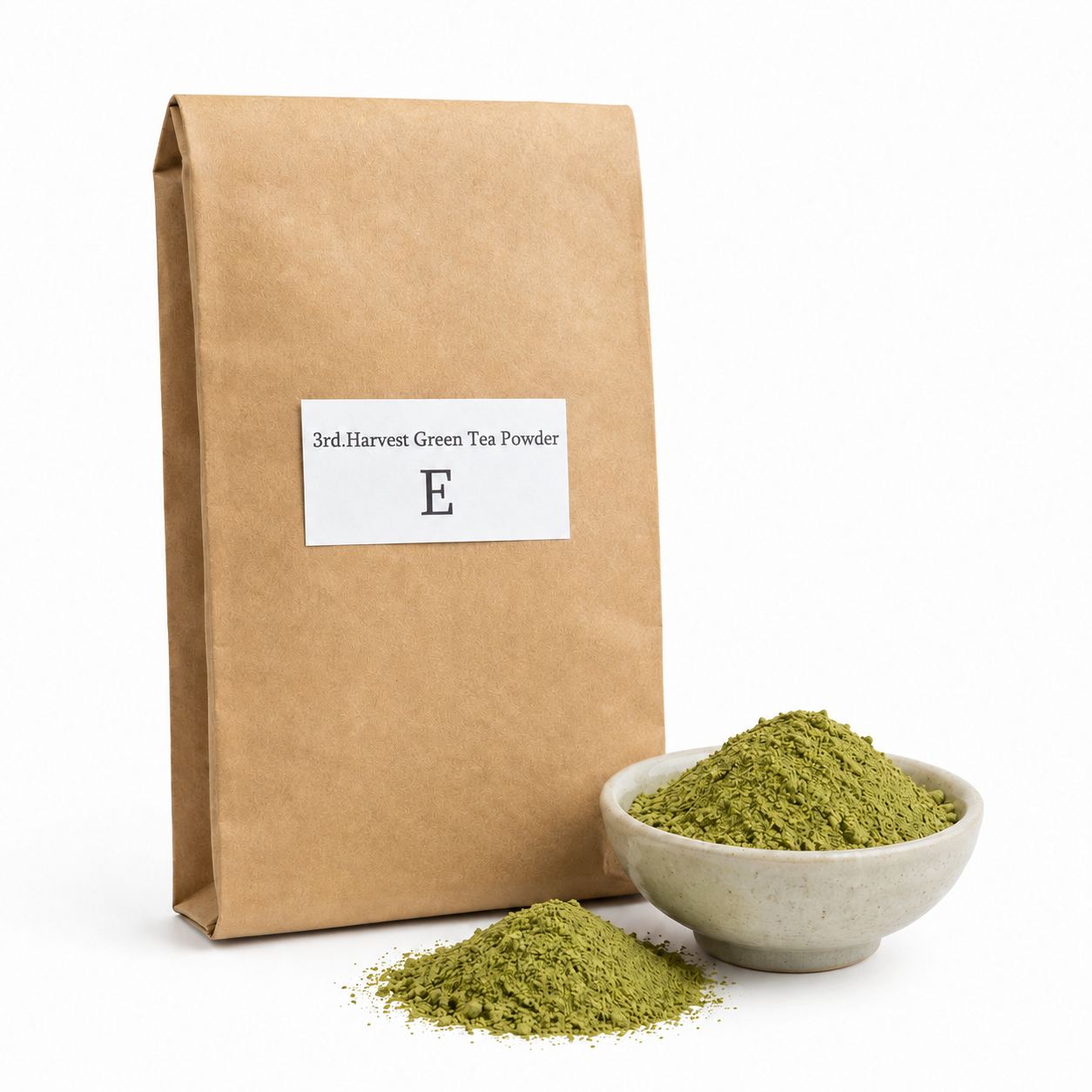
Green Tea Powder E is designed first and foremost for cost performance. It gives cafés, bakeries, restaurants and food manufacturers access to Japanese green tea powder at a price far below many current matcha ingredients, while still identifying the origin, harvest season and cultivar.
Third-harvest Saemidori from Kumamoto
Green Tea Powder E uses third-harvest Saemidori from Kumamoto Prefecture. Saemidori is widely known for attractive green appearance and umami in higher-grade tea, but in this product the objective is different: use later-harvest Saemidori as a practical raw material for high-volume business applications.
By choosing a known Japanese cultivar rather than an anonymous low-cost powder, buyers can still understand where the flavor and color direction comes from. At the same time, using third-harvest material helps reduce the ingredient cost substantially.
Selected Kumamoto Saemidori provides a clearer cultivar story than generic anonymous tea powder.
Later-harvest material is used intentionally to achieve a much lower business-use cost.
Designed for applications where ingredient cost matters strongly and premium matcha is unnecessary.
Learn more about the cultivar in our Saemidori Matcha & Tea Cultivar Guide.
Strong roasting for a fragrant green-tea character
The third-harvest Saemidori is finished with strong roasting. This creates a warmer, more fragrant tea character and helps the powder remain noticeable after milk, sugar, flour, oil or other ingredients are added.
The objective is not the delicate fresh-leaf aroma of premium drinking tea. Instead, the roasting is used to make the green-tea flavor easier to recognize in commercial recipes.
Designed for the finished product: when tea powder is used in latte, cake, ice cream or processed food, aroma strength and ingredient cost can matter more than refined drinking-matcha character.
From JPY 2,800/kg — an exceptionally low Japanese tea-powder price
Built for businesses that use tea powder in volume
Matcha raw-material prices have risen sharply. Green Tea Powder E is intended as a realistic Japanese alternative for recipes where premium matcha would make the finished product too expensive. The final quotation depends on lot, quantity, packaging and destination.
The low price does not mean the product is presented as premium matcha. Instead, Sanrokuen clearly identifies it as third-harvest Japanese green tea powder, allowing buyers to choose it for the applications where that ingredient makes sense.
Finely milled for business use
The tea is finely milled to approximately the 10 µm range as a practical target, making it suitable for beverages, bakery dough, creams, desserts and processed foods. Fine milling helps distribute the leaf material more evenly than coarse powdered tea.
Sanrokuen also operates fine-milling equipment for matcha and green tea powder. For more information on powder size and milling, see Particle Size & Milling.
Product specifications
| Product name | Third-Harvest Green Tea Powder E |
|---|---|
| Category | Japanese green tea powder — not matcha |
| Origin | Kumamoto Prefecture, Japan |
| Cultivar | Saemidori |
| Harvest season | Third harvest |
| Roasting | Strong roast for a fragrant, toasty green-tea character |
| Particle size | Approx. 10 µm median target |
| Net weight | 1 kg per business-use bag |
| MOQ | 1 bag (1 kg) |
| Domestic delivery | Shipping is charged separately. Up to 20 bags can be shipped as one parcel within Japan, subject to carrier and destination conditions. |
| Reference price | From JPY 2,800/kg, EXW factory handover. Final quotation depends on current lot, quantity, package and destination. |
| Recommended applications | Green tea latte, bakery products, cakes, cookies, ice cream, desserts, noodles, cooking, sauces, food service and food manufacturing. |
| Storage | Store sealed in a cool, dry place away from heat, light and moisture. After opening, reseal carefully and use as promptly as practical. |
Recommended uses and business applications
Green tea latte
A low-cost Japanese tea ingredient for cafés and beverage businesses that do not require the word “matcha” on the finished menu or product.
Baking & bakery products
Useful for bread, sponge cake, cookies, doughs and creams where large amounts of tea powder may be required.
Ice cream & desserts
Suitable for ice cream, soft serve, pudding, fillings and desserts where strong roasted tea aroma can remain noticeable.
Noodles & savory cooking
Can be blended into noodles, sauces, dressings, seasonings and doughs where tea is used as a flavor or color ingredient.
Food manufacturing
Particularly suitable for high-volume commercial products where ingredient cost has a major effect on the final retail price.
Private product development
MOQ starts at one 1 kg bag, making it easy to test the powder in a real recipe before moving to higher-volume production.
Green Tea Powder E vs Green Tea Powder S
Both products use selected Kumamoto third-harvest tea, but they are positioned differently. Grade S emphasizes a stronger overall quality level and analytical value, while Grade E is designed to achieve the lowest practical ingredient cost.
| Comparison | Green Tea Powder S | Green Tea Powder E |
|---|---|---|
| Raw material | Selected third-harvest Kumamoto tamaryokucha blend | Third-harvest Kumamoto Saemidori |
| Cultivars | Yabukita, Saemidori, Sayamakaori | Saemidori |
| Roasting | Strong roast | Strong roast |
| Quality positioning | Selected higher-quality third-harvest powder | Cost-focused high-volume powder |
| Reference price | Approx. JPY 4,000–4,200/kg | From JPY 2,800/kg |
| Best use | Latte, desserts, bakery, food service | Large-volume bakery, food processing, noodles, desserts, drinks |
See Third-Harvest Green Tea Powder S or return to the Japanese Green Tea Powder Guide.
Why use Green Tea Powder E instead of matcha?
Use matcha when the product needs matcha identity. Use Green Tea Powder E when cost and tea flavor matter more.
Premium matcha is made from tencha and commands a much higher price. Green Tea Powder E is made from third-harvest green tea, so it should not be labeled or sold as matcha. But for many bakery, dessert and processed-food applications, it can be the more economical ingredient.
- Japanese origin: Kumamoto Prefecture.
- Known cultivar: Saemidori.
- Strong roasting for more noticeable aroma.
- Fine powder for commercial recipes.
- Extremely competitive reference price from JPY 2,800/kg.
- MOQ of only one 1 kg bag.
Related quality information
Third-harvest tea has a different component balance from first-harvest matcha material. Sanrokuen has analyzed those differences directly and uses that information when deciding how later-harvest tea should be positioned.
Related pages: First Harvest vs Third Harvest Green Tea Analysis, Green Tea Powder S, Japanese Green Tea Powder, Particle Size & Milling, Japanese Matcha & Tea Powder Wholesale.
Start with one 1 kg bag.
Buyers can test Green Tea Powder E in their actual latte, bakery, dessert, noodle or food-manufacturing recipe before moving to larger volumes. Domestic shipping is charged separately. Up to 20 bags can be shipped as one parcel within Japan.
Frequently asked questions
Is Green Tea Powder E matcha?
No. It is made from third-harvest Kumamoto green tea, not tencha. Sanrokuen therefore sells it transparently as Japanese green tea powder rather than matcha.
What cultivar is used?
Green Tea Powder E is made from third-harvest Saemidori grown in Kumamoto Prefecture.
Why is it so inexpensive?
Grade E uses third-harvest material and is designed specifically for high-volume commercial food use rather than premium drinking quality. This allows us to achieve a much lower ingredient cost while keeping Japanese origin and cultivar information clear.
Why is it strongly roasted?
Strong roasting gives the later-harvest tea a more fragrant, toasty character that remains easier to recognize after milk, sugar, baking or food processing.
What is the reference price?
The reference price starts from JPY 2,800/kg, EXW factory handover. The final quotation depends on the current lot, quantity, packaging and destination.
What is the MOQ?
The minimum order is one 1 kg bag. Shipping is charged separately.
What applications are recommended?
Green Tea Powder E is intended for lattes, bakery products, cakes, cookies, ice cream, desserts, noodles, sauces, cooking, food service and high-volume food manufacturing.
Can overseas buyers inquire?
Yes. Please tell us the destination country, intended use, expected quantity, packaging requirements and required import documents. International freight and compliance costs are quoted separately.