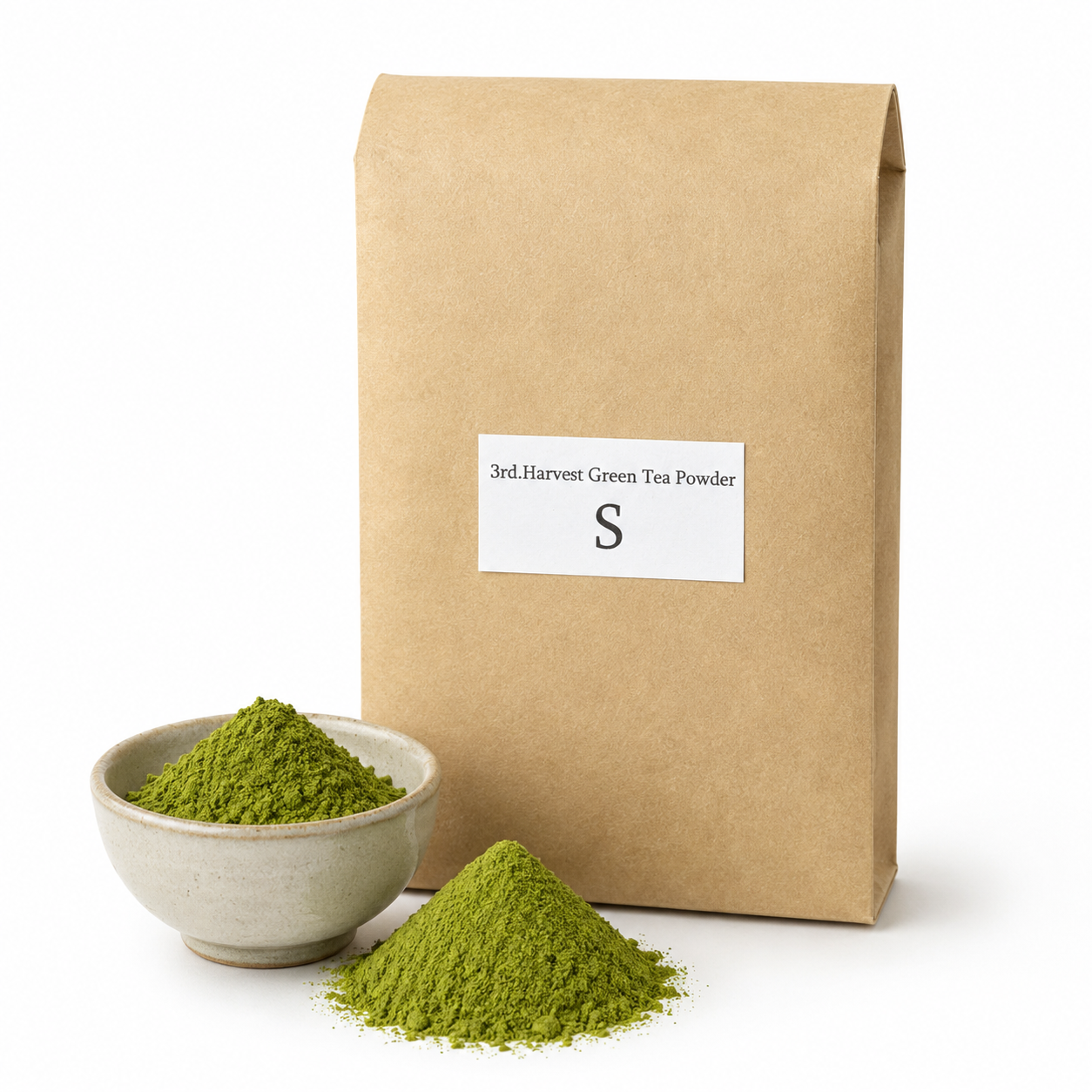
This product is not matcha—and that is intentional. Third-Harvest Green Tea Powder S is made from selected Kumamoto tamaryokucha rather than tencha. For lattes, desserts, baking and food manufacturing, buyers do not always need the cost structure or delicate flavor profile of premium matcha. A well-selected Japanese green tea powder can provide strong tea character and better cost performance for the final recipe.
Selected third-harvest Kumamoto tamaryokucha
Third harvest is often discussed only as a lower-cost season. We take a more selective approach. For Grade S, Sanrokuen chooses better-quality third-harvest tamaryokucha from Kumamoto, using cultivars including Yabukita, Saemidori and Sayamakaori.
Each cultivar contributes a somewhat different character. Yabukita provides familiar Japanese green-tea structure, Saemidori can contribute softer umami and green appearance, while Sayamakaori can add a firmer tea presence that remains useful in milk or food. The final product is evaluated as a blend rather than judged only by cultivar name.
Helps provide a familiar Japanese green-tea character and balanced foundation.
Useful for softening the blend and supporting a more attractive green impression.
Provides a firmer flavor core that can remain noticeable after milk, sugar or food ingredients are added.
Strong roasting for a more fragrant, toasty finish
Grade S is finished with strong roasting. The purpose is not to turn it into hojicha, but to develop a warmer and more fragrant green-tea character that performs well when the powder is combined with other ingredients.
Later-harvest tea can have stronger astringency than premium first-harvest material. Carefully applied roasting helps shift the sensory balance toward a more rounded, aromatic profile, making the powder easier to use in commercial recipes.
Practical target: enough tea strength to survive milk, sugar and heat, while adding a roasted green-tea aroma that makes the finished product more distinctive.
Component analysis: total nitrogen 4.1%
We analyze later-harvest tea instead of judging it only by price.
The selected third-harvest material used for this product measured 4.1% total nitrogen. We regard this as a useful level for evaluating the quality potential of a later-harvest raw material. Total nitrogen is only one indicator; aroma, color, astringency, cultivar, roasting and actual recipe performance also matter.
Sanrokuen's 2026 comparison of first-harvest matcha material and third-harvest green tea powder also showed that harvest season changes the balance of components such as theanine, free amino acids, tannins and fiber. Later-harvest tea should not simply be treated as “bad tea”; it has a different composition and can be more appropriate for different applications.
Read Sanrokuen's original 2026 analysis: First Harvest vs Third Harvest Green Tea →
Why Grade S can work better than expensive matcha in food applications
Premium matcha is optimized for qualities such as refined umami, low harshness, vivid color and direct drinking. Those qualities can be partly hidden once the powder is mixed with milk, sugar, flour, butter, cream or other ingredients.
Grade S is designed for a different job: provide Japanese green-tea flavor, useful color, roasting aroma and practical cost in commercial recipes.
Transparent naming matters.
Because Grade S is made from tamaryokucha rather than tencha, Sanrokuen sells it as Japanese green tea powder, not matcha. Buyers can therefore choose the ingredient based on actual use instead of paying only for the word “matcha.”
Product specifications
| Product name | Third-Harvest Green Tea Powder S |
|---|---|
| Category | Japanese green tea powder — not matcha |
| Origin | Kumamoto Prefecture, Japan |
| Tea type | Tamaryokucha |
| Harvest season | Third harvest |
| Main cultivars | Yabukita, Saemidori, Sayamakaori and selected blend material |
| Roasting | Strong roast for a fragrant, toasty green-tea character |
| Component analysis | Total nitrogen: 4.1% |
| Net weight | 1 kg per business-use bag |
| MOQ | 1 bag (1 kg) |
| Domestic delivery | Shipping is charged separately. Up to 20 bags can be shipped as one parcel within Japan, subject to carrier and destination conditions. |
| Reference price | Selected third-harvest grade: approximately JPY 4,000–4,200/kg. Final quotation depends on the current lot, quantity, package and destination. |
| Recommended applications | Green tea latte, café drinks, baking, cakes, confectionery, ice cream, desserts, noodles, cooking, food service and food manufacturing. |
| Storage | Store sealed in a cool, dry place away from heat, light and moisture. After opening, reseal carefully and use as promptly as practical. |
Component values shown here refer to analyzed raw material handled by Sanrokuen and should not be interpreted as a universal value for all third-harvest tea. Final lot, price and specification should be confirmed at quotation.
Recommended uses and business applications
Green tea latte
Strong roasting aroma and tea presence help the powder remain recognizable after milk and sweetener are added.
Baking & cakes
Suitable for cakes, cookies, bread, sponge, creams and fillings where premium matcha would be unnecessarily expensive.
Ice cream & desserts
Useful in ice cream, soft serve, pudding, tiramisu and dairy desserts that benefit from a noticeable roasted green-tea character.
Noodles & savory foods
Can be evaluated for noodles, doughs, sauces, seasonings and other foods where Japanese green tea is used as a flavor and color ingredient.
Cafés & restaurants
A practical 1 kg ingredient for businesses that want a Japanese green-tea beverage or dessert at a lower ingredient cost than matcha.
Food manufacturing
Designed for repeat commercial use where tea flavor, cost, supply and actual recipe performance are more important than matcha naming.
Third-harvest green tea powder vs matcha
| Comparison | Third-Harvest Green Tea Powder S | Matcha |
|---|---|---|
| Raw tea | Tamaryokucha | Tencha |
| Harvest focus | Selected third harvest | Often first or second harvest depending on grade |
| Flavor direction | Stronger tea character, roasted aroma | From delicate umami to strong latte grades |
| Cost | Lower | Generally higher |
| Best use | Baking, latte, desserts, cooking, food processing | Drinking, premium latte, products requiring matcha identity |
| Can it be labeled matcha? | No — sold as green tea powder | Yes, when produced from tencha as matcha |
For a broader explanation, see Tencha, Simplified Tencha & Green Tea Powder and our Japanese Green Tea Powder Guide.
Quality information backed by our own tea handling
Sanrokuen does not evaluate this product only by saying “third harvest” or “low price.” We select the raw tea, consider cultivar, roast the tea to create the intended aroma, analyze components, mill the material and then evaluate the finished powder in practical use.
Related information: First Harvest vs Third Harvest Green Tea Analysis, Japanese Green Tea Powder, Particle Size & Milling, Japanese Matcha & Tea Powder Wholesale, and Contact Sanrokuen.
Start with one 1 kg bag.
Buyers can evaluate Grade S in their actual latte, dessert, bakery, noodle or food-manufacturing recipe before moving to larger quantities. Domestic shipping is charged separately. Up to 20 bags can be shipped as one parcel within Japan.
Frequently asked questions
Is Third-Harvest Green Tea Powder S matcha?
No. It is made from Kumamoto tamaryokucha rather than tencha. Sanrokuen therefore sells it transparently as Japanese green tea powder, not matcha.
What cultivars are used?
The selected third-harvest blend includes quality Kumamoto tamaryokucha from cultivars such as Yabukita, Saemidori and Sayamakaori.
Why is it strongly roasted?
Strong roasting is used to create a fragrant, toasty tea character that remains noticeable in milk, sugar, baked goods and other commercial recipes.
What did the component analysis show?
The analyzed third-harvest material showed 4.1% total nitrogen. Sanrokuen uses component data as one reference alongside color, aroma, taste, roasting and actual-use performance.
Why use third-harvest tea?
Third-harvest tea offers a different balance of flavor and components from first-harvest matcha and can provide stronger tea character at a lower cost. It is particularly useful in recipes where milk, sugar, flour or other ingredients would mask a delicate premium matcha.
What is the MOQ?
The minimum order is one 1 kg bag. Shipping is charged separately.
Can overseas buyers inquire?
Yes. Please tell us the destination country, intended use, expected quantity, packaging requirements and any required import documents. International freight and compliance costs are quoted separately.