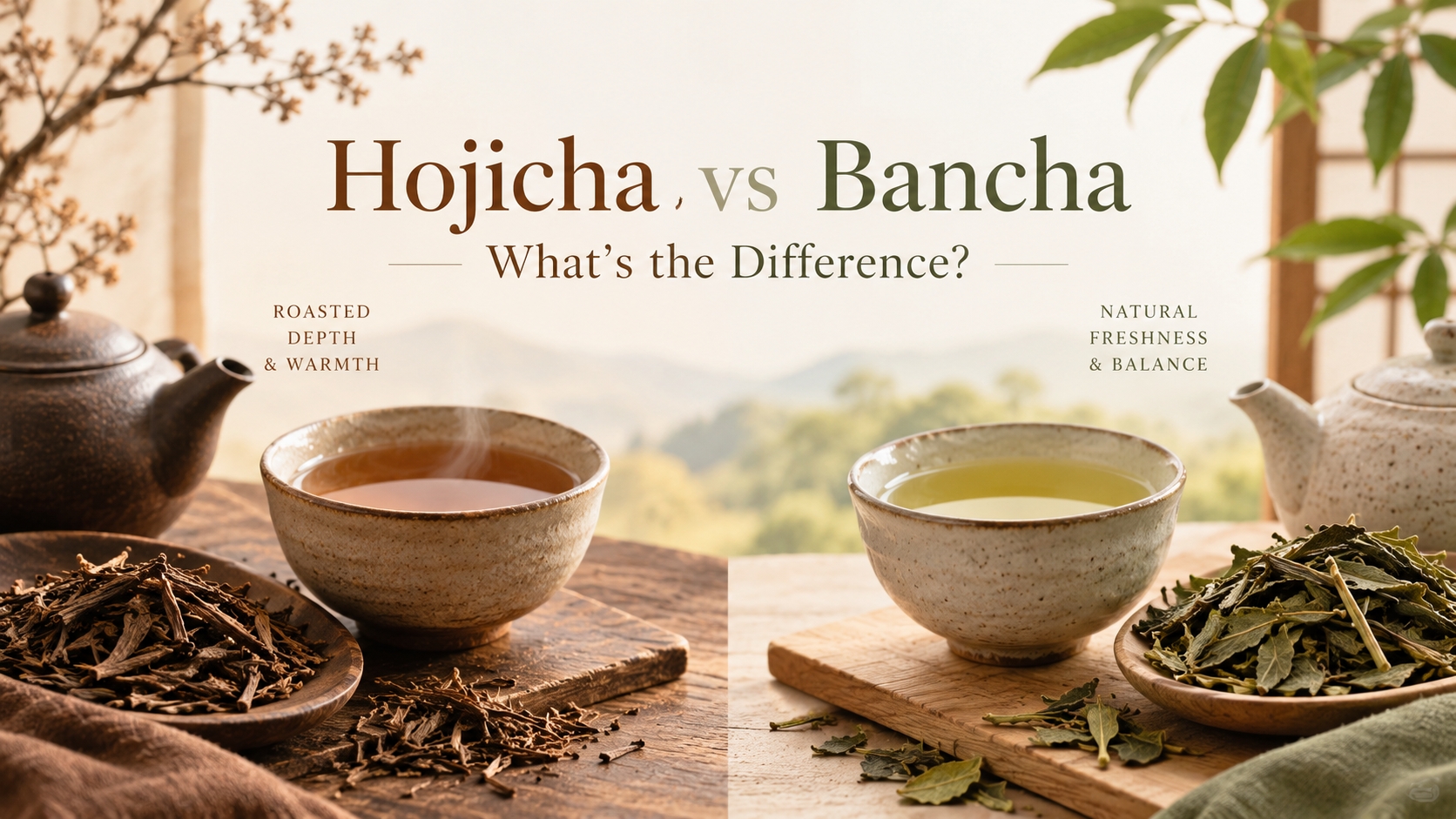
Bancha and hojicha are not the same thing. Bancha is generally a Japanese green tea made from more mature leaves, larger leaves and stems. Hojicha is green tea that has been roasted at high temperature. Bancha is a common raw material for hojicha, but hojicha can also be made from sencha, stem tea and even first-harvest tea.
This is one of the easiest Japanese-tea terms to misunderstand.
If someone tells you that hojicha is “roasted bancha,” they are not completely wrong. A great deal of everyday hojicha is indeed made from bancha or other mature tea material.
But that definition is too narrow.
The simplest way to understand the difference is to ask two separate questions:
- What kind of green-tea material is it? → this helps explain bancha.
- Was that green tea roasted? → this explains hojicha.
For the broader definition of hojicha, see our English guide What Is Hojicha?.
Hojicha vs bancha at a glance
| Point | Bancha | Hojicha |
|---|---|---|
| Basic identity | Japanese green tea generally made from more mature leaves, larger leaves and stems | Japanese green tea transformed by roasting |
| Main defining factor | Raw material, harvest stage and regional convention | High-temperature roasting |
| Leaf color | Green to yellow-green | Brown to dark brown |
| Liquor | Yellow-green to golden | Golden brown to reddish brown |
| Aroma | Light green-tea aroma | Toasty, nutty, grain-like, caramel-like |
| Taste | Light, refreshing, sometimes mildly astringent | Roasted, clean, often softer in perceived astringency |
| Can it become hojicha? | Yes | Already roasted |
What is bancha?
In its common nationwide sense, bancha is a Japanese green tea made from tea material that is more mature than the tender shoots used for premium first-harvest sencha.
The material may include larger leaves, harder leaves, older leaves and stems. Because the leaves are more mature, the finished tea is usually lighter in umami and more suitable as an everyday tea.
Bancha is normally processed as green tea: the fresh leaves are heated early to stop substantial oxidation, then rolled and dried.
Green tea made from mature material
Fresh leaf → heating to stop oxidation → rolling/drying → bancha.
Green tea transformed by roasting
Bancha, sencha or stem tea → high-temperature roasting → hojicha.
What is hojicha?
Hojicha is defined mainly by roasting.
Green tea—often bancha, sencha or stem tea—is exposed to strong heat. The leaves turn brown and the fresh green aroma is replaced by a warm roasted aroma.
This is why hojicha can be made from several different raw materials. A light everyday hojicha made from mature leaves may taste very different from a richer first-harvest hojicha, even though both are correctly called hojicha.
Our What Is Hojicha? guide explains common raw materials, Kaga bocha, roasting and first-harvest hojicha in more detail.
So is hojicha just roasted bancha?
Sometimes yes. As a complete definition, no.
Correct: Bancha can be roasted to make hojicha.
Too narrow: All hojicha is roasted bancha.
Historically, bancha and stem material have been popular raw materials because roasting works very well with them. Strong heat reduces green or coarse notes and replaces them with a warm, toasted fragrance.
But a tea maker can also roast:
- sencha,
- kukicha or stem tea,
- first-harvest tea,
- tencha stems,
- or other Japanese green-tea material.
This is one reason hojicha varies so much in body, sweetness, roast intensity and suitability for food or lattes.
Why is bancha such a common raw material for hojicha?
Mature tea material often has less of the intense umami associated with tender first-harvest shoots. It can also have a firmer green-tea character.
Roasting transforms that material in a very useful way.
High heat generates aroma compounds including pyrazines, furans and pyrroles. These contribute to the toasted, nutty and warm-grain character associated with hojicha.
In practical tea manufacturing, this means a relatively simple everyday green tea can become a highly aromatic roasted tea.
Flavor: light green freshness vs roasted warmth
Bancha
Ordinary bancha is usually light and refreshing. Depending on the material and firing, it may have a mild green aroma, a little astringency and a clean finish.
It is a classic everyday tea rather than a tea designed around concentrated umami.
Hojicha
Hojicha leads with roast. Common descriptors include:
- toasted grain,
- roasted nuts,
- caramel,
- wood,
- and warm cereal.
Strong roasting also reduces much of the grassy aroma associated with green tea, which is why hojicha often feels easier to drink for people who do not enjoy strongly vegetal sencha.
Why do they look so different?
Bancha remains green because it is still ordinary green tea.
Hojicha becomes brown because high-temperature roasting causes major changes in color and aroma.
This visual difference is so strong that some people assume hojicha is not a green tea at all. Botanically and by processing category, however, hojicha begins as green tea.
To see where hojicha and bancha fit among sencha, gyokuro, kukicha, oolong and black tea, see 28 Types of Japanese Tea.
A complication: “bancha” does not mean exactly the same thing everywhere in Japan
This is where translation becomes difficult.
In English, bancha is often simplified as “late-harvest green tea.” That is useful as a starting point, but Japanese usage is broader and partly regional.
Ordinary bancha
The general meaning discussed above: mature green-tea leaves and stems made into an everyday green tea.
Kyobancha
Kyoto-style bancha is made from large leaves and stems and is strongly heated, giving it a distinctive smoky or roasted aroma. It can seem closer to hojicha than ordinary green bancha, even though its regional name contains “bancha.”
Awa Bancha
Awa Bancha from Tokushima is even more different. It is a traditional post-fermented tea produced using lactic-acid fermentation. It is not ordinary bancha and it is not hojicha.
Translation note: Japanese tea names often reflect local history rather than one perfectly uniform national naming system. When buying “bancha,” it is worth checking how the tea was actually made.
Which has less caffeine?
Hojicha is often described as lower in caffeine than other green teas, but the comparison is not that simple.
Japanese standard food-composition data list brewed tea at:
| Tea | Caffeine |
|---|---|
| Bancha | 10 mg / 100 ml |
| Hojicha | 20 mg / 100 ml |
These values are based on specified preparation conditions and should not be treated as a universal rule for every product.
The important point is that hojicha is not automatically lower in caffeine simply because it has been roasted. Raw material, harvest season, leaf amount and brewing all matter.
How should bancha and hojicha be brewed?
Both are easy everyday teas and generally tolerate hotter water than premium sencha.
| Tea | Leaf | Water | Temperature | Time |
|---|---|---|---|---|
| Bancha | About 4 g | 200 ml | 90–100°C / 194–212°F | 30–60 sec |
| Hojicha | About 4 g | 200 ml | 95–100°C / 203–212°F | About 30 sec |
For more preparation details, see How to Brew Japanese Green Tea.
Which should you choose?
| If you want... | Try... |
|---|---|
| Light green-tea freshness | Bancha |
| Warm toasted aroma | Hojicha |
| An everyday tea with meals | Either |
| A roasted milk drink | Hojicha |
| A simple, refreshing green tea | Bancha |
| Tea for desserts or latte powder | Hojicha |
Can hojicha be made from first-harvest tea?
Yes—and this is important to Sanrokuen's approach.
First-harvest tea generally has more sweetness, umami and body than mature later-season tea. When it is carefully roasted, those qualities can remain underneath the roasted aroma.
Sanrokuen's view: raw material matters as much as roast
We do not think of hojicha as simply “bancha roasted brown.” The raw tea strongly affects what remains after roasting.
A mature, economical tea can make an excellent light hojicha for meals. But for latte, confectionery and desserts, milk and sugar can hide a weak tea very quickly.
For those applications, we prefer raw material with enough sweetness, body and tea flavor to remain noticeable after roasting and mixing.
Our standard hojicha powder therefore uses first-harvest tencha stem material from Kagoshima and is roasted and milled in-house in Kumamoto.
See What Is Hojicha Powder? or our Hojicha Powder Wholesale page for more detail.
Frequently asked questions
Is hojicha the same as bancha?
No. Bancha is generally a green tea made from more mature leaf material. Hojicha is green tea that has been roasted.
Can bancha become hojicha?
Yes. Roasting bancha at high temperature produces hojicha.
Is all hojicha made from bancha?
No. Hojicha can also be made from sencha, stems, first-harvest tea and other green-tea materials.
Is bancha always late-harvest tea?
Not always. “Late-harvest green tea” is a useful simplification, but Japanese bancha terminology also varies by region and manufacturing tradition.
Is Kyobancha the same as hojicha?
No. Kyobancha is a regional Kyoto tea style made from large leaves and stems with strong heating. It may taste smoky or roasted, but it has its own production tradition and name.
Is Awa Bancha a type of hojicha?
No. Awa Bancha is a traditional post-fermented tea from Tokushima that uses lactic-acid fermentation.
Which has less caffeine?
It depends on the tea and preparation. Japanese standard composition data list bancha at 10 mg/100 ml and hojicha at 20 mg/100 ml under the specified brewing conditions, so hojicha should not automatically be assumed to contain less caffeine.
Summary: think “raw material” for bancha and “roasting” for hojicha
The easiest way to remember the difference is:
Hojicha describes green tea transformed by roasting.
Bancha is therefore one of the most common raw materials for hojicha—but it is not the only one.
Once you understand that distinction, hojicha becomes much more interesting. You can begin asking not only “How dark was it roasted?” but also “What tea was roasted in the first place?”
That question explains why one hojicha can be light and simple while another retains sweetness, body and enough tea character to work in milk or desserts.